It's one of the most repeated bits of animal trivia out there: a goldfish only remembers things for a few seconds. That's supposedly why it can swim in circles all day without getting bored. Every lap is a brand-new adventure.
Here's the truth: that's a myth. Goldfish have a memory span of at least three months. They can tell different shapes, colors, and sounds apart, and with a little training they can learn to respond to signals and even perform simple tricks.
What Goldfish Can Actually Remember
Goldfish are much better learners than their reputation suggests. Using rewards, people have trained them to recognize and react to lights of different colors. A goldfish can learn that a certain color means something good is coming, usually food.
Food is the big motivator. Fish respond most clearly to colors when feeding is involved. They also learn to expect meals if you feed them at about the same time every day. If your goldfish seems to crowd the front of the tank around dinnertime, that's not a coincidence. It remembers the routine.
So the old line about a fish forgetting its own bowl is backward. A goldfish knows its surroundings, notices patterns, and holds onto what it learns for months at a time.
A Fish With a Long Family History
Goldfish have been living alongside people for a very long time. They are native to China, where they are a small relative of carp. Some gray or silver carp species tend to produce red, orange, or yellow mutations, and this was first recorded in imperial China during the Jin dynasty, which ran from 266 to 420.
People in China began breeding goldfish for color more than 1,000 years ago. Over the centuries, that careful breeding produced all kinds of shapes, fins, and eyes, plus colors far beyond plain gold. Today about 300 breeds are recognized in China, and most of the world's goldfish breeds came from there.
The Trouble With the Classic Fishbowl
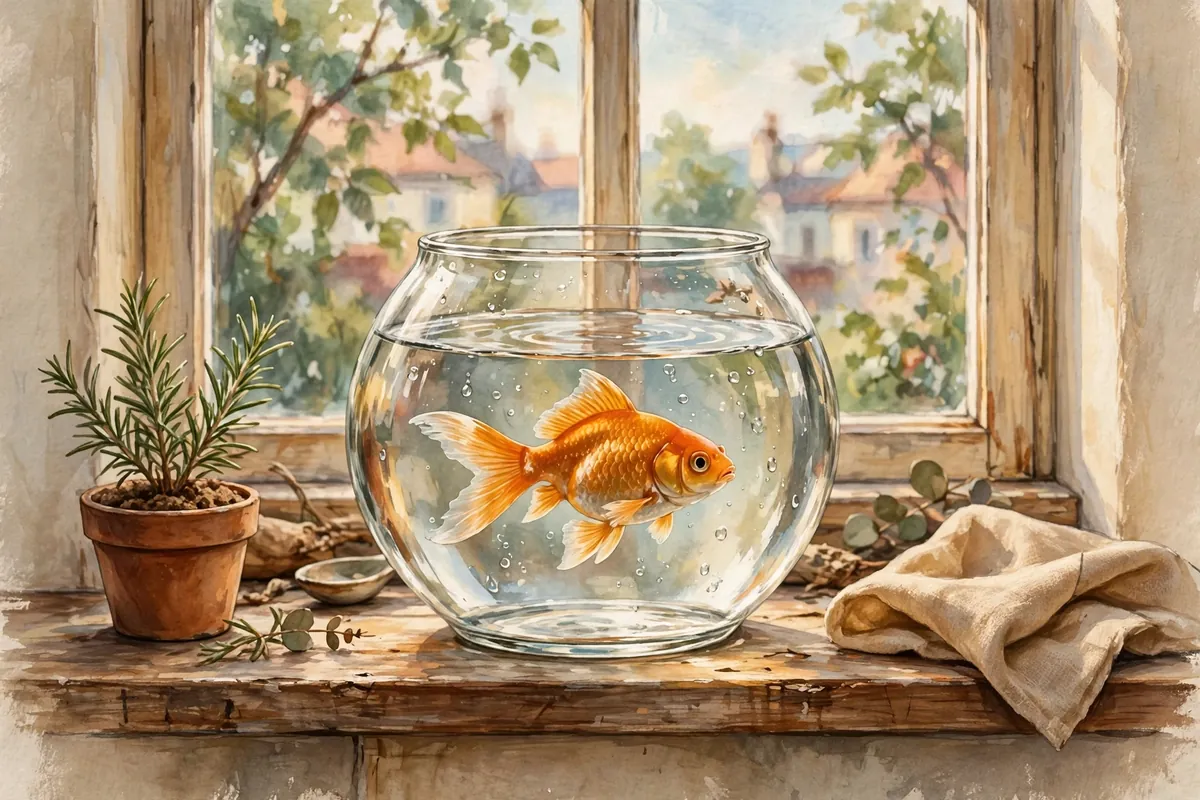
The picture of a goldfish in a little round bowl is almost as famous as the memory myth, and it's just as misleading. Fishbowls are actually bad for goldfish health. Several cities have banned them under animal welfare rules, including Rome and Monza in Italy.
The problem is that goldfish need a lot of oxygen and produce a lot of waste, partly because they don't have a stomach. In a small bowl, oxygen runs low and harmful waste builds up quickly. Fish kept that way can suffer from disease and stunted growth.
The bowl habit seems to have started with a misunderstanding. In China, goldfish normally lived in ponds and were only put in smaller display vessels for a while so guests could admire them. Somewhere along the way, the temporary showcase became a permanent home.
Bigger Than You'd Expect
Another surprise is size. Every goldfish variety can reach about 5 inches long, and single-tailed types such as the common and comet goldfish often grow past a foot. Wild goldfish usually measure between about 4.7 and 8.7 inches, but some reach 16 inches.
You may have heard that goldfish only grow to fit their tank. That's another myth, though tank size does influence how fast they grow. And when goldfish are released into the wild, they can spread quickly. They have become an invasive pest in parts of North America and Australia.
Give Your Goldfish Some Credit
So the next time someone jokes about having the memory of a goldfish, you can smile and set the record straight. That little orange swimmer can learn colors, keep track of mealtimes, and remember what it learned months later.
Give it plenty of clean water and room to swim, and it may just recognize you as the one who shows up with dinner. Not bad for a fish with a supposed three-second brain.