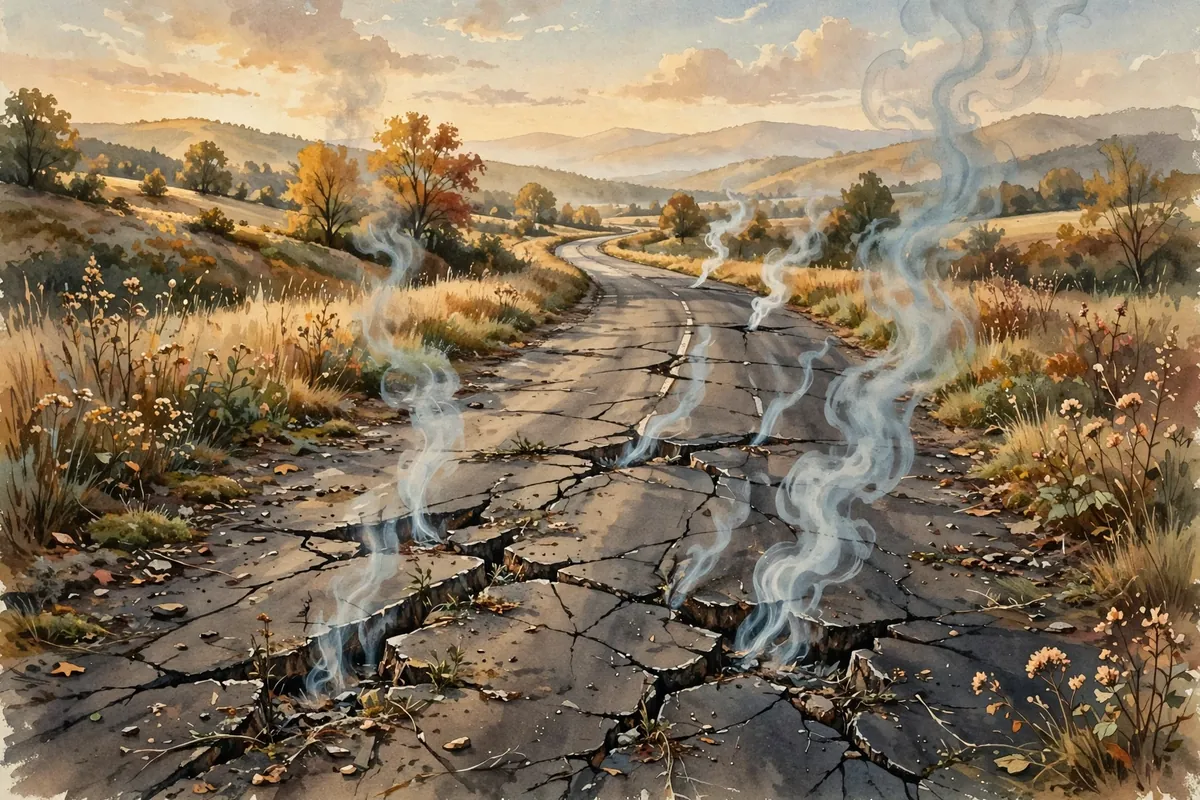
Drive into Centralia, Pennsylvania, today and you'll find something eerie. There are streets laid out in a neat grid, but most of the houses are gone. In spots, wisps of steam and smoke drift up from metal vents and cracks in the ground.
The reason is a coal mine fire that has been burning underneath the town since 1962. It spread through a maze of old mine tunnels, and over the decades it pushed Centralia from about 1,000 residents in 1980 down to just five by 2020. In 2006, experts said it could keep burning for another 250 years.
How the Fire Started
Centralia grew up on coal. Mines opened there in the 1850s and 1860s, and by 1890 the town had 2,761 people, seven churches, five hotels, and 27 saloons. Beneath it lay a labyrinth of tunnels dug to reach the region's anthracite coal.
Experts still argue about exactly how the fire began. One well-known account says that in May 1962, the borough council hired volunteer firefighters to clean up the town dump, which sat in an old strip-mine pit, ahead of Memorial Day. On May 27, they set the trash on fire, as had been done in past years. This time, the fire wasn't fully put out, and an unsealed opening let it creep into the abandoned mines below.
Another version says hot ash or coal was dumped into the pit the day before. Either way, a fire-resistant clay barrier that should have protected the pit was never finished, and the flames reached the coal seam underneath.
When People Realized
For years, the danger seemed far away. Then in 1979, the town's mayor, John Coddington, who ran a gas station, pulled the dipstick out of one of his underground fuel tanks and found it hot. He lowered a thermometer into the tank and discovered the gasoline was 172 degrees Fahrenheit.
The real wake-up call came on February 14, 1981. A 12-year-old boy named Todd Domboski was in his grandmother's backyard when the ground suddenly opened beneath him. The sinkhole was 4 feet wide and about 150 feet deep. He saved himself by grabbing a tree root, and his 14-year-old cousin pulled him out. The steam pouring from the hole held a deadly level of carbon monoxide.
A Town Moves Away
In 1983, Congress set aside more than $42 million to help people relocate. Nearly everyone accepted a buyout. More than 1,000 people moved out and 500 buildings were torn down. In 1992, the state took over all property in the borough through eminent domain, and in 2002 the Postal Service retired Centralia's ZIP code, 17927.
A few residents refused to leave. In 2013, officials reached an agreement with the last seven, allowing them to stay in their homes for the rest of their lives. The fire also spread beneath the nearby village of Byrnesville, which had to be abandoned too.
The Road That Smoked
The fire's most famous sign was a stretch of Pennsylvania Route 61. Heat and gases cracked the pavement so badly that the road was finally closed and rerouted in 1993. The abandoned section became known as Graffiti Highway, covered in spray paint by visitors. In 2020, the owners buried it under mounds of dirt.
Centralia even caught Hollywood's eye. The screenwriter of the Silent Hill movie researched the town while working on the script.
Today the town is mostly quiet fields and empty streets, with the fire still smoldering below. It's a strange, haunting reminder that some fires don't need anyone watching them to keep going.