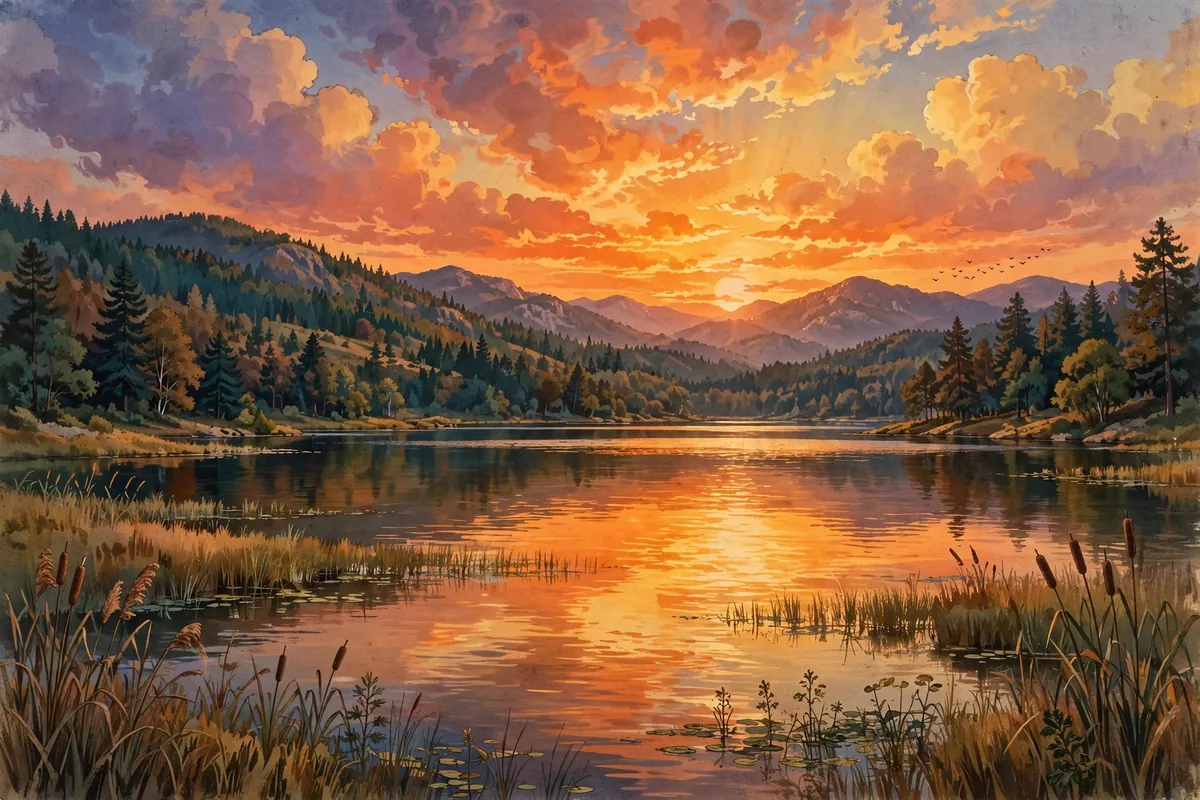
There's a reason people pull over to photograph sunsets. In the space of a few minutes, the sky shifts from pale blue to gold, orange, pink, and deep red. The Sun itself, which looked white and blinding at noon, turns into a soft orange disk sinking toward the horizon.
The Sun doesn't actually change color. What changes is the path its light takes to reach you. At sunset, sunlight has to pass through far more of Earth's atmosphere. Along the way, air molecules scatter the blue and green light out of the beam, leaving mostly orange and red to reach your eyes.
Why Blue Gets Knocked Out First
Sunlight is a mix of every color. As it travels through the air, it bumps into molecules that are much smaller than the wavelengths of light. Those tiny particles scatter shorter wavelengths, like blue and green, more strongly than longer ones, like orange and red. Scientists call this Rayleigh scattering.
During the day, that scattered blue light bounces all around the sky, which is why the sky looks blue. At midday, the sunlight coming straight down takes a fairly short path through the air, so the Sun still looks white.
The Long Road at the End of the Day
When the Sun is low on the horizon, its light has to travel sideways through a much thicker slice of atmosphere. By the time it reaches you, the blue and green have been almost completely scattered away. What's left is the warm orange and red.
Clouds can make the show even better. That reddened sunlight hits cloud droplets and other larger particles, which scatter all colors fairly evenly. So the clouds catch the orange and red light and light up the whole horizon.
Here's a bonus oddity. Near the horizon, the atmosphere bends sunlight so much that when you watch the Sun touch the horizon, it's actually already about one full Sun-width below it. You're seeing a slightly bent image of where it was.
Who Figured This Out
People have wondered about sky colors for a very long time. Around 1506 to 1510, Leonardo da Vinci suggested that tiny particles in the air scattering sunlight gave the sky its blue color.
In 1869, the scientist John Tyndall noticed that light scattered by very tiny particles had a faint blue tint. Then in 1871, Lord Rayleigh began publishing the math that explained why shorter wavelengths scatter more. Later work showed his equations applied even to single molecules of air. The effect still carries his name.
Sunsets on Other Worlds
Even on Earth, sunsets move around. In the Northern Hemisphere, the Sun sets toward the northwest in spring and summer and toward the southwest in fall and winter, and those directions flip south of the equator. Earth's sunsets aren't the only kind, either. Mars has a thin atmosphere filled with fine red dust blown up by strong winds. That dust scatters light differently, and the result is a surprise: Martian sunsets have more blue in them than Earth's do.
Back home, every sunset is a little science lesson painted across the sky. The Sun is the same as it was at noon. Its light has simply traveled a longer road to reach you, and lost its blues along the way. Not a bad trade for the view.