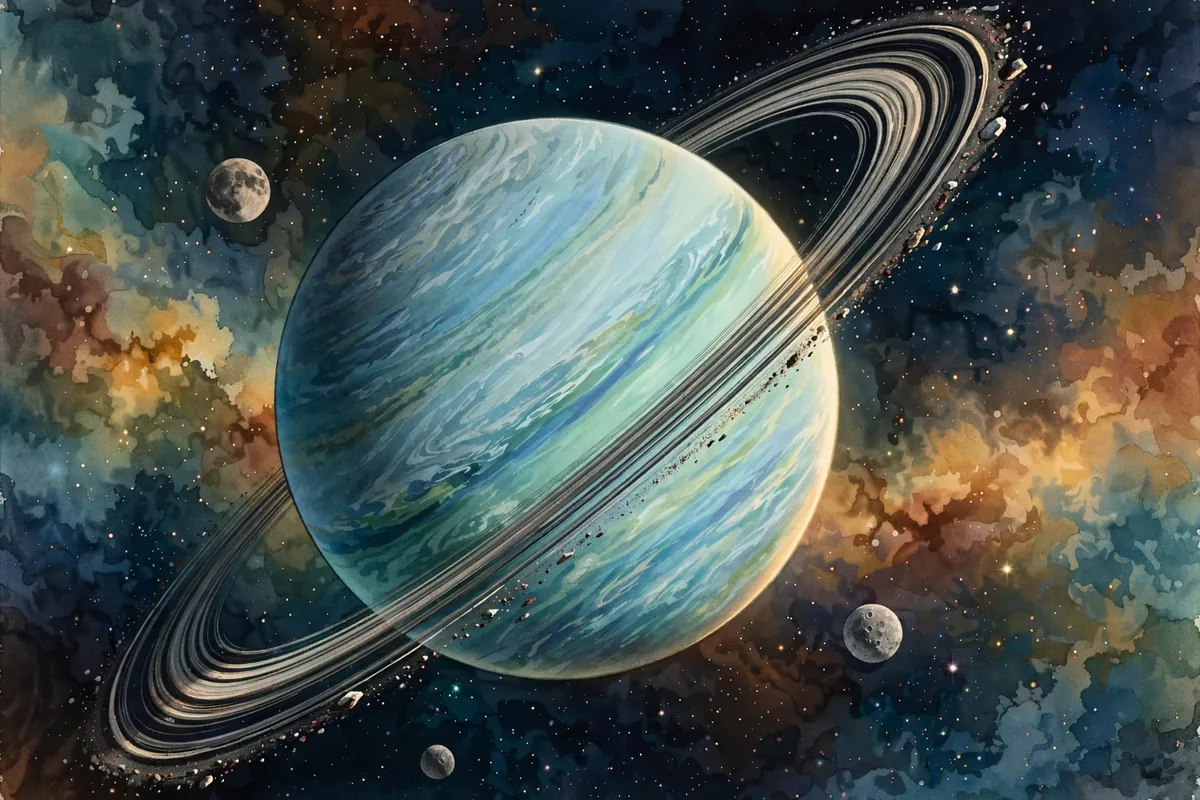
Picture the planets as spinning tops circling the Sun. Most of them spin fairly upright, tilted a little like Earth. Then there's Uranus. It looks like someone knocked it over and it kept on spinning anyway, rolling around the Sun like a ball.
The short answer: scientists aren't completely certain why Uranus is tipped on its side. The leading idea is that early in the solar system's history, a huge object, perhaps as big as Earth or bigger, slammed into the young planet and knocked it over. One study suggests that collision happened 3 to 4 billion years ago.
Just How Tilted Is It?
Earth's axis is tilted about 23 degrees, which is why we have seasons. Uranus is tilted about 82 degrees, or about 98 degrees, depending on which pole you decide to call north. Either way, its spin axis lies almost flat along the plane of its orbit.
Uranus takes 84 Earth years to circle the Sun. Because it's on its side, there are stretches of its orbit when one pole points almost straight at the Sun while the other faces away into darkness. Only a narrow strip around the equator gets a quick day and night.
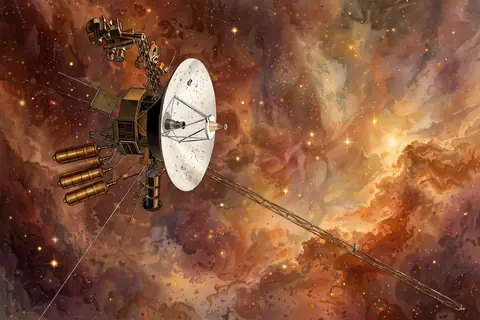
The result is the strangest seasons in the solar system. Each pole gets around 42 years of continuous sunlight, followed by about 42 years of darkness. When Voyager 2 flew past in 1986, Uranus's south pole was pointed almost directly at the Sun.
The Giant Impact Idea
Why would a planet end up like this? The usual explanation is a cosmic collision. As the planets were forming, the solar system was crowded with large chunks of rock and ice. If a big one struck Uranus at the right angle, it could have tipped the planet over.
Research led by Jacob Kegerreis of Durham University suggested the culprit was a protoplanet larger than Earth. Some scientists think the same impact may explain another Uranus puzzle. The planet gives off surprisingly little internal heat, and one idea is that the crash caused it to lose much of its original warmth. Other researchers think a layer inside the planet traps the heat instead.
More Uranus Oddities
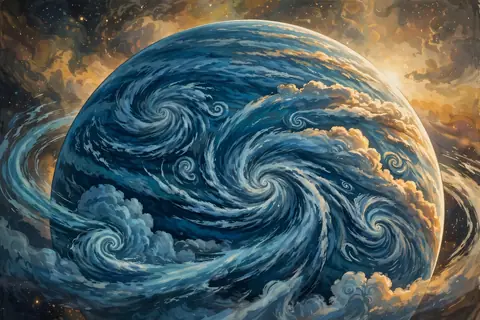
Uranus has the coldest atmosphere of any planet, dipping to about minus 371 degrees Fahrenheit. It's an ice giant, made mostly of water, ammonia, and methane in an unusual fluid state. Its day lasts about 17 hours and 14 minutes.
There's another puzzle in its weather. Because of the tilt, averaged over its year, the polar regions get more sunlight than the equator. Yet the equator is warmer than the poles, and nobody knows exactly why.
Its 29 known moons have a literary flair. They're named after characters from the works of William Shakespeare and Alexander Pope, including Miranda, Ariel, Titania, and Oberon.
Discovered by Accident, Almost Named for a King
Uranus is faintly visible without a telescope, but it's so dim and slow-moving that ancient stargazers never recognized it as a planet. On March 13, 1781, William Herschel spotted it from his garden in Bath, England, with a homemade telescope. At first he thought it was a comet.
Herschel wanted to name it Georgium Sidus, or George's Star, after King George III. Other astronomers preferred a name from mythology, and it took about 70 years for everyone to settle on Uranus. So the sideways planet was nearly called George. Somehow, that seems fitting for a world that has always done things its own way.