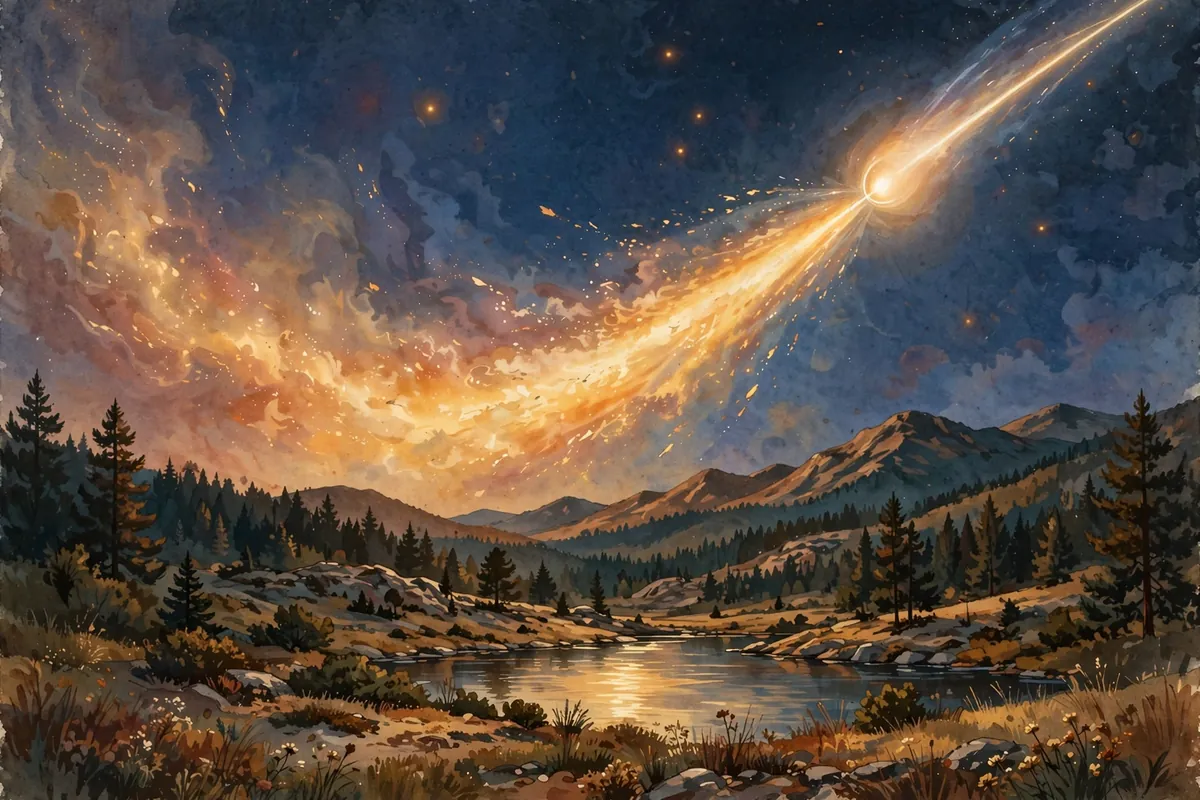
Picture a comet and you probably imagine a bright ball with a long, glowing tail streaming out behind it. It looks like a shooting star frozen in place. But that tail isn't trailing behind the comet the way smoke trails behind a train.
A comet's tail always points away from the Sun, no matter which direction the comet is traveling. Sunlight pushes on the comet's dust, and a steady stream of particles from the Sun, called the solar wind, sweeps its gas outward. So when a comet heads back out of the inner solar system, its tail can actually lead the way.
A Dirty Snowball Wakes Up
The solid heart of a comet, called the nucleus, is a mix of rock, dust, and ices, including frozen water, carbon dioxide, carbon monoxide, methane, and ammonia. In 1950, astronomer Fred Whipple described comets as dirty snowballs, and the nickname stuck.
Far from the Sun, a comet stays frozen and is almost impossible to spot. As it gets closer, sunlight heats the ices, which turn to gas and stream away, carrying dust with them. This forms a huge, thin cloud around the nucleus called the coma. The coma can be larger than the Sun, even though the solid nucleus is usually less than about 19 miles across.
Two Tails, Two Directions
Many comets actually have two tails. The dust tail is made of particles about the size of a human hair. The pressure of sunlight pushes them away, and they form a gentle, curving arc that shines by reflecting sunlight.
The second is the ion tail, made of gas molecules that the Sun's ultraviolet light has electrically charged. These get caught up in magnetic fields carried by the solar wind. The ion tail glows on its own, and it runs narrow and straight, pointing directly away from the Sun. Ion tails have been seen stretching about 350 million miles.
Sometimes, when Earth lines up just right with a comet's orbit, part of the dust tail even appears to point toward the Sun. Astronomers call this an anti-tail.
How Comets Revealed the Solar Wind
That stubborn tail direction helped uncover something big. In the 1950s, German astronomer Ludwig Biermann was intrigued that comet tails always point away from the Sun, whichever way the comet is moving. He proposed that the Sun must give off a steady stream of particles that pushes the tails outward.
He was right. Today we call it the solar wind, and it flows out at roughly 155 to 465 miles per second. The same wind also helps power the northern and southern lights here on Earth.
The solar wind can even snap a tail off. On April 20, 2007, NASA's STEREO spacecraft watched the ion tail of Comet Encke get completely cut loose as the comet passed through a huge burst of material from the Sun.
Comets and Shooting Stars
Comets also leave behind trails of bigger, heavier grains that the Sun can't easily push away. When Earth passes through one of these trails, we get a meteor shower. The Perseids each August come from Comet Swift–Tuttle, and Halley's Comet is the source of the Orionid shower in October.
So the next time you see a comet hanging in the night sky, remember that its tail is really a wind sock. It's showing you exactly where the Sun is, and which way its invisible wind is blowing.