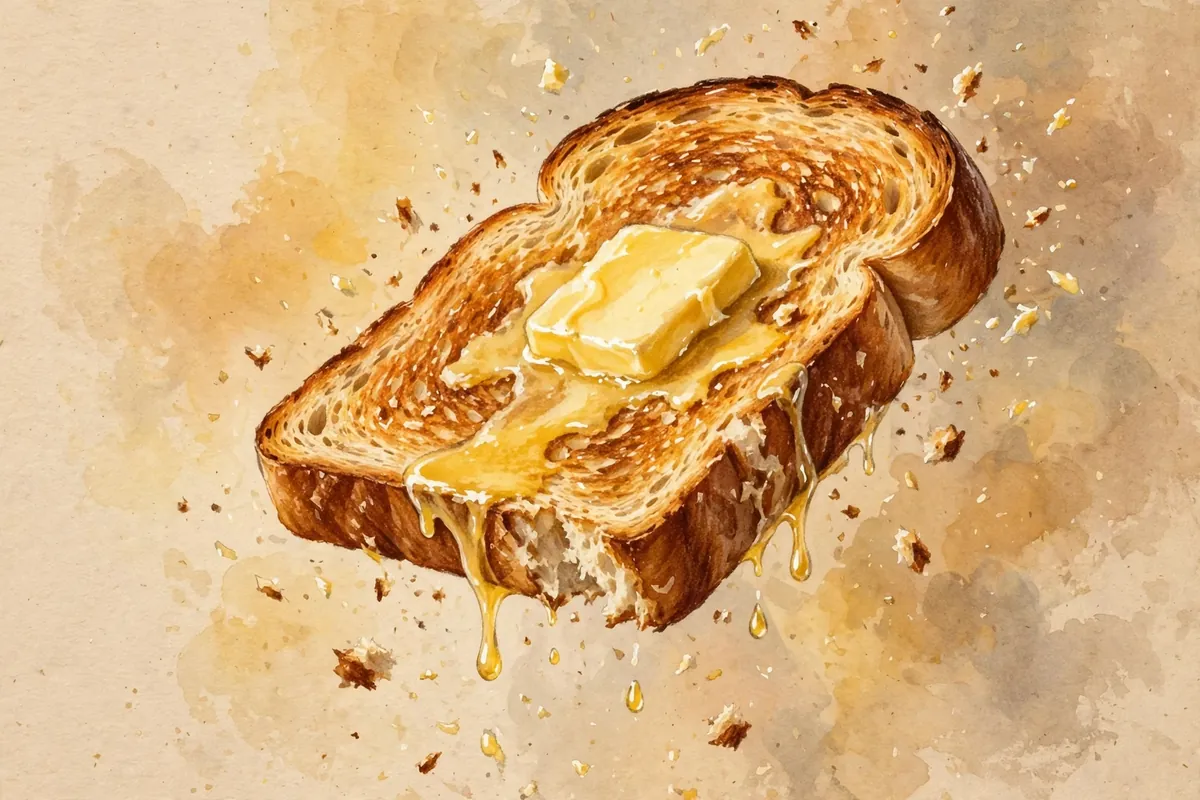
It's practically a law of the kitchen. You knock a slice of buttered toast off the table, and it lands with the buttered side smack on the floor. People have grumbled about it for well over a century. But does toast really always land butter-side down, or does it just feel that way?
Here's the truth. It doesn't always land butter-side down, and it isn't bad luck either. If you toss toast into the air, it lands butter-side down only about half the time, just as chance would predict. But when toast slides off the edge of a typical table, it does tend to land butter-side down more often. The reason is simple physics: a table is just the right height for the toast to make about half a flip before it hits the floor.
Half a Turn, Then Splat
Picture toast sliding off the edge of a table. As one edge tips over, the slice starts to fall at an angle, and that sets it spinning. Scientists who modeled the fall found that ordinary tables, somewhere between about two and six feet tall, give the toast just enough time to rotate roughly half a turn.
Since toast usually sits butter-side up, half a turn flips it butter-side down. If tables were more than 10 feet tall, the toast would have time to make a full turn and land butter-side up. And if you knocked it off fast enough, at about 1.6 meters per second, it wouldn't rotate enough to flip at all.
What About the Butter?
Many people assume the butter makes that side heavier, pulling it down. But mathematician Ian Stewart called the butter's effect on the toast's tumble 'negligible.' Most of it soaks into the middle of the slice. In other words, plain toast would flip the same way. You just wouldn't notice, because nothing would be ruined.
That points to another reason the belief is so strong. We remember the messy landings and forget the harmless ones.
A Prize-Winning Question
In 1991, the BBC science series Q.E.D. tested the idea by tossing toast into the air. It landed butter-side down only half the time. But other studies looked at toast dropped from a table, which is how it usually happens in real life, and found that it more often landed butter-side down.
British physicist Robert Matthews took the question further. He argued that the problem traces back to basic laws of nature. Table height is tied to human height, and our height is limited by the strength of the chemical bonds in our bodies. A much taller person, he reasoned, would be in serious danger from simply falling over. For this, Matthews won the 1996 Ig Nobel Prize in physics, a tongue-in-cheek award that honors research that first makes people laugh, and then makes them think.
An Old Complaint
Written grumbles about falling buttered bread go back to the mid-1800s. The idea is often credited to an 1884 comic poem by James Payn, whose narrator never had a slice of bread fall on the floor except on the buttered side.
It became a perfect example of Murphy's law, the saying that anything that can go wrong will go wrong. Fittingly, Matthews also wrote about Murphy's law for Scientific American in 1997.
Jokers have taken it even further. The 'buttered cat paradox' asks what would happen if you strapped toast butter-side up to the back of a cat, since cats famously land on their feet. Thankfully, nobody needs to find out. Just keep your toast away from the table edge, or butter it over the plate.