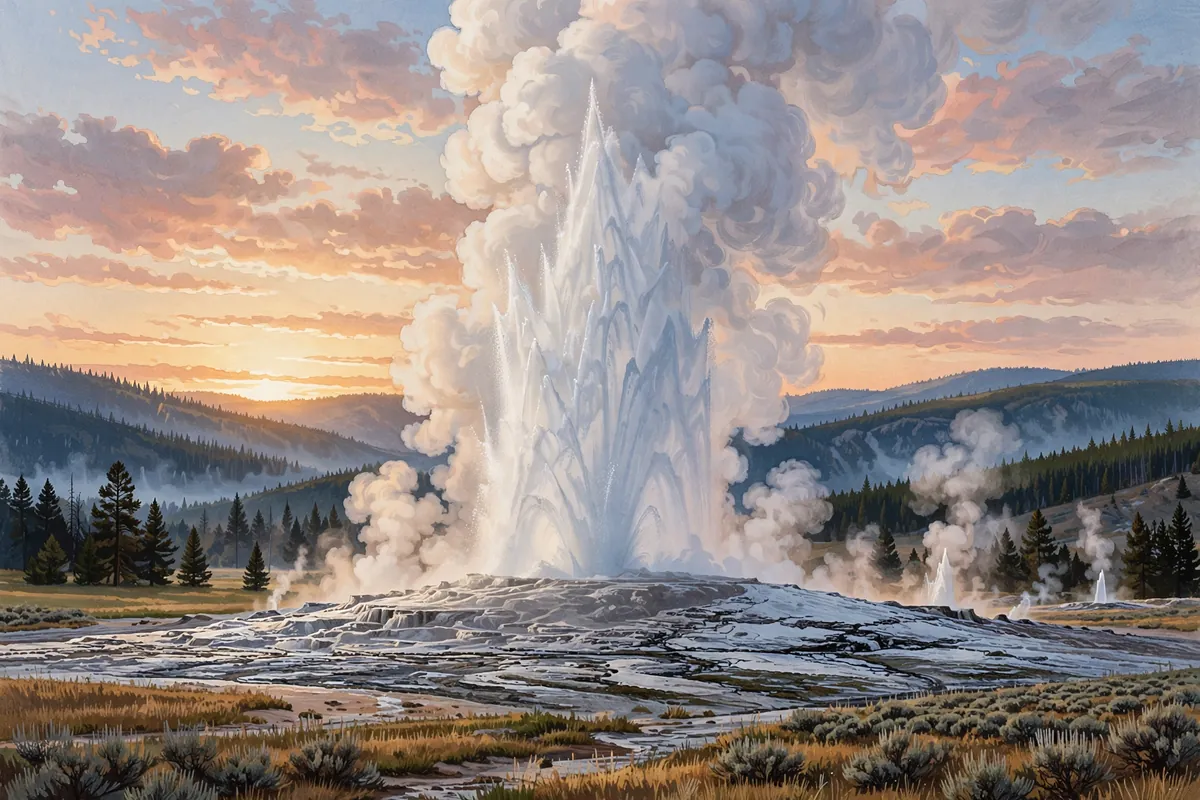
Most of nature runs on its own unpredictable schedule. But in Yellowstone National Park, visitors can check a posted time, find a seat, and watch a tower of boiling water shoot into the sky close to when it was predicted. That's Old Faithful, and it has earned its name. So what makes it so dependable?
A big part of the answer is that Old Faithful isn't connected to any of the other thermal features in its part of Yellowstone, the Upper Geyser Basin. Its underground plumbing works on its own, so it isn't thrown off by neighboring hot springs and geysers. On average it erupts about every 90 minutes, and its next eruption can be predicted from how long the last one lasted.
How a Geyser Works
Geysers need three things: heat, water, and the right underground plumbing. Surface water seeps down through the ground until it reaches rock heated by magma below. In an ordinary hot spring, that hot water simply rises back up. That's why geysers are usually found in areas of recent volcanic activity, like Yellowstone.
A geyser is different because its plumbing has narrow spots, or constrictions. These trap the heat and pressure. When the water deep below finally boils, the steam pressure blasts a column of superheated water and steam out through the top.
Scientists have even sent probes down into Old Faithful. Between 1983 and 1994, instruments lowered about 72 feet found water at 244 degrees Fahrenheit, well above the normal boiling point, because of the pressure down there.
The Rangers' Clever Trick
Old Faithful doesn't erupt every hour on the hour, as some people believe. The gap between eruptions has ranged from about 35 minutes to around two hours. But there's a pattern.
The wait depends on how long the previous eruption lasted. Within about 10 minutes either way, Old Faithful will erupt again roughly 65 minutes after an eruption shorter than two and a half minutes, or about 91 minutes after a longer one. A researcher named Harry Woodward first described this kind of relationship back in 1938.
The schedule has shifted over time. In 1939, eruptions averaged about 66 minutes apart. Since 2000, they've averaged around 90 minutes, possibly because earthquakes changed underground water levels. After a major 1983 earthquake in Idaho, the intervals grew noticeably longer.
Faithful, but Not the Biggest
Each eruption shoots out between about 3,700 and 8,400 gallons of boiling water, reaching 106 to 185 feet high and lasting from one and a half to five minutes. The average height is about 145 feet. Yet Old Faithful isn't Yellowstone's tallest geyser. That title belongs to Steamboat Geyser, which is far less predictable.
Old Faithful was the first geyser in the park to be named. Members of the Washburn–Langford–Doane Expedition saw it on September 18, 1870, watched it erupt nine times during their stay, and called it Old Faithful. More than a million eruptions have been recorded since.
A Very Hot Laundry
In the park's early days, some visitors used Old Faithful as a washing machine. An 1883 guidebook described clothes dropped into the crater between eruptions being shot out "thoroughly washed." Cotton and linen survived, but woolens were torn to shreds. Thankfully, that practice is long gone, and today the only thing visitors bring is a camera and a little patience.