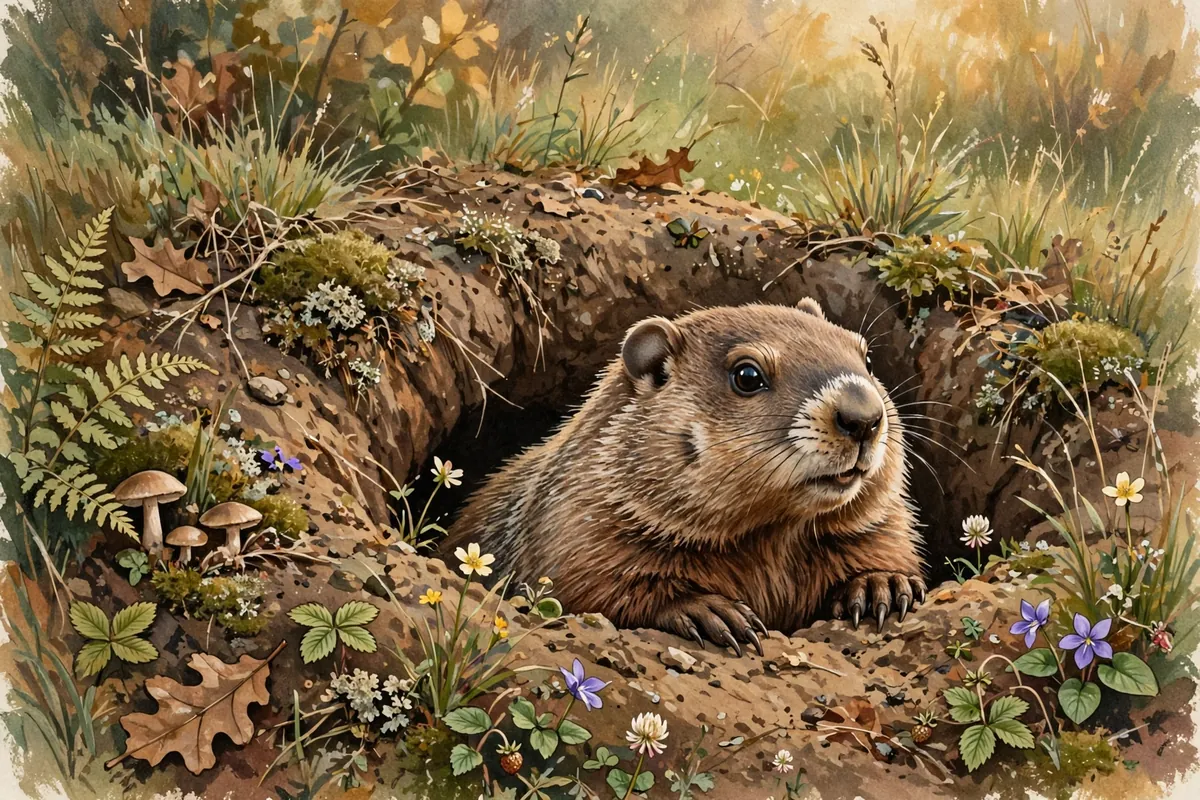
It's one of America's quirkiest holidays. Before dawn on February 2, people in top hats gather on a hill in Pennsylvania, a groundhog is lifted from his burrow, and the whole country waits to hear whether winter will drag on. But can a groundhog really tell us when spring is coming?
Here's the truth: no. Studies have found no consistent link between a groundhog seeing its shadow and when spring-like weather actually arrives. Estimates put Punxsutawney Phil's accuracy at roughly 35 to 41 percent, which is worse than you'd expect from flipping a coin. The groundhog doesn't predict spring. People simply carried an old weather tradition across the ocean and gave it a new star.
A Badger, a Bear, and Candlemas
The custom traces back to German-speaking parts of Europe and the Christian festival of Candlemas on February 2. Old weather lore said that clear, sunny weather on Candlemas meant a long winter ahead.
In Germany, the forecasting animal was usually the badger. If a badger came out of its den on Candlemas and saw its shadow in the sunshine, people expected four more weeks of winter. In some regions the bear or the fox played the role, and the bear may have been the original forecaster before bears grew scarce. A version of the badger rule even appears in a collection of farmers' weather sayings printed in Austria in 1823.
When the Pennsylvania Dutch, immigrants from German-speaking lands, settled in America, they brought the tradition with them. There were no European badgers handy, so the groundhog got the job.
The date itself is old, too. February 2 falls close to Imbolc, a Celtic day marking roughly the midpoint between the winter solstice and the spring equinox.
Gobbler's Knob and the Inner Circle
The local newspaper in Punxsutawney, Pennsylvania, first reported a Groundhog Day observance in 1886. The first official celebration came in 1887, when a group trekked to a spot called Gobbler's Knob to consult the groundhog. People have gathered there every year since.
The ceremony is run by the Punxsutawney Groundhog Club's Inner Circle, recognizable by their top hats and tuxedos. According to the playful legend, Phil whispers his forecast to the club president, who understands Groundhogese thanks to an ancient acacia wood cane. If Phil sees his shadow, that means six more weeks of winter. If not, an early spring.
The fun includes the claim that Phil never makes mistakes. Any wrong forecast is blamed on a bad translation. Fans also insist he's the same groundhog who started in 1887, kept going by a sip of groundhog punch at a yearly picnic.
Phil's Many Rivals
Phil isn't the only furry forecaster. Chuckles in Connecticut has been predicting since 1968, and one analysis credits him with a 60 percent accuracy rate. In Buffalo, a groundhog named Buffalo Bert always sees his shadow, a joke about the city's long winters. West Virginia's French Creek Freddie, who debuted in 1978, claims an accuracy rate of about 50 percent.
The holiday got a huge boost from the 1993 film Groundhog Day, starring Bill Murray and Andie MacDowell, which became a cult classic and drew bigger crowds to Punxsutawney.
So enjoy the show next February, but maybe don't put away your snow shovel based on Phil's forecast. He's a much better entertainer than he is a meteorologist.