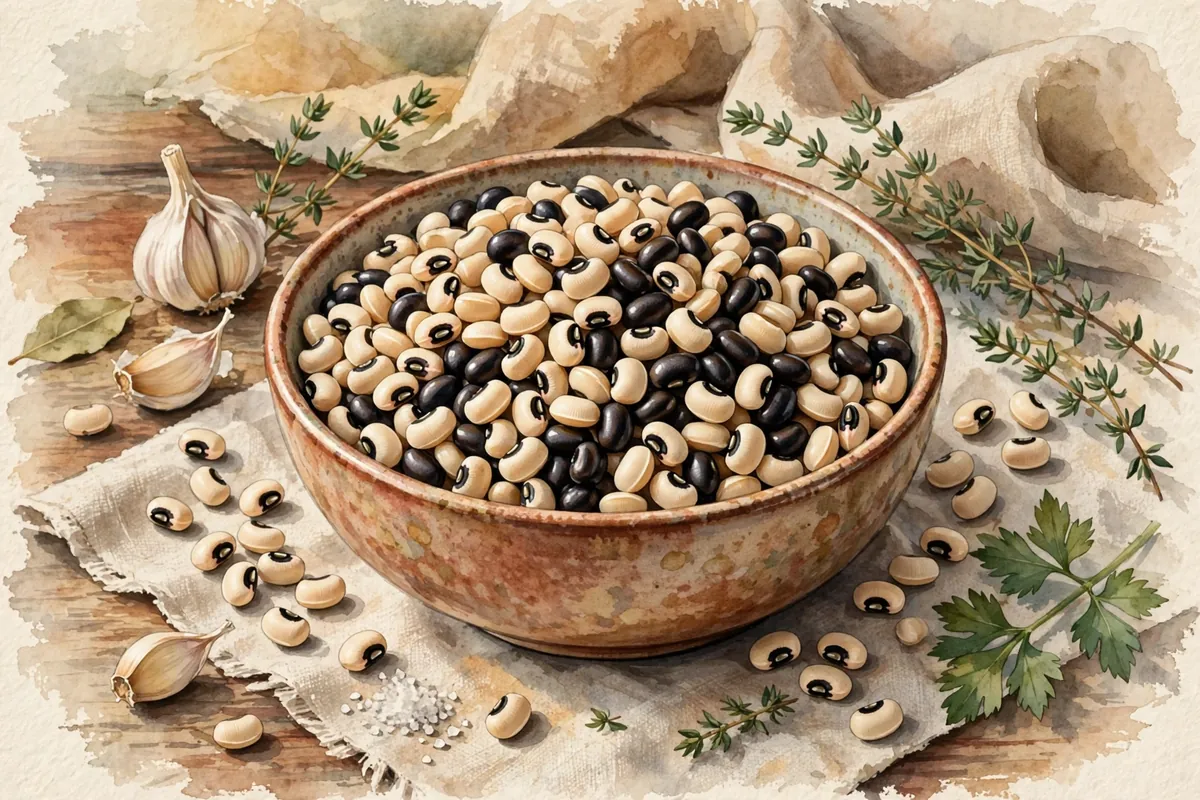
In much of the American South, New Year's Day wouldn't be complete without a pot of black-eyed peas simmering on the stove. Grandmothers insist on it. Even people who don't care much for peas will eat at least a spoonful, just to be safe. So where did this lucky tradition come from?
The short answer is that the peas stand for prosperity, and the custom has deep roots in African-American and Southern food traditions. Eating black-eyed peas, often as a dish called Hoppin' John, on New Year's Day is thought to bring a prosperous year. Exactly how the custom began is uncertain, and several competing stories exist.
What Each Food Means
The traditional New Year's plate is full of symbols. The peas swell when they're cooked, so they represent growing prosperity. Some say they stand for pennies or coins, and some families even put a coin in the pot or under the dinner bowls.
The greens, whether collards, mustard, turnip greens, or cabbage, stand for money because they're the color of American paper currency. Cornbread represents gold. And pork, a common flavoring, stands for moving forward, because pigs root forward when they forage.
The Competing Origin Stories
One popular story dates to the Civil War. As General William T. Sherman's Union troops marched through Georgia, they seized Confederate food supplies but supposedly left the peas and salt pork, thinking they were animal feed. Southerners felt lucky to have something to eat that winter.
Historians have their doubts. Sherman's army carried its own animal feed and probably wouldn't have left even feed behind. The march ran from mid-November to late December 1864, after the first frosts, so it's unlikely there were standing fields of peas to spare.
Another tradition links the peas to freedom. Black-eyed peas became a symbol of emancipation for African Americans who had been enslaved. The Emancipation Proclamation took effect on New Year's Day.
A Pea With African Roots
The black-eyed pea is a kind of cowpea, a plant first domesticated in Africa. It originated in West Africa and was grown in Virginia from the 17th century by enslaved Africans, who brought familiar crops from their homelands. Scientist George Washington Carver later encouraged farmers to plant it because, as a legume, it adds nitrogen to the soil.
The dish Hoppin' John, peas cooked with rice and pork, appears in print by at least 1838. Nobody knows for sure where the name came from. One idea is that it's a twist on the Haitian Creole term for the peas, pwa pijon.
Fun Little Rituals
Families add their own twists. Some say each person should leave three peas on the plate to bring luck, fortune, and romance. Others count the peas in a serving to predict how much luck is coming. Leftovers eaten the next day earn a new name, "Skippin' Jenny," and showing that kind of thrift is said to bring even more good fortune.
The lucky-peas idea isn't only Southern, either. In Guyana, families cook a New Year's Eve dish called cook-up rice, made with rice, black-eyed peas, and meats simmered in coconut milk. Tradition says it should be the very first thing eaten in the new year.
Whatever the true origin, it's a warm way to start the year, gathered around the table with a hopeful bowl of peas.