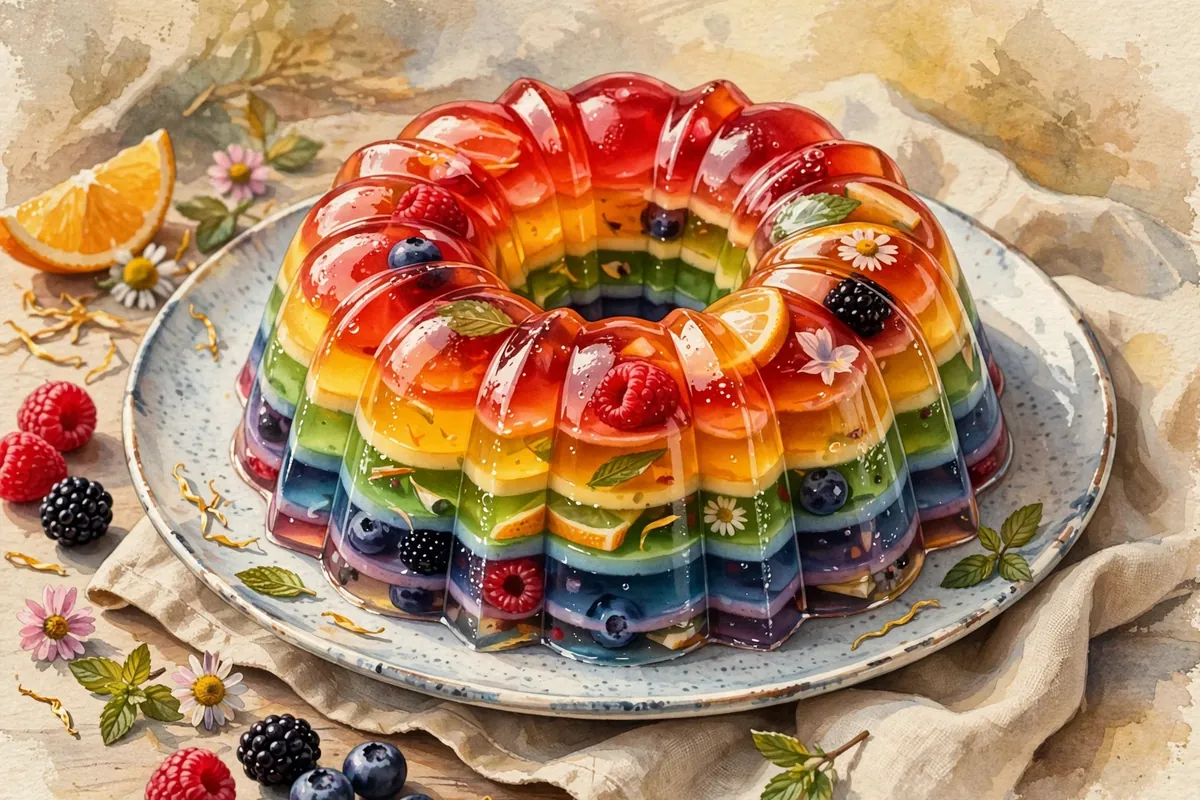
For generations, a wobbly, jewel-colored mold of Jell-O has shown up at potlucks, church suppers, and holiday tables across America. It's sweet, cheap, and endlessly adaptable. But it wasn't always a hit. In fact, it started out as a tough sell.
Jell-O became an American classic thanks to a mix of new technology and very clever marketing. It was trademarked in 1897 in Le Roy, New York, but sold slowly until its owners began handing out free Jell-O cookbooks in 1904. Add refrigeration, home economics classes, and catchy advertising, and the wiggly dessert was on its way.
A Fancy Dish Made Simple
Gelatin, made from collagen extracted from boiled bones and connective tissue, has been part of desserts since the 15th century. In the Victorian era, spectacular jelly molds were in fashion, but gelatin came in sheets and had to be purified, which took a lot of time. Gelatin desserts were mostly for royalty and the well-to-do.
That changed in 1845, when industrialist Peter Cooper patented powdered gelatin, which was far easier to make and to cook with. Cooper also built the Tom Thumb, the first American steam-powered locomotive.
Born in Le Roy, New York
In 1897, Pearle Bixby Wait, a carpenter and cough syrup maker in Le Roy, trademarked a gelatin dessert called Jell-O. He and his wife, May, added strawberry, raspberry, orange, and lemon flavoring to granulated gelatin and sugar.
In 1899, Wait sold Jell-O to Orator Francis Woodward, whose Genesee Pure Food Company already made a successful health drink called Grain-O. At first, Woodward struggled to sell the powdered dessert.
Free Cookbooks and Famous Faces
Starting in 1902, the company ran ads in the Ladies' Home Journal calling Jell-O “America's Most Famous Dessert.” Still, it remained only a minor success. Then, in 1904, the company sent armies of salesmen into the field to hand out free Jell-O cookbooks, a pioneering marketing tactic.
It worked. Within a decade, new flavors like cherry and peach arrived. Ads featured stars such as actress Ethel Barrymore, and some were painted by the artist Maxfield Parrish. In 1934, comedian Jack Benny became the dessert's spokesman, and the radio jingle spelling out J-E-L-L-O stayed familiar for decades.
The company kept experimenting. In 1923 it launched D-Zerta, an artificially sweetened version. In 1936, chocolate returned to the lineup as an instant pudding made with milk, and it proved enormously popular.
Salads, Molds, and the Jell-O Belt
By 1930, congealed salads were all the rage, and the company introduced lime Jell-O to go with them. Popular recipes mixed in cabbage, celery, green peppers, and even cooked pasta. By the 1950s, Jell-O was selling savory flavors like celery, Italian, and seasoned tomato, all since discontinued. Singer-songwriter Tom Lehrer even claimed to have invented the Jell-O shot in the 1950s, though a recipe for gelatin punch dates back to 1862.
Jell-O also found a special home in Utah. In 2001, the Utah Senate recognized it as a favorite snack food of the state, which had long had the highest per-capita Jell-O consumption. Residents had even rallied to take back that title after Des Moines, Iowa, pulled ahead in 1999.
So the next time you spot a shimmering Jell-O mold on the buffet table, give it a little respect. It's a small-town invention that won over America with free cookbooks, a catchy jingle, and a whole lot of wiggle.