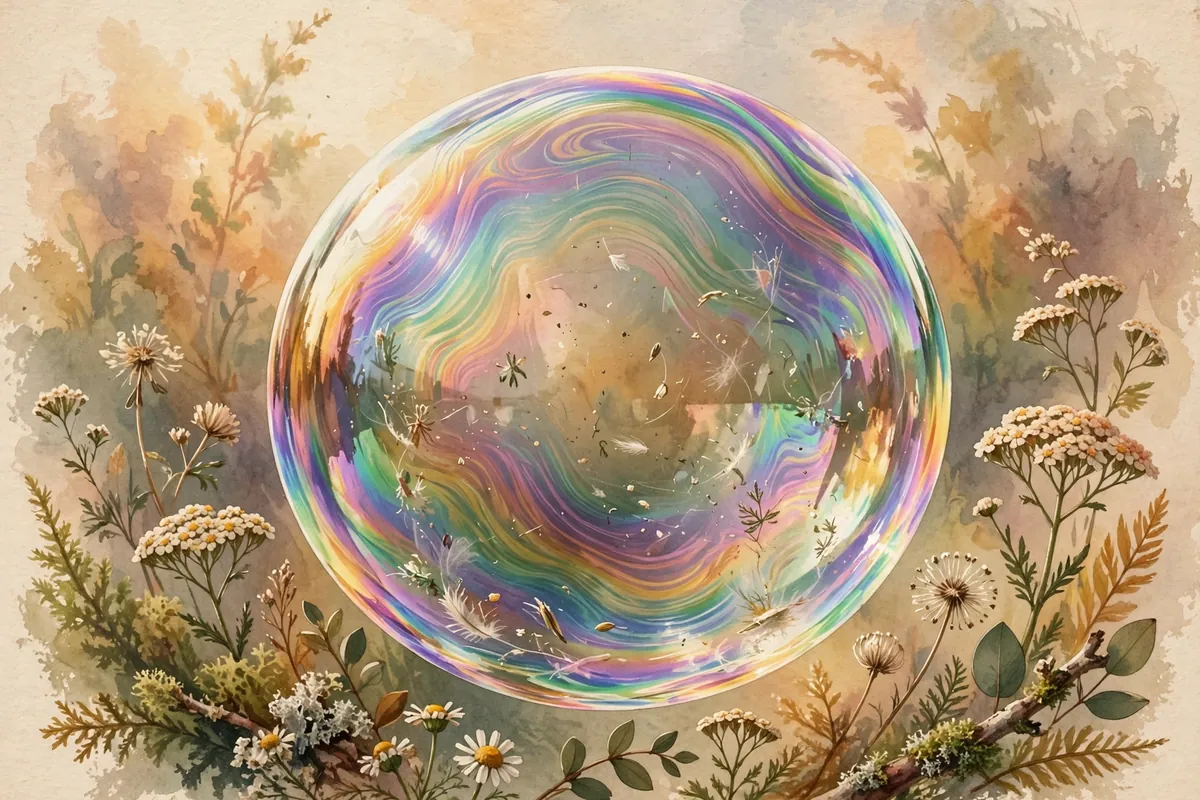
Blow a soap bubble on a sunny day and watch it drift. Swirls of pink, green, blue, and gold slide across its surface, changing every second. Yet a bubble is just a thin layer of soapy water wrapped around air, and both of those are clear. So where do the colors come from?
They come from light bouncing off the bubble's film twice: once off the outer surface and once off the inner surface. Because the film is about as thin as a wavelength of visible light, those two reflections overlap and interfere, strengthening some colors and canceling others. It looks like a rainbow, but a rainbow works differently, by bending light.
Two Reflections, One Bubble
Light travels in waves, and each color has its own wavelength. When the reflection from the back of the film lines up with the reflection from the front, that color gets brighter. When the two are out of step, that color fades. This is called interference.
Which colors win depends on how thick the film is at each spot. Since the thickness varies across the bubble, different areas glow different colors. Bubble performer Tom Noddy compared it to looking at a contour map of the bubble's surface.
The colors keep moving because the film keeps changing. Gravity pulls water down through the film, and evaporation thins it, so the pattern swirls and shifts until the bubble finally pops.
That's also why colored bubbles are so tricky to make. The shimmer comes from the film's thickness rather than from any dye, so producing bubbles in artificial colors has turned out to be a real challenge.
Why Bubbles Are Round
Bubbles are a favorite of mathematicians, too. A bubble pulls itself into the shape with the least surface area that can hold its air, and that shape is a sphere. That has been known since 1884.
When two bubbles stick together, they form a shape that keeps their total surface as small as possible. If they're the same size, the wall between them is flat. If not, the wall bulges into the bigger bubble, because the smaller one has higher pressure inside. Proving that this double bubble is the most efficient shape took until 2000.
Engineers have borrowed these lessons. Frei Otto used soap films to work out the shapes of tent-like roofs, including West Germany's pavilion at Expo 67 in Montreal. Soap films stretched across wire frames can form many other shapes, and they sometimes find those shapes faster than a computer can calculate them.
How to Make Bubbles Last
A bubble's skin is only about a micrometer thick, which is why it pops so easily. Touching something dry or dirty usually breaks it, though wetting the surface with soapy water can help.
Adding glycerol slows the water draining down the film, and blowing bubbles in humid air slows evaporation. In one set of experiments, a mix of 85.9 percent water, 10 percent glycerol, 4 percent dish soap, and 0.1 percent guar gum gave the longest-lasting bubbles.
People have loved bubbles for a long time. Seventeenth-century Flemish paintings show children blowing bubbles with clay pipes, and a Chicago company called Chemtoy began selling bubble solution in the 1940s.
So the next time a bubble floats past, take a closer look before it pops. Those shifting colors are a living map of a film about as thin as a wave of light, and that's a pretty magical thing to watch for a few seconds.