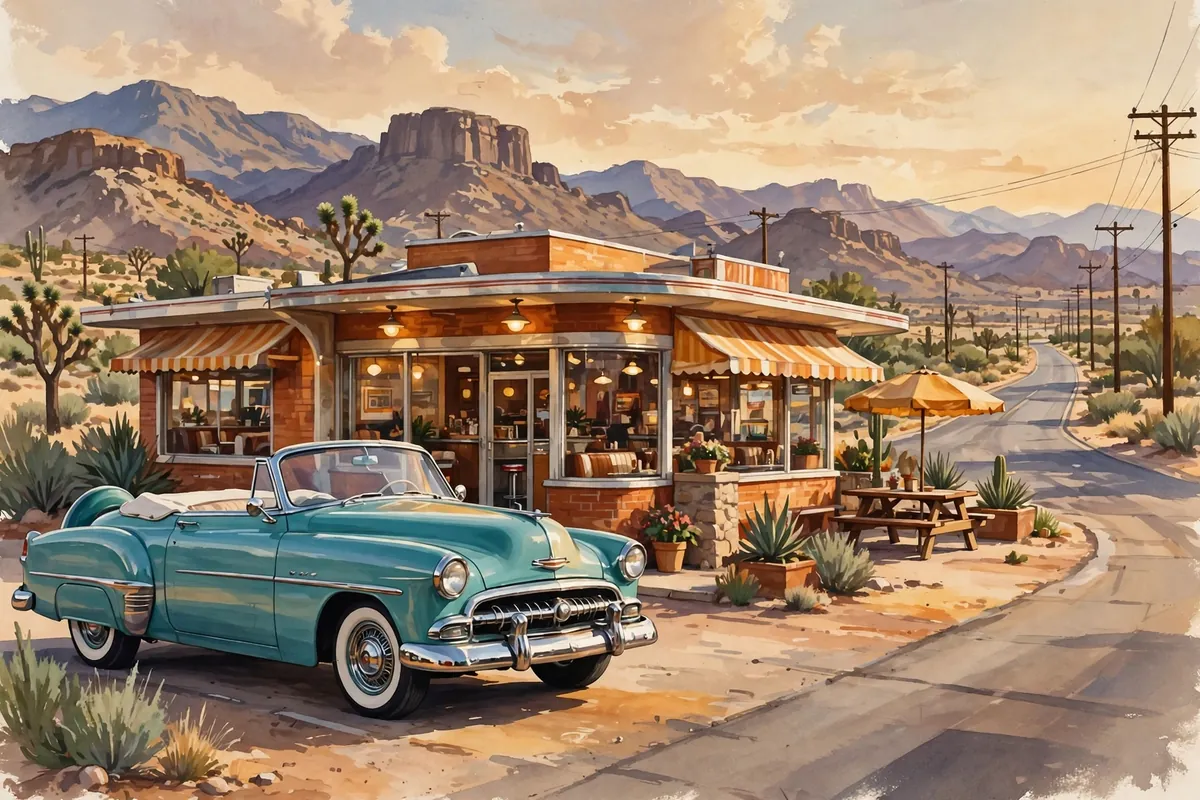
Neon motel signs, chrome-trimmed diners, and a ribbon of two-lane blacktop stretching across the desert: few roads capture the American imagination like Route 66. People still go out of their way to drive what's left of it. But how did one highway earn a name as warm as “the Mother Road”?
The nickname comes from John Steinbeck's 1939 novel The Grapes of Wrath. The book follows families fleeing the Dust Bowl, the devastating droughts and dust storms of the 1930s, as they head west to California along Route 66. Steinbeck called it “the Mother Road,” and the name became forever tied to the highway.
From Chicago to the Pacific
Route 66 was one of the original highways in the U.S. numbered highway system. It was established on November 11, 1926, and its signs went up the following year. It ran 2,448 miles, from Chicago through Missouri, Kansas, Oklahoma, Texas, New Mexico, and Arizona, ending in Santa Monica, California.
Businessman Cyrus Avery and others pushed for a Chicago-to-Los Angeles route, calling it the “shortest, best and most scenic.” At first, parts of it were still unpaved. By 1938, it became the first U.S. highway to be fully paved.
A Road of Hope During Hard Times
During the Dust Bowl, Route 66 became a lifeline. Many people from the southern Great Plains, often called “Okies” at the time, traveled it to California in search of work.
All that traffic changed the towns along the way. Gas stations, restaurants, and motor courts sprang up to serve travelers. For many small communities, the highway was the heart of the local economy. Those roadside businesses helped create the classic Route 66 look that travelers still go looking for today.
The Many Names of Route 66
“The Mother Road” wasn't its only nickname. Early on, it was called “The Great Diagonal Way” because of its slanting path across the Midwest. A group of boosters, the U.S. Highway 66 Association, promoted it as “The Main Street of America.” It was also known as the Will Rogers Highway.
Those boosters had some wild ideas. In 1928, they promoted the “Bunion Derby,” a multiday footrace that followed the route from Los Angeles to Chicago and then continued to New York City. In 1932, they ran magazine ads urging Americans to drive Route 66 to the Summer Olympics in Los Angeles.
Get Your Kicks
Route 66 also became a star in its own right. Bobby Troup's 1946 song “(Get Your Kicks on) Route 66,” first recorded by Nat King Cole, turned into a standard performed by many artists. Much later, the 2006 Pixar film Cars told a story about small towns left behind when interstates bypassed the old road.
That's exactly what happened in real life. By the late 1970s, most of Route 66 had been replaced by interstate highways, and it was retired in stages. In 1979, the route was cut back so that it no longer ran through most of Arizona. Williams, Arizona, was the last town on the route to be bypassed. In 1985, Route 66 was officially removed from the U.S. Highway System.
But the Mother Road never really died. Many stretches are preserved as Historic Route 66, a National Scenic Byway, and some keep the number 66 on state roads in Oklahoma and Arizona. So if you ever want to see the country the slow way, the Mother Road is still waiting.