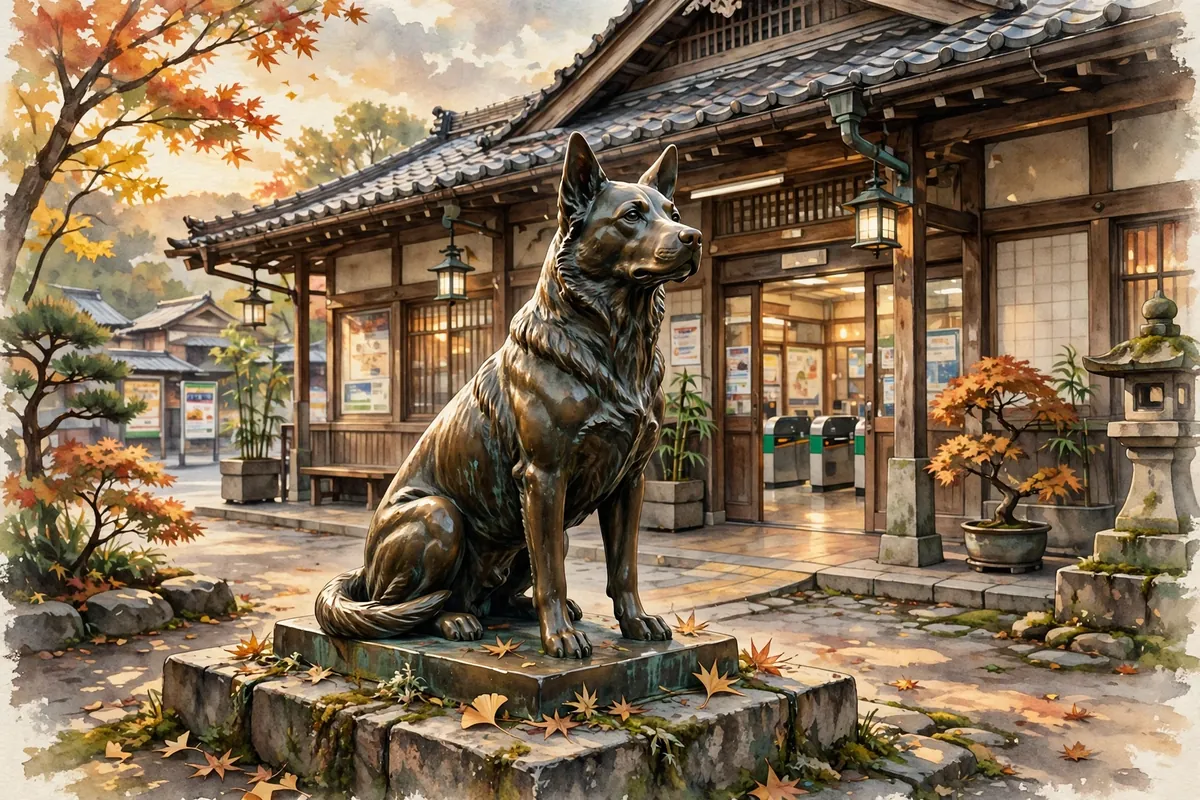
Outside Shibuya Station in Tokyo, one of the busiest spots in the world, there's a bronze statue of a dog. Crowds rush past it every day, and plenty of people use it as a meeting point. But the dog it honors was real, and his story still makes grown adults reach for a tissue.
His name was Hachiko, an Akita born in November 1923. He met his owner, Professor Hidesaburo Ueno, at Shibuya Station at the end of each workday. In May 1925, Ueno died suddenly at work and never came home. Hachiko kept going back to the station almost every day for the rest of his life, about nine and a half years, until he died in March 1935.
A Puppy From the North
Hachiko was born on a farm near Odate, in Japan's Akita Prefecture, and was shipped to Tokyo in January 1924. The train ride through snowy mountains was so rough that he was at first thought to be dead. Ueno and his partner, Yaeko Sakano, nursed him back to health over six months.
Ueno doted on the puppy and even let him sleep under his bed. Each day Ueno commuted to work, and each evening Hachiko went to meet him at the station. Locals and station staff came to know the pair well. They only had about 15 months together.
The Long Wait
On May 21, 1925, Ueno died suddenly of a cerebral aneurysm in a colleague's office. That evening Hachiko went to the station as usual, but his owner never stepped off the train. A few days later, after Ueno's wake, the dog went back to wait again.
Over the next couple of years Hachiko was passed to several caretakers, and he kept escaping or wandering back toward Shibuya. He finally settled with the family of Ueno's gardener, Kikusaburo Kobayashi, who lived near the station. From there, rain or shine, Hachiko showed up at the ticket gates at the same spot and the same time a train was due.
Life at the station wasn't always kind. Many people saw him as a stray. Vendors and passersby sometimes kicked him or poured water on his face, and dog catchers picked him up more than once. A policeman who knew him would bring him home.
From Stray to National Hero
Things slowly changed. A dog expert named Hirokichi Saito, who studied Akitas, learned Hachiko's story and wrote many articles about his loyalty. In October 1932, an article in the Asahi Shimbun newspaper made the dog famous across Japan. Visitors started coming just to see him, and people began calling him Chuken Hachiko, meaning "faithful dog Hachiko."
In 1934, while Hachiko was still alive, a bronze statue of him went up outside Shibuya Station. Sadly, that statue was taken down and melted for metal during World War II. Ordinary people and famous ones donated money for a replacement, which was unveiled in 1948. It still stands today, and the station exit beside it is called the Hachiko Exit.
How the Story Ended
Hachiko died on March 8, 1935, at age 11, and was found at the entrance to an alley in Shibuya. Decades later, a modern examination concluded that cancer and heartworm caused his death. Some of his remains were buried beside Professor Ueno in Tokyo's Aoyama Cemetery, and his preserved body is on display at Japan's National Museum of Nature and Science.
His fame kept spreading. His story led Helen Keller to bring the first Akita to America. In 2009, Richard Gere starred in Hachi: A Dog's Tale, an American film based on his life. And in 2015, the University of Tokyo unveiled a new statue showing Ueno finally coming home, with an excited Hachiko leaping up to greet him.
That last statue might be the sweetest part of the whole tale. After all those years of waiting by the gates, Hachiko finally gets his reunion, at least in bronze. Anyone who has ever been greeted at the door by a happy dog understands exactly how he felt.