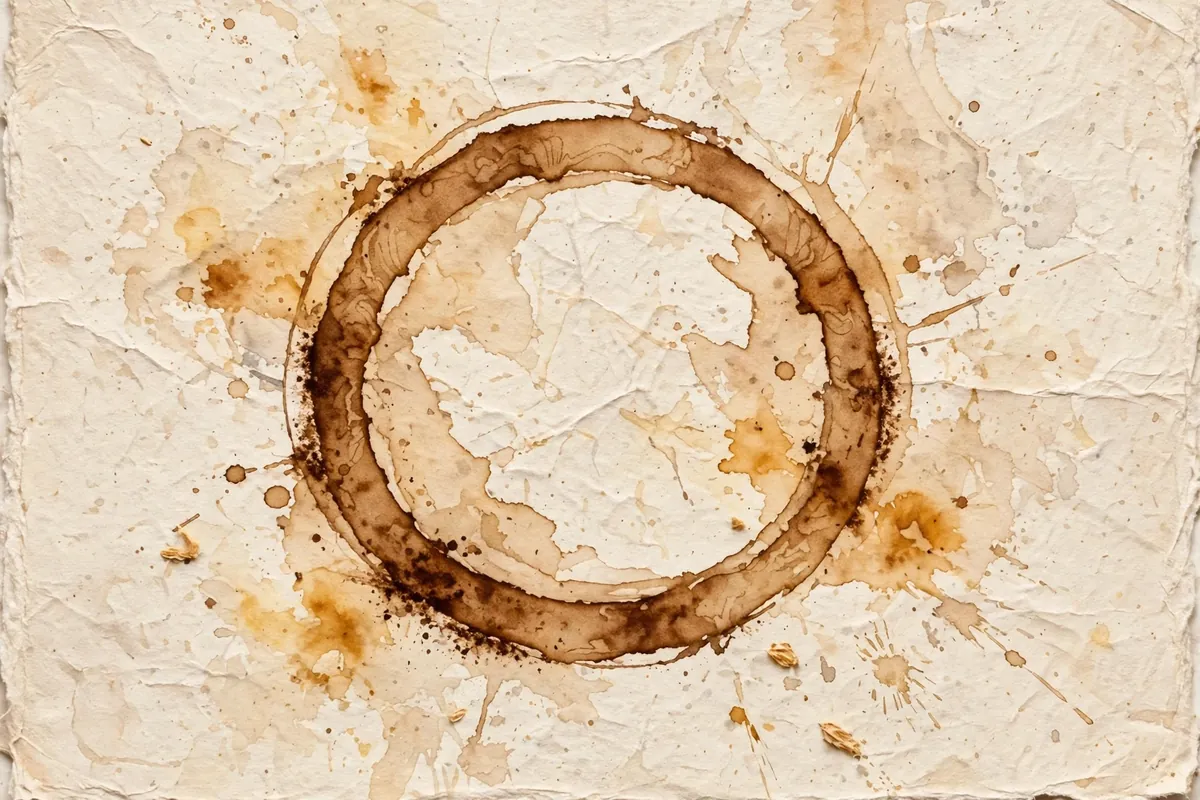
You've seen it a thousand times. A drip of coffee lands on the counter or a mug leaves a wet circle on a napkin. When it dries, the stain isn't a solid brown spot. Instead, there's a pale center surrounded by a dark ring, as if someone outlined it.
Physicists have a name for this: the coffee ring effect. As a drop dries, liquid evaporates from its edge, and more liquid flows outward from the middle to replace it. That steady outward current carries the tiny coffee particles with it, and nearly all of them get dumped at the rim. When the water is gone, the particles are left behind in a ring.
A Hidden Current in Every Drop
It's hard to believe a little drop of coffee has a current inside it, but it does. As the drop evaporates, the liquid lost at the edge has to be replaced. Liquid from the interior moves outward to fill in, a movement scientists call capillary flow.
Coffee is full of tiny suspended particles. They ride that outward flow like leaves on a stream. The result can carry nearly all of the dispersed material to the edge of the drop.
Researchers have even noticed a rush-hour effect. Near the very end of drying, the flow toward the edge speeds up dramatically, packing even more particles into the ring.
The drop's surface plays a part as well. As the drop shrinks, its surface collapses and traps the floating particles. Once caught there, they stay on the surface for the rest of their trip to the edge.
Why the Edge Stays Put
For a ring to form, the edge of the drop has to stay pinned in place as it dries. If the edge stays put, particles keep piling up there. On very slippery or water-repelling surfaces, the edge is less likely to stay pinned, and ring formation can be suppressed.
Another flow can work against the ring. Evaporation can create what's called a Marangoni flow, which can carry particles back toward the center. Water's Marangoni flow is weak to begin with, and natural surfactants, substances that change surface tension, weaken it further. That's one reason coffee rings form so easily.
Not Just Coffee
Coffee gets the credit, but you'll see the same effect with a spill of red wine. Any liquid carrying tiny particles can leave a ring when it dries.
The shape of the particles matters too. The classic ring is made by round, spherical particles. Scientists found that adding long, stretched-out particles, such as cellulose fibers, can stop the ring from forming.
There's also a lower size limit. If the liquid evaporates much faster than the particles can move, they don't have time to reach the edge, and they spread out evenly instead. For particles about 100 nanometers across, the smallest coffee ring that can form is around 10 micrometers wide, about ten times thinner than a human hair.
Why Scientists Care
It might sound like a trivial kitchen puzzle, but the coffee ring effect matters in technology. In printed electronics, manufacturers need a perfectly even layer of material once a liquid dries. A ring-shaped deposit is a problem, so researchers have found ways to fight it, from mixing solvents to heating the surface.
Others put the effect to work, using it to line up tiny particles into neat, orderly layers. So the next time you wipe up a coffee ring, take a second look. That little brown circle is a lesson in physics.