After months of gray skies and frozen ground, there's a moment many of us wait for. You glance out the window and there it is: a robin with a rusty-orange breast, hopping across the lawn. For generations, that sight has meant one thing. Spring is on its way.
The short answer for why: robins really do move north with the warming weather. American robins tend to follow the line where the average temperature reaches about 37°F, heading north in spring and back south in fall. So when they show up, milder days usually aren't far behind.
Riding the Warm Weather North
Most American robins leave their northern breeding grounds by the end of August. They spend the winter south of Canada, in a band that stretches from Florida and the Gulf Coast to central Mexico, plus along the Pacific Coast.
They begin returning north in February and March, with the exact timing depending on latitude and climate. Some travel much farther than others. One study found that robins tagged in Alaska travel as much as 3.5 times farther across the seasons than robins tagged in Massachusetts.
Once they're back, they get right to work. The robin is one of the earliest birds to lay eggs, starting to breed shortly after it returns to its summer range. It's also among the earliest birds to sing at dawn, which is one more reason it feels like spring's alarm clock.
The Twist: Some Robins Never Left
Here's the part that surprises people. Not every robin flies south. Some spend the winter in the northern United States and southern Canada. Their secret is a flexible menu.
In warm months, robins eat plenty of earthworms, beetle grubs, and caterpillars. But about 60 percent of their diet is fruits and berries. That ability to switch to berries lets them winter much farther north than most other North American thrushes. So that first robin of spring may have been nearby all along.
Why Robins Pull Up Worms
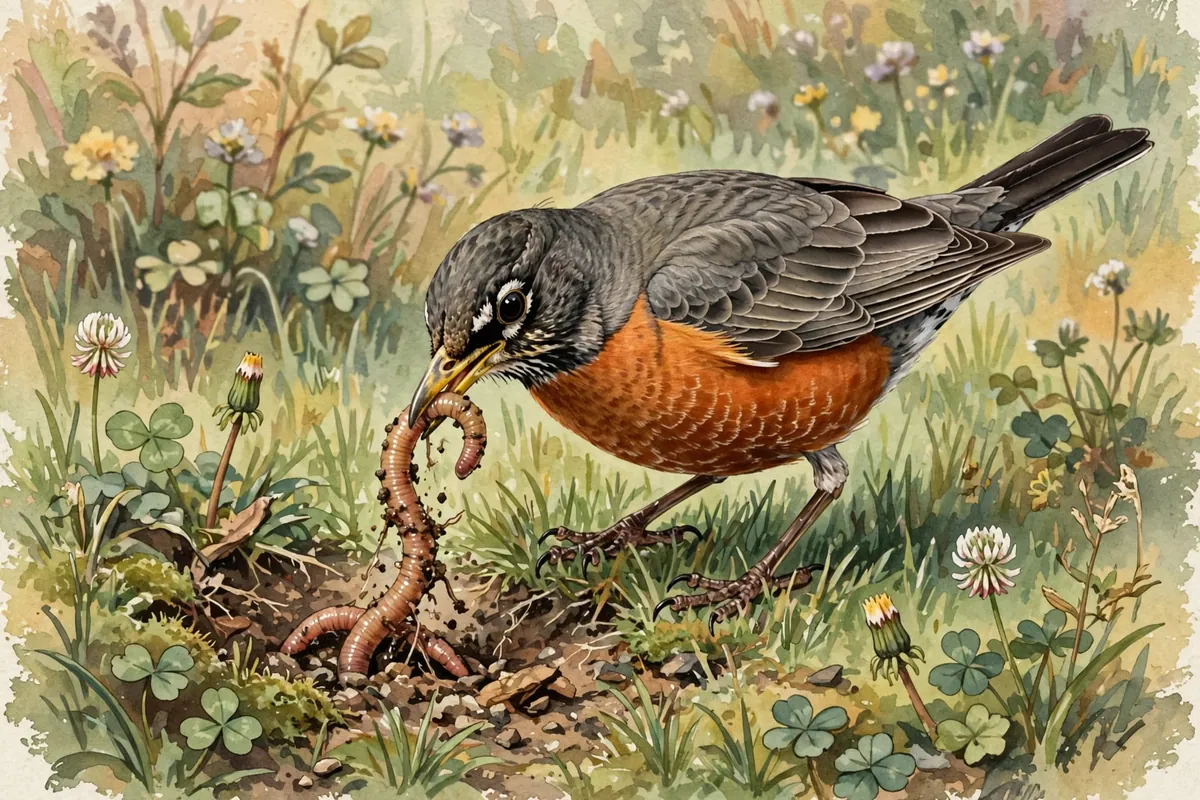
The classic image of a robin tugging a worm from the grass is spot on. Robins forage mostly on the ground and find worms mainly by sight, sometimes by hearing. They pounce, then pull.
That's why you so often see them running across lawns, stopping, and cocking their heads. Their babies are fed mostly on earthworms and other soft-bodied prey, so a busy robin on your lawn in spring may well be feeding a nest nearby.
A Bird Wrapped in Folklore
The robin's link to spring runs deep in American culture. Emily Dickinson wrote a poem titled "I Dreaded That First Robin So." Another 19th-century poem, "The First Robin" by William Henry Drummond, was said to be based on a Quebec superstition that whoever sees the first robin of spring will have good luck.
The bird even starred in the popular song "When the Red, Red Robin (Comes Bob, Bob, Bobbin' Along)." Today it's the state bird of Connecticut, Michigan, and Wisconsin.
Worth Watching For
So the old saying holds up pretty well. When robins return in numbers, they're following warmer temperatures north, and spring tends to arrive along with them.
Just don't be too surprised if you spot one on a snowy January day, munching berries in a bare tree. Some robins simply decided to stick around and wait for spring with the rest of us.