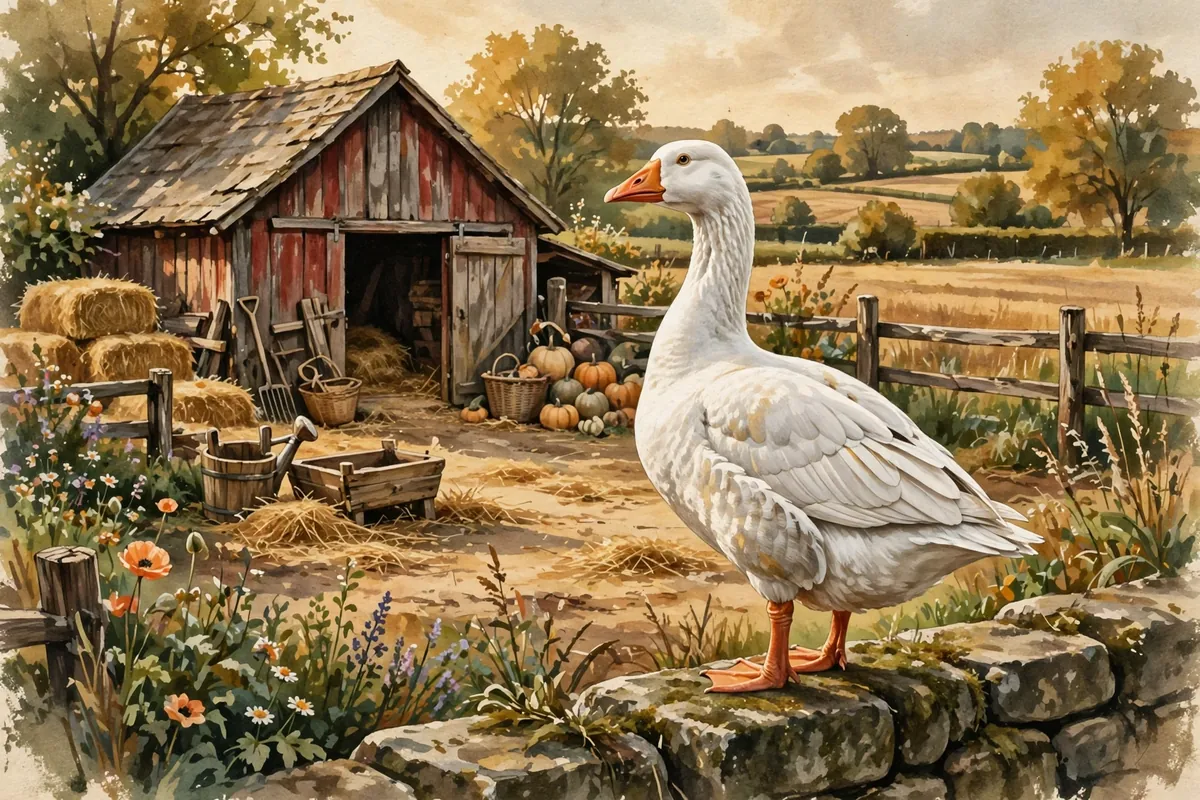
Ask people to name a guard animal and most will say a dog. Maybe a llama, if they've spent time around sheep farmers. But one of history's most famous lookouts didn't bark at all. It honked.
According to ancient Roman writers, a flock of geese saved Rome around 390 BC. Gallic warriors tried to sneak up the Capitoline Hill at night, and the sacred geese of the goddess Juno raised such a racket that a Roman named Marcus Manlius woke up and fought off the attackers. Historians treat parts of the tale as legend, but the Romans honored those geese for centuries.
The Night the Geese Sounded the Alarm
The story takes place during the Gallic siege of Rome. With much of the city taken, the Romans held out on the Capitoline, the rocky hill that served as their citadel. After one failed attack, the Gauls tried again under cover of darkness, climbing quietly toward the top.
The guard dogs stayed silent. Two ancient writers, Plutarch and Aelian, explained that the Gauls had fed the hungry dogs to keep them quiet. The temple geese, however, called out excitedly. Their cries caught the attention of Manlius, who stopped the attackers from gaining a foothold and earned the nickname "Capitolinus."
A Parade for Geese
Rome never forgot. In a yearly ritual, geese were decorated in gold and purple and carried through the streets on a litter like honored guests. The dogs fared far worse, since they were ritually punished every year for failing to warn the city.
Geese and dogs were still kept on the Capitoline well into the 4th century AD. Not everything in the story holds up, though. Roman accounts of the siege are a jumble of legends, and some scholars suspect the citadel may actually have been breached, with heroic stories layered on later to soften the disaster.
Why Geese Make Good Guards
Legend or not, the Romans picked a good lookout. Geese are known for excellent eyesight, a watchful and curious nature, and strong territorial instincts. They're smart enough to tell an unusual sound or stranger from everyday noise, and when something seems off, they let everyone know with loud honking.
They can also be fierce. Goose attacks on people are commonly reported, and Canada geese in Cincinnati parks have knocked people down and broken bones. That same bold attitude is exactly what makes them useful on guard duty.
Geese on Duty Today
Guard geese never really retired. On farms, they're said to help keep predators away from other poultry and to deter snakes. They've reportedly guarded U.S. Air Defense Command sites in Germany, a police station in Xinjiang, China, and Ballantine's whisky distillery in Dumbarton, Scotland, where the flock was known as the "Scotch Watch."
During the COVID-19 pandemic, about 500 geese helped dogs, drones, and people patrol a 331-mile stretch of China's border with Vietnam. An official there said the birds are sensitive to sounds and can sometimes be more aggressive than dogs. In Brazil, geese have watched prison fences, partly because they're cheap and, unlike dogs, can't be won over with food.
So the next time a goose hisses at you in the park, try not to take it personally. It comes from a long line of loyal sentries, all the way back to the birds that may have saved Rome.