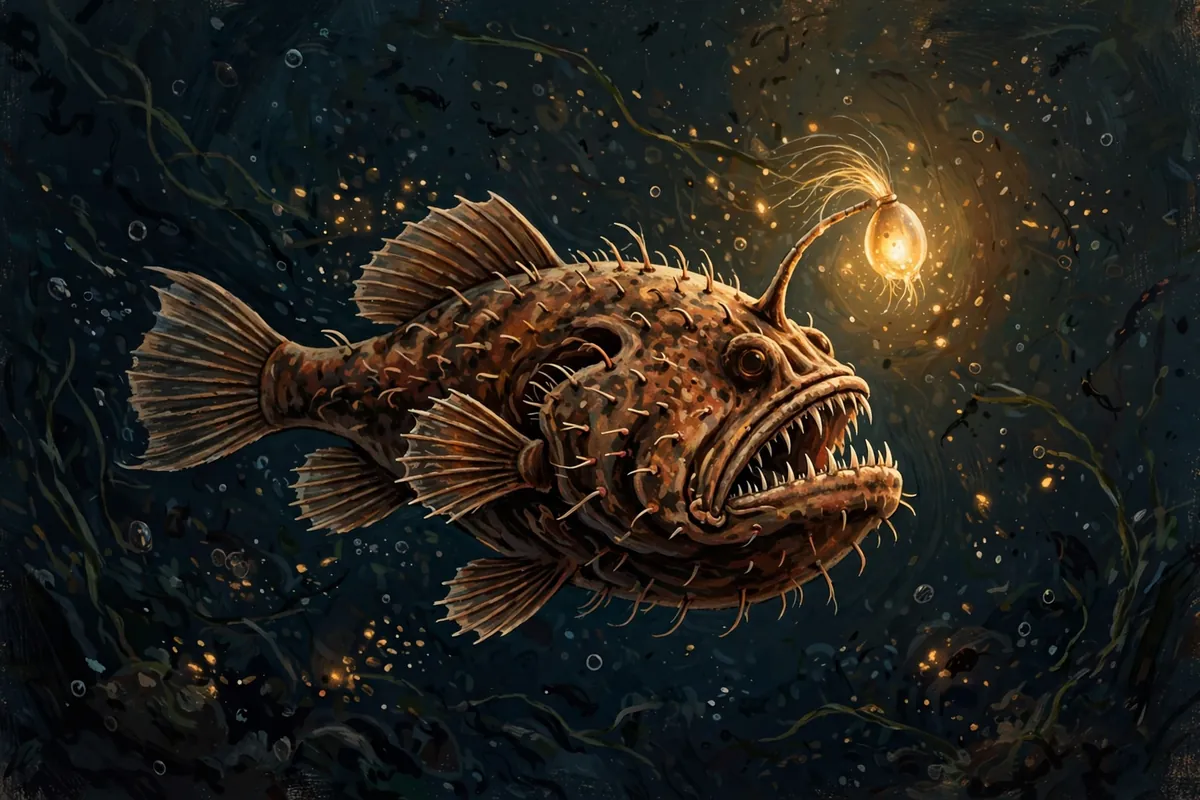
Imagine the deep ocean: cold, crushing, and pitch black. Then, out of nowhere, a tiny light bobs in the darkness like a lantern. A small fish swims over to investigate, and that's the last thing it ever does. Welcome to the dinner table of the deep-sea anglerfish.
The light comes from a lure at the tip of a long, flexible spine on the anglerfish's head. In most deep-sea species, the glow is made by bioluminescent bacteria living inside the lure. The fish provides the home and the supplies, and the bacteria provide the light.
A Fishing Rod Built Into Its Head
Anglerfish get their name from the way they hunt, which looks a lot like a person fishing. The "rod" is actually the front spine of a dorsal fin that has changed shape over time. Scientists call the rod the illicium and the fleshy bait at its tip the esca.
Every anglerfish has a lure, but they don't all glow. Frogfish, which are anglerfish relatives, have lures that look like little shrimp or worms. Batfish may release smells to attract prey. It's the deep-sea anglerfish, living far below where sunlight reaches, that turned their lures into lights.
The rod isn't stiff, either. Muscles let the fish slide, vibrate, twist, and wave the lure in front of its mouth. In one species, the rod is more than four times the length of the rest of its body.
How the Bacteria Make the Glow
Scientists think the anglerfish controls its light through the lure's blood supply. Blood brings oxygen and other substances that the bacteria use to produce light. More supply means a brighter glow, which gives the fish some control over its built-in lamp.
Depending on the species, the light can look pink, purple, white, yellow, orange, green, or blue. The brightest part is thought to fall in the blue-green range. That's no accident. Blue-green light travels farthest through water, and it's the color most deep-sea animals see best.
Some anglerfish carry extra light organs on their skin or fins, too. One species is thought to use lights on its skin as camouflage, matching the faint glow from above so it doesn't cast a silhouette.
A Mouth Ready for Anything
Food is scarce in the deep, so an anglerfish can't afford to let a meal get away. Many have a wide mouth that stretches around the front of the head, lined with inward-pointing teeth. The teeth fold back to let prey slide in, then stop it from escaping.
Their bones are thin and flexible, and both the jaw and stomach can stretch to enormous size. That lets an anglerfish swallow prey up to twice as large as its own body.
The Strangest Part: Tiny Husbands
The fish with the glowing lure is almost always a female. Male deep-sea anglerfish don't have a lure at all, and they're many times smaller than females. In one species, males reach about 6 inches while females are commonly around 30 inches long.
To reproduce, a male finds a female and clamps onto her with his teeth. In some species, he permanently fuses to her body, and their tissues grow together. It's the only known natural example of this kind of fusion in adult animals with backbones.
So the glowing monster from nature documentaries is really a team effort: a female fish, her light-making bacteria, and sometimes a tiny partner along for the ride. Down in the dark, it takes a crowd to keep the lights on.