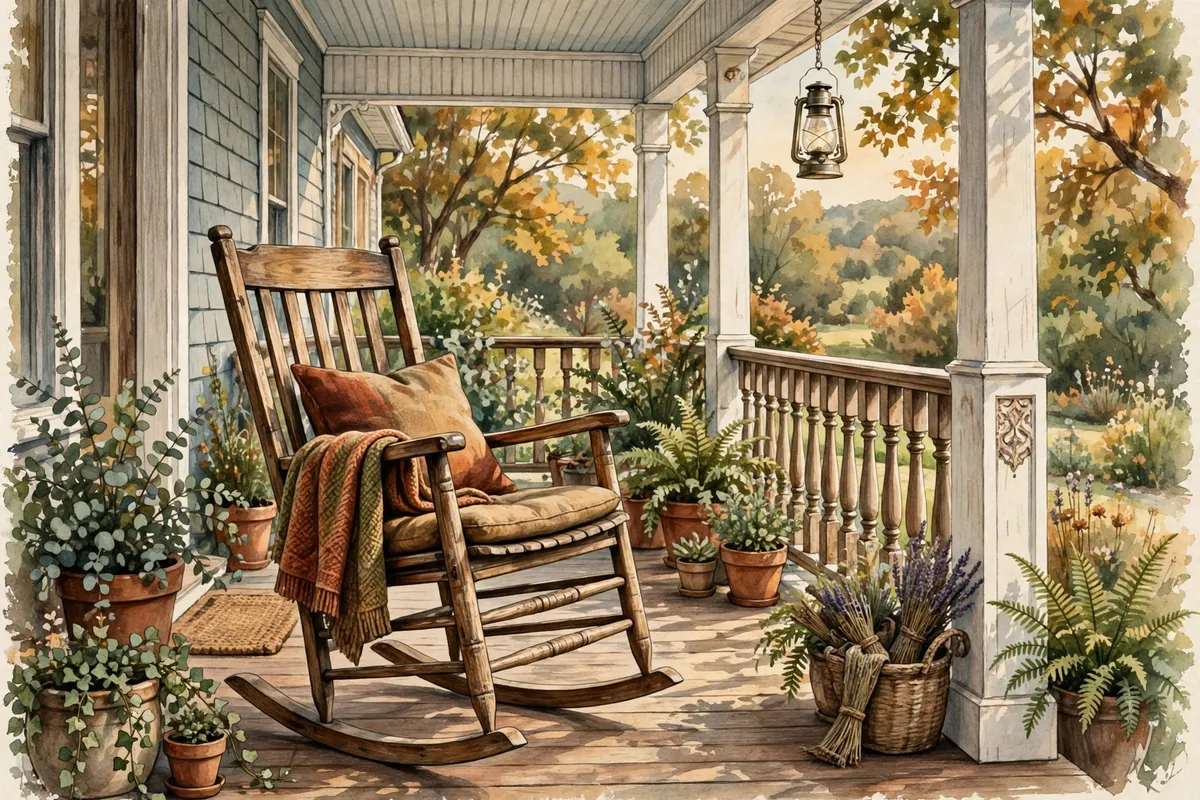
Close your eyes and picture a classic American front porch. Maybe there's a screen door, a hanging fern, a glass of iced tea. And almost certainly, there's a rocking chair or two, creaking softly as someone watches the evening go by. Why do rockers and porches seem to belong together?
There's no single official reason, but history and comfort offer good clues. Rocking chairs were originally used outdoors, in gardens, as ordinary chairs with rockers attached. Porches, meanwhile, became outdoor living rooms in pleasant weather, and rocking chairs are counted among the traditional porch furnishings. Add the gentle motion that so many people find soothing, and the match makes sense.
A Chair That Started Outside
Rocking cradles go back to ancient times. One was even found in the ruins of Herculaneum, the Roman town buried by Mount Vesuvius. Rocking chairs came much later. Early versions appeared in England around 1725, and the first known use of the term rocking chair dates to 1766.
You may have heard that Benjamin Franklin invented the rocking chair. Historians don't think so. They trace its origins to North America in the early 1700s, when Franklin was still a child.
Why the Rocking Feels So Good
A rocking chair has two curved bands, called rockers, that touch the floor at only two points. With a small shift of weight or a light push of the feet, you glide back and forth with almost no effort.
Many adults find that motion calming. Studies have shown that gentle rocking can help people fall asleep faster than staying still, much like a parent rocking a baby. That's why rocking chairs are so closely tied to nurseries and to quiet evenings outside.
A president even helped make rockers fashionable. Dr. Janet Travell, John F. Kennedy's physician, treated his back pain partly with a rocking chair and matching rocking ottoman. When the public saw pictures of the president in his rocker in the Oval Office, rocking chairs grew more popular.
Porches as Outdoor Living Rooms
A covered porch protects you from sun and rain while letting you enjoy the breeze. When it's big enough, it works as extra living space during nice weather, with room for chairs, tables, plants, a porch swing, and rocking chairs.
In the American South, porches are often wide and deep enough for families to entertain guests or gather on special occasions. A rocking chair fits that slow, sociable style perfectly. You can sit for hours, chat with neighbors, and wave to passersby. Porches look different elsewhere. In the Northeast, a porch is often a smaller sitting spot where you might shed muddy work clothes before heading in, while ranch-style homes in the Southwest use porches for shade.
Rockers Through the Years
Rocking chairs have come in many styles. Boston rockers, despite the name, were made in Connecticut, usually painted black and decorated with fruit and flowers. In the 1830s, inventor Peter Cooper designed a metal rocking chair that later appeared at the famous Crystal Palace Exhibition of 1851. German craftsman Michael Thonet introduced his elegant bentwood rocker in 1860.
Folding rockers caught on for travel and outdoor use, and woodworker Sam Maloof became famous for rockers with ski-shaped runners. Through all the changes, the simple pleasure stayed the same. So pull up a rocker, pour something cold, and let the evening take its time.