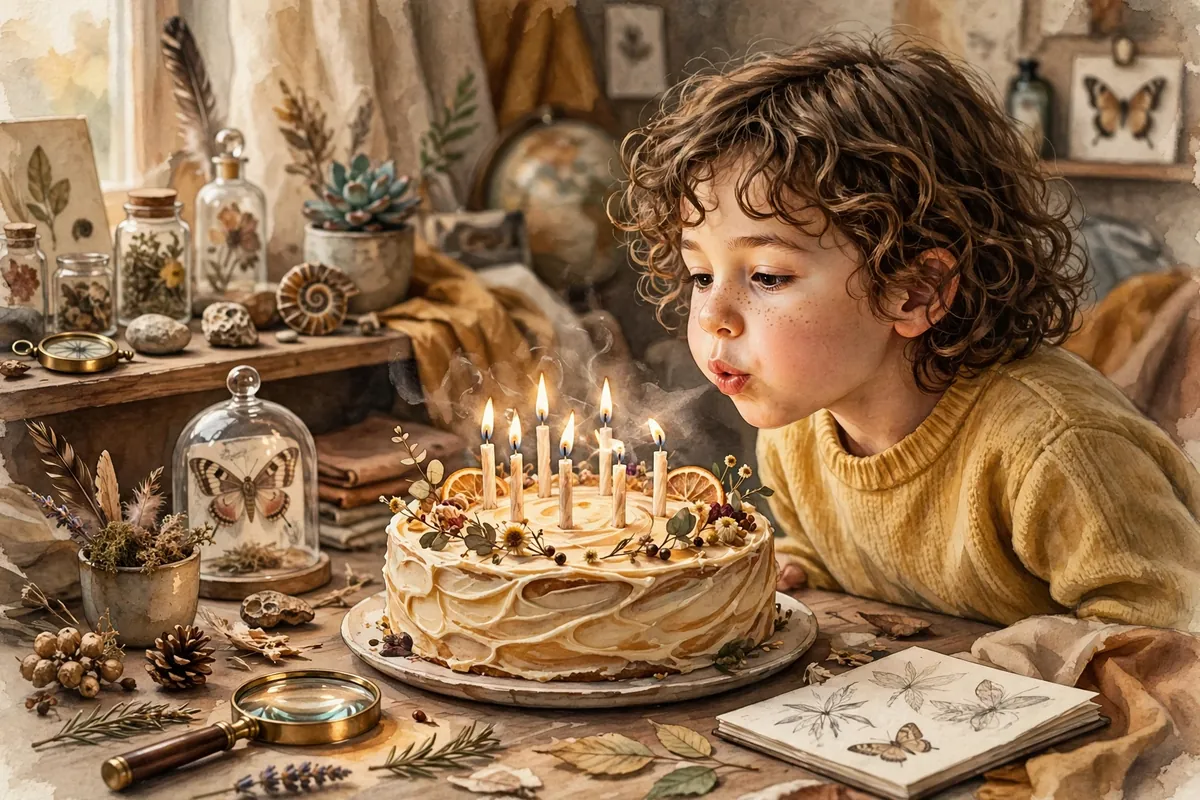
The lights go down, everyone starts singing, and a glowing cake appears. Then comes the big moment: one deep breath, a silent wish, and a puff of smoke. It's one of the most familiar rituals in the world. But why do we set a cake on fire and then blow it out?
The honest answer is that nobody knows exactly where the custom began. There are a few theories. One points to the ancient Greeks and the goddess Artemis. The strongest historical trail leads to 18th-century Germany, where birthday cakes topped with candles were part of children's celebrations. The wish part is a superstition: if you blow out every candle in one breath, your wish is supposed to come true.
A Goddess and the Moon
One popular theory goes back to early Greece. People there are said to have used candles to honor the birth of the goddess Artemis on the sixth day of each lunar month.
It's a lovely story, but historians haven't established a clear link between those Greek customs and our modern candles on cakes. So treat it as a possibility, not a proven fact.
The German Connection
The clearest evidence comes from Germany in the 1700s. Birthday celebrations for children, called Kinderfest, featured cakes and candles. Germans of the time believed adults could protect children from evil spirits on that day.
One famous early example is the 1746 birthday party of Count Ludwig von Zinzendorf. His cake was said to be as big as an oven could bake, with candles stuck in it to mark the years of his age.
The German writer Goethe described his 52nd birthday in 1801, spent as a guest of a prince, when servants carried in a large cake with about fifty flaming candles that began to melt and threatened to burn down. He noted that children's cakes of the time often had extra candles for the years to come.
Cakes for Everyone
Birthday cakes themselves may be much older. In ancient Rome, cakes were sometimes served at special birthdays and weddings. Those were rings made from flour and nuts, raised with yeast and sweetened with honey.
For a long time, fancy layered cakes with icing were a luxury for the wealthy. The Industrial Revolution made ingredients and goods more widely available, and birthday cakes gradually became something nearly everyone could enjoy.
Wishes, Songs, and a Few Germs
Today, the number of candles usually matches the person's age, sometimes with one extra for luck. The guests sing, the birthday person makes a wish, and according to a common superstition, the wish must be kept secret or it won't come true.
The song has its own story. The melody of “Happy Birthday to You” comes from an 1893 tune called “Good Morning to All,” traditionally credited to sisters Patty and Mildred Hill, though that claim is disputed. The birthday words and the melody first appeared together in print in 1912.
And yes, scientists have studied the blowing part, too. In 2017, Clemson University researchers found that blowing out candles increased the bacteria on the frosting about 14 times on average, though one researcher called it “not a big health concern.”
So the next time you lean over a glowing cake, you're joining a tradition that's at least a few centuries old and maybe much older. Make it a good wish.