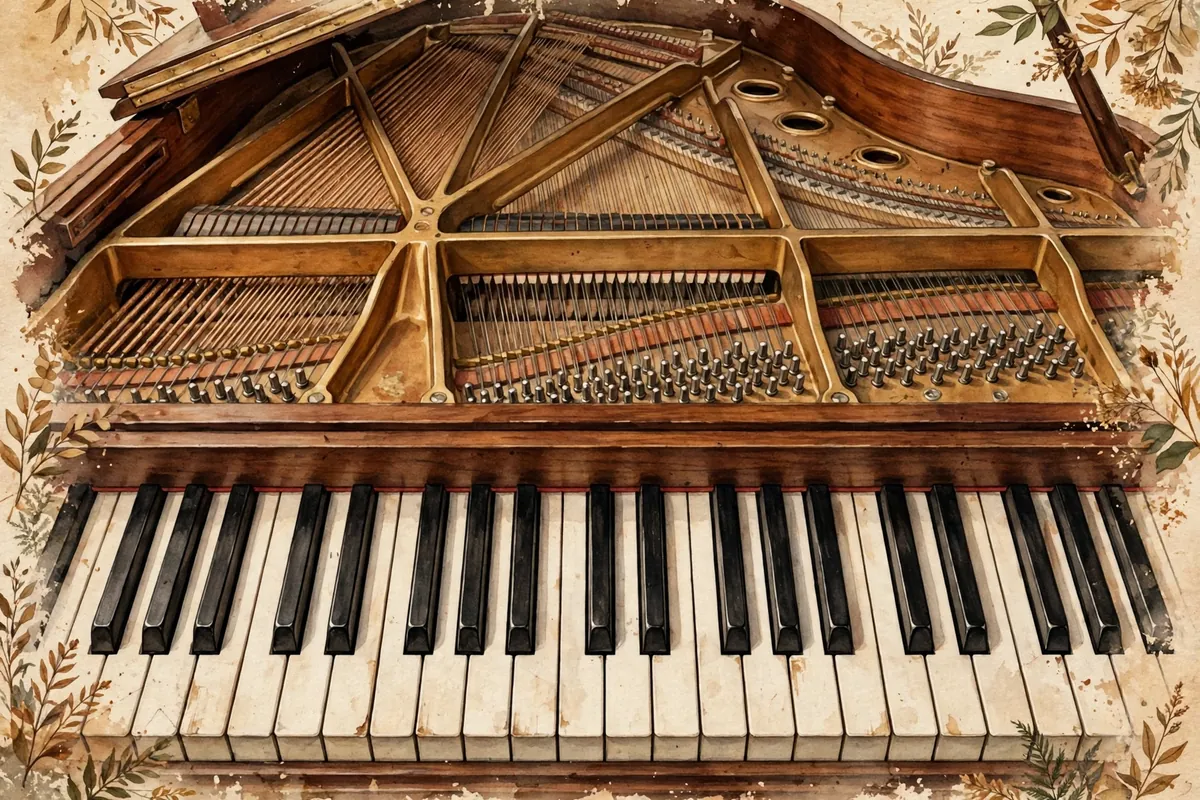
Sit down at almost any piano and you'll find the same thing: 52 white keys and 36 black keys, 88 in all. It feels like a number that was always meant to be. But the first pianos had far fewer keys, and getting to 88 took more than a century.
The short answer is that the keyboard grew as composers and pianists wanted a bigger range of notes. In Mozart's day, pianos covered about five octaves. By the 1820s, some reached seven. Today's standard 88 keys span a little more than seven octaves, running from a very low A to a very high C.
Where the Piano Began
The piano was invented by Bartolomeo Cristofori, a harpsichord expert in Italy who worked for the powerful Medici family. Records show one of his pianos existed by 1700. He called it a name meaning roughly “a keyboard of cypress with soft and loud,” which was shortened over time to pianoforte, and eventually just piano.
His big breakthrough was a hammer that strikes a string and immediately falls away so the note can ring. Unlike a harpsichord, the piano let players control how loud or soft each note sounded simply by how hard they pressed the keys.
Octave by Octave
Between about 1790 and 1860, the piano changed dramatically. Composers wanted a fuller, more powerful sound, and the Industrial Revolution supplied strong piano wire and massive iron frames that could handle the tension of more strings.
The keyboard stretched along with it. The piano maker Broadwood, which sent pianos to both Joseph Haydn and Ludwig van Beethoven, built pianos with five octaves and a fifth in the 1790s, six octaves by 1810, and seven octaves by 1820. Beethoven made use of those extra notes in his later works.
Some older pianos stopped at 85 keys, exactly seven octaves. The modern 88-key keyboard adds a few more notes at the top, for seven octaves plus a little extra.
The Math Behind the Keys
Each key plays a note a little higher than the one before it. Every 12 keys make an octave, and going up one octave doubles the frequency of the sound. The 49th key, the A above middle C, is tuned to 440 vibrations per second.
Follow that rule down to the lowest key, and the bottom A vibrates just 27.5 times a second, a deep rumble. The top C reaches about 4,186 vibrations per second, a bright little ping. Strings vary too: there's one string per note in the bass, two in the tenor, and three in the treble.
Pianos That Go Beyond 88
Not everyone stopped at 88. In 1909, the composer Ferruccio Busoni asked the Austrian maker Bösendorfer for extra low notes so he could play an organ piece that went below the standard keyboard. The result, the Imperial grand, has 97 keys and a full eight octaves.
Those extra keys were originally hidden under a hinged lid so pianists wouldn't hit them by accident. Newer models simply color the tops of the extra white keys black. Jazz great Oscar Peterson was so impressed after playing one that he told his manager he had to have one too.
Australian maker Stuart & Sons went even further, building a 108-key piano in 2018 and a 112-key model delivered to Rockford in the United States in 2024. Still, for nearly every pianist on Earth, 88 keys is home. And that's plenty of room to make some beautiful music.