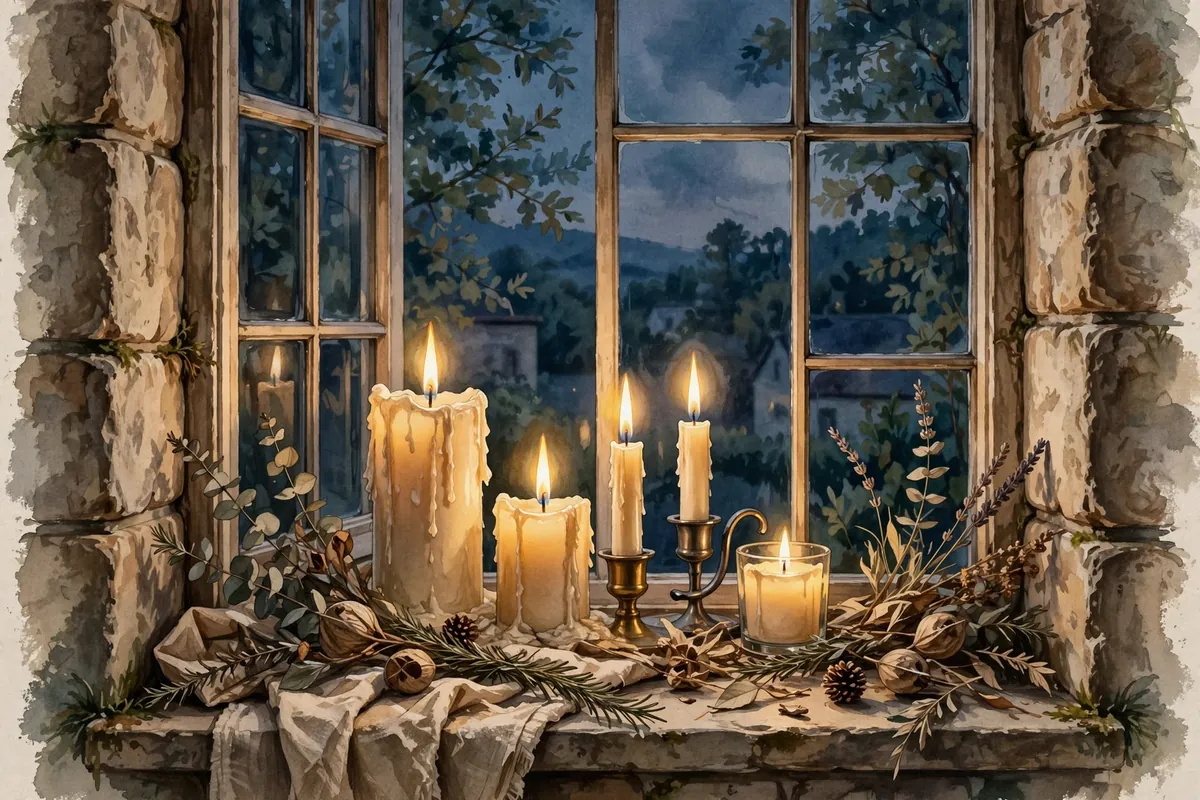
There's something about candlelight in December. A single flame in a window on a snowy night, a ring of candles on the dining table, a candlelit Christmas Eve service. Even in an age of LED lights, candles still feel like the heart of the season. So why do we light them?
Here's the answer. In the Christian tradition, Christmas candles are a symbol of Jesus as the Light of the World. Candles placed in each window are meant to express that belief, and the candles or lights on a Christmas tree carry the same meaning. Over the centuries, that symbol grew into many traditions, from candlelit trees to the Advent wreath.
Candles on the Christmas Tree
The Christmas tree was first recorded among Lutheran Christians in Germany in the 1500s. In 18th-century Germany, upper-class families sometimes decorated their trees with candles, which were an expensive light source at the time. Candles were glued to branches with melted wax or fastened with pins.
When German Lutherans brought the decorated tree to America, the Moravians added lighted candles to it. Special candleholders came along around 1890, and between 1902 and 1914, small lanterns and glass balls were used to hold the candles.
The candlelit tree caught on in Britain during Queen Victoria's time. On Christmas Eve in 1832, the 13-year-old princess wrote in her journal about two large trees "hung with lights and sugar ornaments."
From Flames to Light Bulbs
Electric lights arrived in the 1880s. In December 1882, Edward H. Johnson, an associate of Thomas Edison, showed off a tree at his New York City home hand-wired with 80 red, white, and blue bulbs about the size of walnuts. Local papers dismissed it as a publicity stunt, but he became known as the Father of Electric Christmas Tree Lights.
Electric lights were too expensive for most families at first. They didn't replace candles for the majority of people until 1930. Even today, miniature candles are still used on trees in some cultures.
The Advent Wreath
Another beloved candle tradition is the Advent wreath. Research points to Johann Hinrich Wichern, a Lutheran pastor in Hamburg, Germany, as its inventor. In 1839, children at his mission school kept asking every day whether Christmas had arrived.
So Wichern took a large wooden ring from an old cartwheel and decorated it with 24 small red candles and four large white ones. A new candle was lit each day of Advent. Over time, the idea shrank into the familiar evergreen wreath with four candles, sometimes with a fifth Christ candle in the center for Christmas Eve or Christmas Day. The custom reached North America in the 1930s.
A Candle in an Orange
Some churches use a charming candle tradition called the Christingle. It's a candle set in an orange, with the candle representing light and the orange representing the world, often decorated with a red ribbon and sweets. It began with a Moravian bishop in Germany in 1747, as a way to get children thinking about Jesus.
So when you strike a match and light a candle this Christmas season, you're joining a very old tradition. Whether it glows in the window, on the table, or in a child's hands, that little flame has been bringing warmth and meaning to the darkest time of year for centuries.