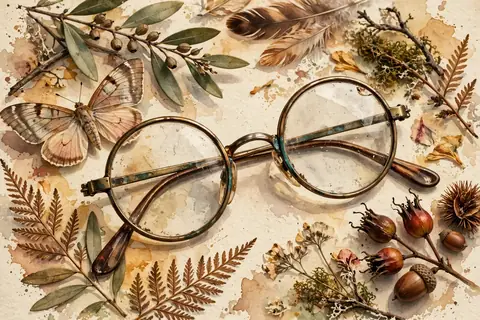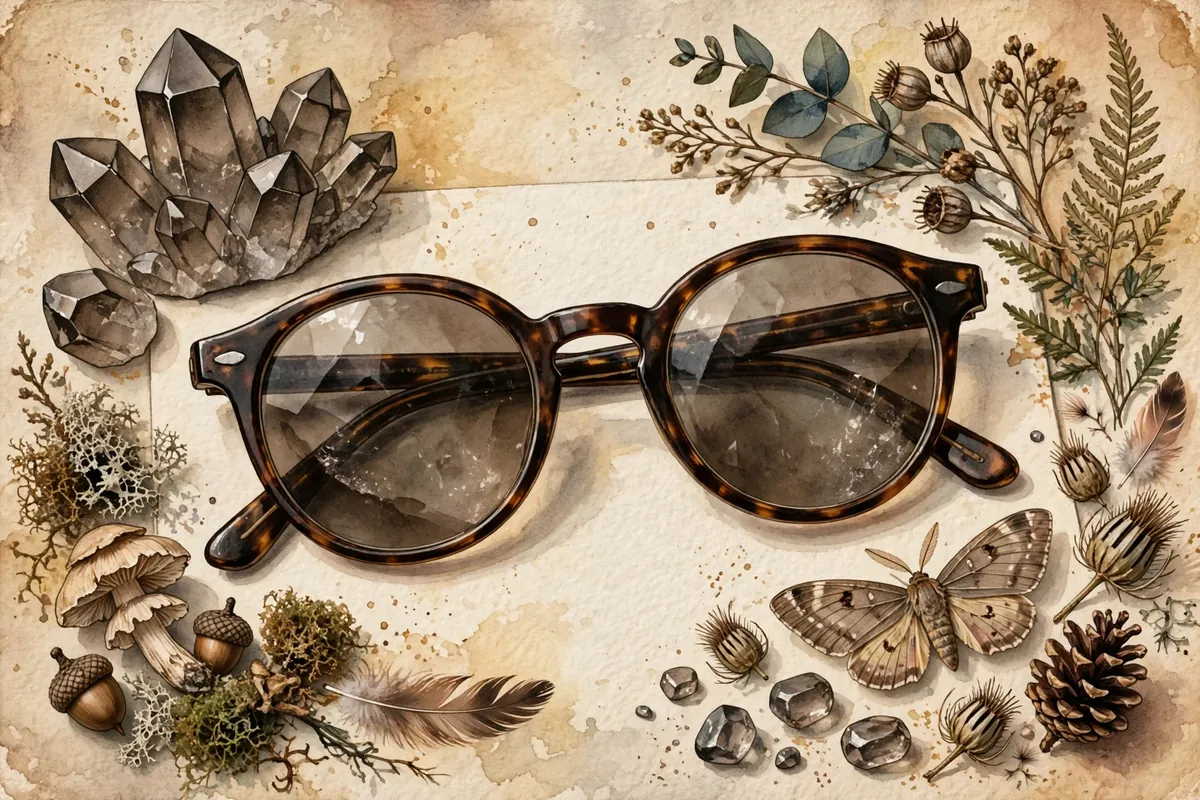
There's a popular bit of trivia that says sunglasses were invented for judges. It's a fun image: a stern official in ancient China hiding his eyes behind dark lenses so nobody could read his reaction in court. Like a lot of good trivia, it's partly true.
The earliest known sunglasses were flat panes of smoky quartz used in China in the 12th century, possibly earlier. They didn't correct vision, but they did protect the eyes from glare. Documents describe judges in Chinese courts wearing these crystal glasses to hide their facial expressions while questioning witnesses. So judges were famous early users, but glare protection was part of the story from the start.
Dark Clouds for the Eyes
The Chinese name for these quartz glasses meant dark clouds. It's a lovely name for something designed to put a little shade between your eyes and the world.
For a judge, those dark clouds had a bonus. A raised eyebrow or a flicker of doubt could tip off a witness. Behind smoky quartz, a judge could keep a perfect poker face.
Other Clever Eye Shades
China wasn't the only place where people found ways to cut the sun's glare. Since the 13th century, the Inuit made snow goggles from flattened walrus or caribou ivory with narrow slits to look through. These blocked most of the harsh light reflected off snow and ice.
There's an even older story. The Roman writer Pliny the Elder claimed that Emperor Nero liked to watch gladiator fights through cut emeralds, though these seem to have worked more like mirrors than sunglasses.
In Venice by the 1700s, women and children wore tinted Murano glass spectacles called gondola glasses to shield their eyes from glare off the canals. In France, King Louis XIV's court watched the 1706 solar eclipse through a telescope fitted with a smoky glass filter.
From Soldiers to Movie Stars
By the 1800s, tinted spectacles were worn by railway travelers, and soldiers on long marches used them against the sun. By 1895, sunglasses were showing up in newspaper ads. The real boom came in the 20th century.
Movie stars helped make sunglasses fashionable in the early 1920s. In 1929, Sam Foster began mass-producing inexpensive sunglasses from celluloid and selling them on the boardwalk in Atlantic City, New Jersey, under the name Foster Grant. By 1937, 20 million pairs were sold in the United States. Life magazine called them a new fad for city streets.
Polarized lenses arrived in 1936, when Edwin H. Land began experimenting with his patented Polaroid filter. Pilots also adopted sunglasses, adding to their cool, iconic image. Polarized lenses are especially good at cutting glare bouncing off water or a road, which is why anglers and drivers love them.
A Word About Your Eyes
Today, sunglasses are about health as much as style. The American Optometric Association recommends sunglasses that block ultraviolet light whenever you're out in the sun. Dark lenses without UV protection can actually be worse than none, because they make your pupils open wider and let in more UV. If you have questions about protecting your eyes, talk to your doctor or eye care professional.
So the next time you slip on a pair of shades, you're joining a long line of glare-dodgers, from Inuit hunters to Venetian gondola riders. And yes, a few poker-faced judges too.