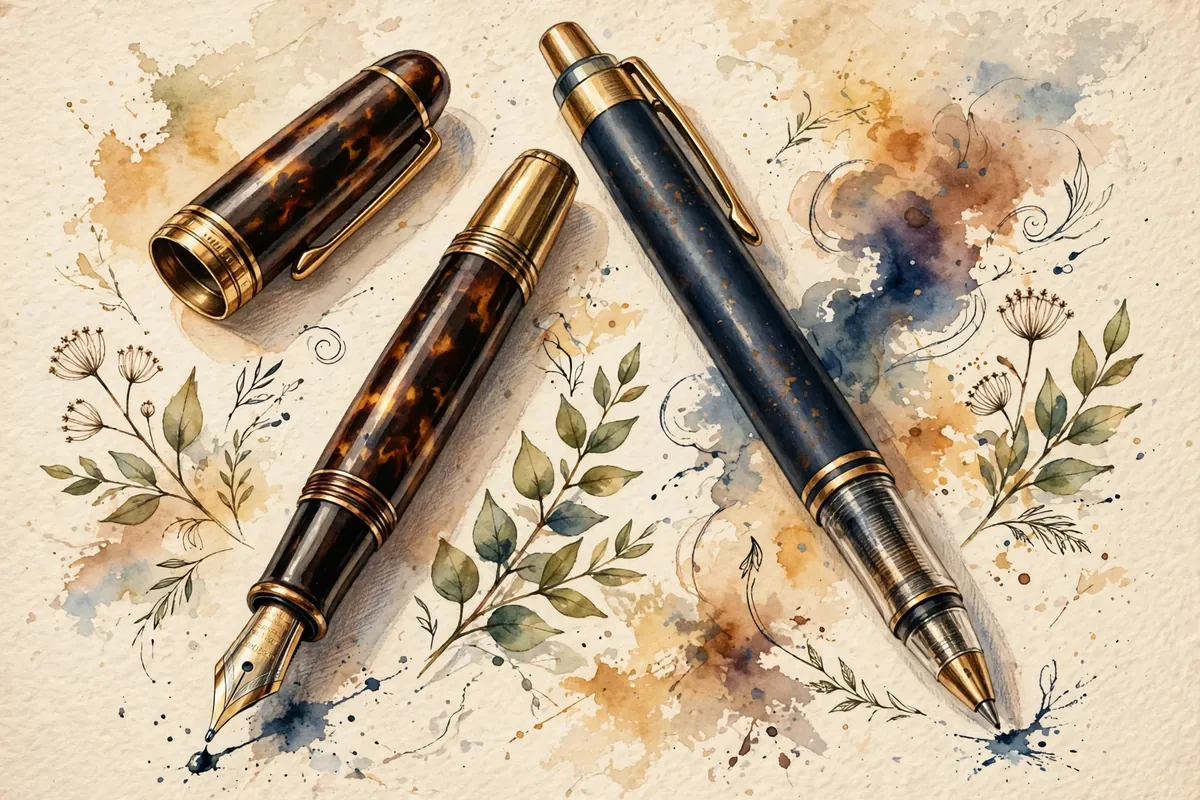
If you learned to write with a fountain pen, you probably remember the inkwells, the blotting paper, and the smudges on the side of your hand. Today most of us grab a cheap ballpoint without a second thought. How did that little click pen take over the world?
The ballpoint pen won because it was simpler and tidier. Its tiny rolling ball spreads thick, fast-drying ink, so there's no refilling, far less leaking, and very little smearing. Early ballpoints were pricey and unreliable, but by the 1960s, better manufacturing made them the everyday pen of choice.
The Fountain Pen's Long Reign
The fountain pen was a big improvement on dipping a pen in an inkwell. It holds ink inside, feeding it to the nib through a mix of gravity and capillary action. There's even compelling evidence that Leonardo da Vinci built and used a working version during the Renaissance. Mass-produced fountain pens arrived in the 1880s, and Waterman of New York became an early market leader.
But they had their headaches. Many early pens were filled with an eyedropper, a slow and messy job, and they tended to leak inside their caps. Even into the 1940s and 1950s, though, fountain pens stayed on top, because early ballpoints were expensive and often leaked or skipped.
A Rough Start for the Ballpoint
The ballpoint idea is older than you might think. The first patent went to American inventor John J. Loud in 1888. His pen used a small rotating steel ball to mark rough surfaces like wood and wrapping paper. It was too coarse for writing letters, and the patent eventually lapsed.
Other inventors tried for decades. If the ink was too thick, it wouldn't reach the paper. If it was too thin, the pen leaked and smeared. Getting the ball, socket, and ink just right was the hard part.
The Newspaperman's Bright Idea
The breakthrough came from László Bíró, a Hungarian newspaper editor who was tired of refilling fountain pens and cleaning up smudged pages. He noticed that newspaper printing ink dried quickly and left the paper clean. Why not a pen that used that kind of ink?
With his brother György, a dentist who knew some chemistry, he developed a thick ink and a ball-and-socket tip that controlled the flow. Bíró filed a British patent in 1938. In 1941 the brothers fled to Argentina, where their pen became so popular that ballpoints are still called biromes there. Britain's Royal Air Force crews used them because fountain pens tended to leak in airplanes.
From Luxury to Pocket Change
American businessman Milton Reynolds spotted a Bíró pen in Buenos Aires and raced to make his own. His Reynolds Rocket debuted at Gimbels department store in New York on October 29, 1945, for $12.50, about $224 in today's money. Thousands sold within a week.
Then came Marcel Bich, whose Bic company helped make ballpoints cheap and everywhere. The Bic Cristal launched in 1950 and became the world's most popular pen, with its 100 billionth sold in 2006. Fountain pens never vanished, though. They still have devoted fans who love their smooth writing, and they've enjoyed a comeback in recent years.
So next time you grab a pen from a cup by the phone, thank a frustrated newspaperman. He just wanted to stop smudging his pages.