We say it when a phone call gets us out of an awkward conversation, or when the meeting ends just before it's our turn to present. "Saved by the bell!" It's a handy little phrase. And it comes with a famous, spine-tingling origin story that gets passed around every Halloween.
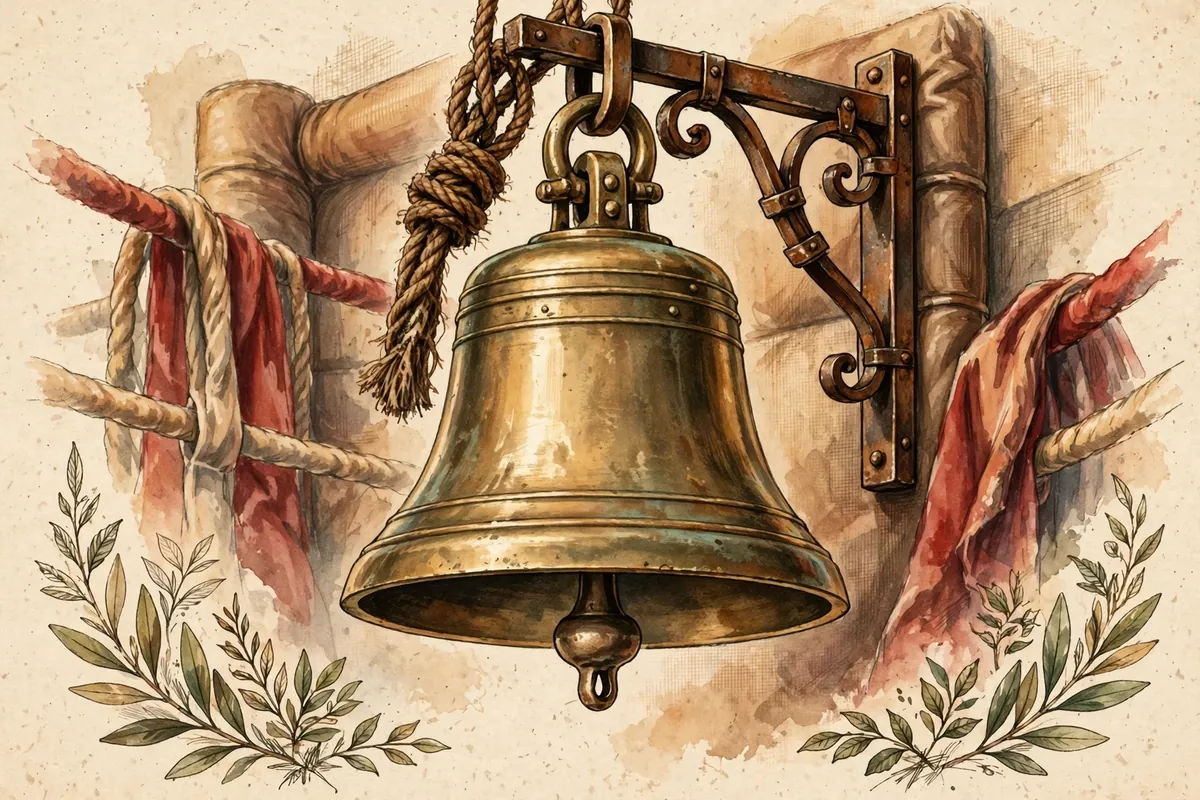
Here's the truth. The phrase comes from boxing, not from graveyards. When a boxer is knocked down, the referee starts counting to ten. If the bell rings to end the round before the count is finished, the fighter gets a break until the next round to recover. The Oxford English Dictionary dates the boxing use to 1932 and the everyday, figurative use to 1959.
The Graveyard Legend
The popular myth goes like this. Long ago, people were so afraid of being buried alive that coffins were fitted with a string tied to a bell above ground. If someone woke up underground, they could ring the bell and be dug up, saved by the bell.
The scary part isn't entirely made up. The fear of being buried alive, called taphophobia, was very real, especially during the cholera epidemics of the 1800s, when quick burials were common. Many safety coffins were patented in the 18th and 19th centuries. Some really did use a cord attached to a bell.
The Strange World of Safety Coffins
The first recorded safety coffin was ordered by Duke Ferdinand of Brunswick before his death in 1792. It had a window, an air tube, and a lock instead of nails. He kept two keys in a special pocket of his burial clothes, one for the coffin and one for the tomb door.
In 1798, a German priest reportedly suggested running a cord from every coffin to the church bells. One doctor, Adolf Gutsmuth, had himself buried several times to demonstrate his own design. In 1822, he stayed underground for several hours and ate a meal of soup, beer, and sausages delivered through a pipe.
There were also "waiting mortuaries," most popular in 19th-century Germany, where attendants watched the recently deceased for signs of life. Bells were sometimes strung to the bodies to alert them to any movement. But there's no documented case of anyone being saved from accidental burial this way.
Why the Dates Don't Add Up
The timeline is the giveaway. Bell-equipped coffins date mostly to the 1700s and 1800s. Yet the phrase "saved by the bell" doesn't show up until the 20th century, and its earliest known uses are about boxing.
In the ring, the meaning is perfectly clear. A dazed fighter on the canvas, the referee counting, and then the bell clangs just in time. From there, it was a short hop to everyday life, where any timely interruption that rescues us from trouble counts as being saved by the bell.
A Phrase With Staying Power
Boxing has given English plenty of everyday expressions, and this is one of the most popular. A whole generation also knows it as the title of a hit teen sitcom that aired on NBC from 1989 to 1993, set at a fictional high school where the school bell rang often.
So the next time an interruption rescues you, you can enjoy the phrase without picturing a creepy graveyard. Just imagine a boxer catching a lucky break and getting one more round to fight.