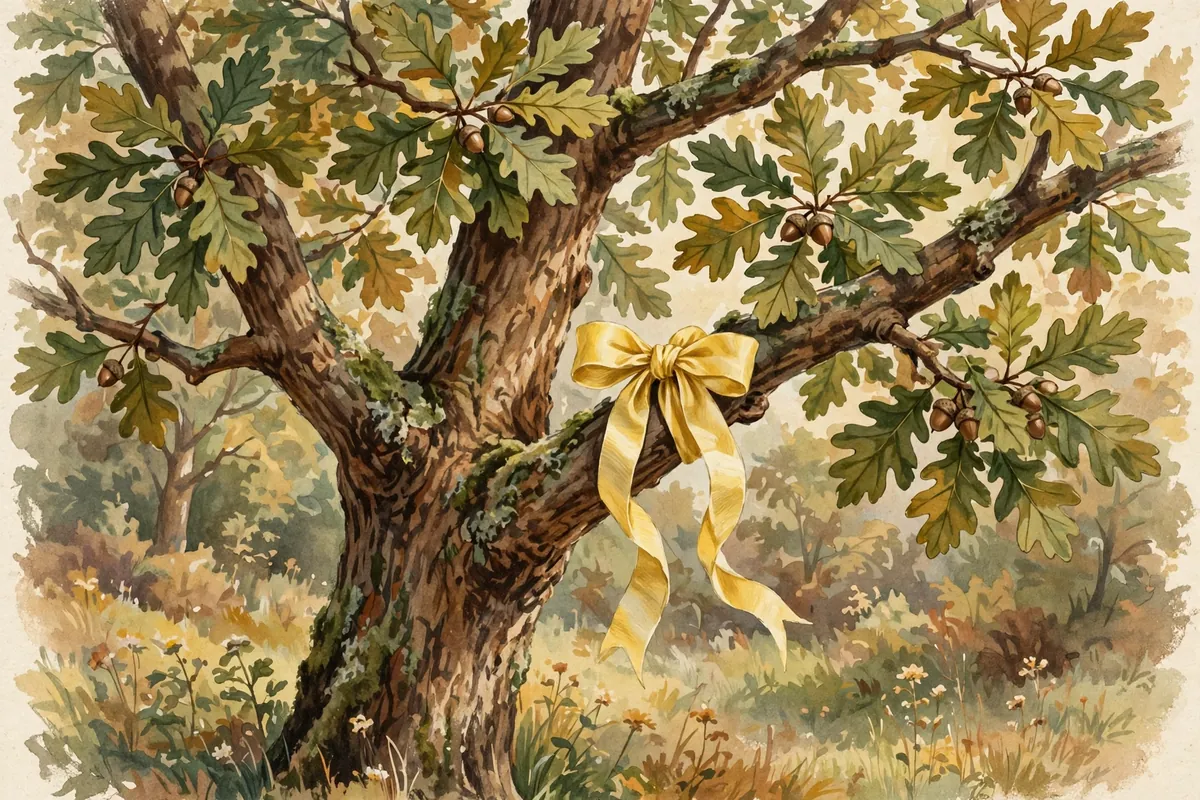
You've probably seen them: bright yellow ribbons tied around tree trunks, porch posts, and mailboxes. They often appear when a loved one is far away, especially someone serving in the military. But how did a simple strip of yellow cloth come to mean “come home safe”?
The short answer: in the United States, the yellow ribbon has long stood for hope and for waiting for someone to return. One early root is an old military marching song about a woman who wears a yellow ribbon for her faraway soldier. It became a household symbol in the 1970s, thanks to a famous story and the hit song “Tie a Yellow Ribbon Round the Ole Oak Tree.”
An Old Soldiers' Song
Yellow is the official color of the U.S. Army's armor branch, and old Hollywood Westerns often showed cavalry soldiers wearing yellow neckerchiefs. The yellow ribbon also shows up in a popular military marching song.
The first copyrighted version came out in 1917, written by George A. Norton, with the title “Round Her Neck She Wears a Yeller Ribbon (For Her Lover Who Is Far, Far Away).” The song was later reworked as “She Wore a Yellow Ribbon” for a 1949 movie of the same name.
The Story of the Man on the Bus
The tree part of the tradition comes from a story that's been told in different versions. In October 1971, newspaper columnist Pete Hamill wrote a piece for the New York Post called “Going Home.” In it, college students on a bus to Fort Lauderdale befriend an ex-convict who is watching for a yellow handkerchief tied to a roadside oak, a sign that his family will welcome him back.
Hamill said he had heard the story through oral tradition. Earlier versions existed too. A 1961 Reader's Digest article told of a released prisoner who asked his family to hang a white ribbon in an apple tree beside the railroad tracks if they had forgiven him.
A Song That Played for 17 Years Straight
In 1972, songwriters Irwin Levine and L. Russell Brown copyrighted “Tie a Yellow Ribbon Round the Ole Oak Tree,” recorded by Tony Orlando and Dawn. In the song, a released prisoner rides a bus past his old home and will only get off if he sees the ribbon.
It was a smash. In May 1973, it sold 3 million records in three weeks. The music rights group BMI later calculated that radio stations had played it 3 million times, equal to 17 years of nonstop airplay.
Hamill sued, believing the song copied his story. He dropped the suit after folklorists found older versions of the tale that predated his column.
From a Song to a National Symbol
The ribbon took on a bigger meaning during the Iran hostage crisis. In November 1979, a group led by Suzan Garrett in Leitchfield, Kentucky, organized a campaign to tie yellow ribbons around public trees in support of the Americans held hostage in Tehran.
Since then, yellow ribbons have become a common way to show support for the safe return of American troops, including prisoners of war and those missing in action. The symbol has spread abroad, too. In the Philippines, supporters tied yellow ribbons to welcome opposition leader Benigno Aquino Jr. home in 1983.
So a yellow ribbon on a tree is more than decoration. It's a quiet message to someone far away: we're thinking of you, and we're waiting for you to come home.