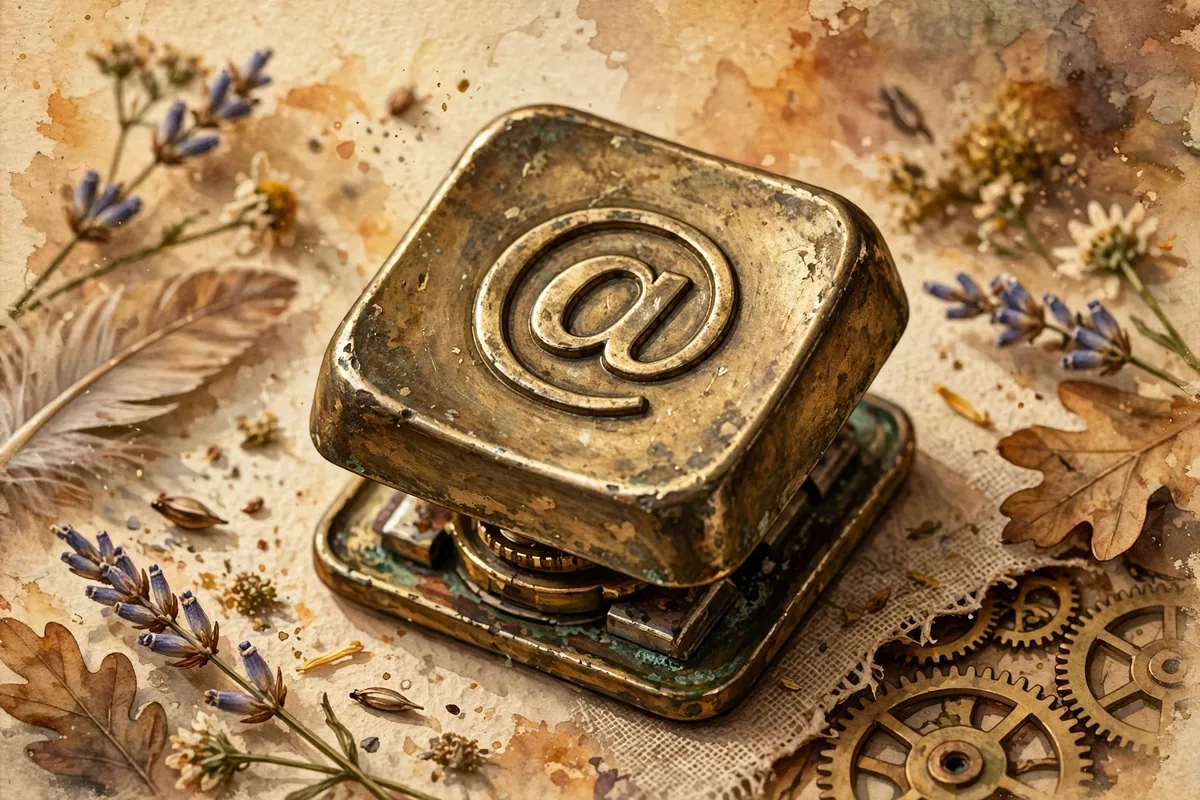
You probably type it every day without a second thought. It's in every email address and all over social media. But the little @ sign is much older than computers, and for most of its life it had nothing to do with the internet.
The short answer: @ began as a merchant's shorthand. In English, it meant "at the rate of," as in "10 widgets @ $1.50 each." Then in 1971, programmer Ray Tomlinson chose it to separate a person's name from their computer's name when he created the first email system that could send messages between different computers. That's why email addresses look like name@place today.
A Symbol for Wheat, Wine, and Prices
Nobody knows exactly where @ came from. The earliest known symbol in this shape appears in a 1345 Bulgarian translation of a Greek chronicle, where the first letter of the word for "amen" looks like an at sign. That book is now kept in the Vatican library.
In Spanish, Catalan, and Portuguese, the symbol long stood for the arroba, a unit of weight of about 25 pounds. One symbol resembling @ shows up in a Spanish record of a wheat shipment from 1448. And in a 1536 letter sent from Seville to Rome, it was used for a measure of wine in a deal involving trade with Peru.
In English, it settled into its role on invoices and price lists. It wasn't on the earliest successful typewriters, but it appeared on the popular Underwood typewriters starting with the Underwood No. 5 in 1900.
The Programmer Who Picked It
Ray Tomlinson worked on ARPANET, the computer network that came before the internet. Back then, you could only send mail to people who used the same computer. In 1971, he built the first email system that could send messages between users on different machines.
He needed a way to show where a message was going. He chose @ because it wasn't used in usernames or in the programming system he was working with, and because it naturally meant "at." So user@host meant a person located at a particular computer. It's been the standard ever since.
In 2010, the Museum of Modern Art in New York added the @ sign to its design collection, describing it as a "defining symbol of the computer age."
A Monkey Tail and a Strudel
Here's a fun part. English never settled on a catchy name for it, so we just say "at." Other languages got creative. In Dutch, it's apenstaart, or "monkey's tail." In Danish, it's snabel-a, or "elephant's trunk A." In Italian, it's chiocciola, meaning "snail." Ukrainians and Welsh speakers sometimes call it a snail, too.
In Hebrew, it's often called shtrudel, because it looks like a slice of strudel pastry. Czechs call it zavináč, after a rolled-up pickled herring. And in German, it has been called Klammeraffe, or "spider monkey."
From Email to Everything
Today, @ does much more than email. On social media, putting @ before a name mentions or tags that person. Facebook added this feature in September 2009.
So the next time you type an email address, give a little nod to the shopkeepers who priced their goods with it, and to the programmer who gave it a brand-new job. Not bad for a symbol that once mostly showed up on invoices.