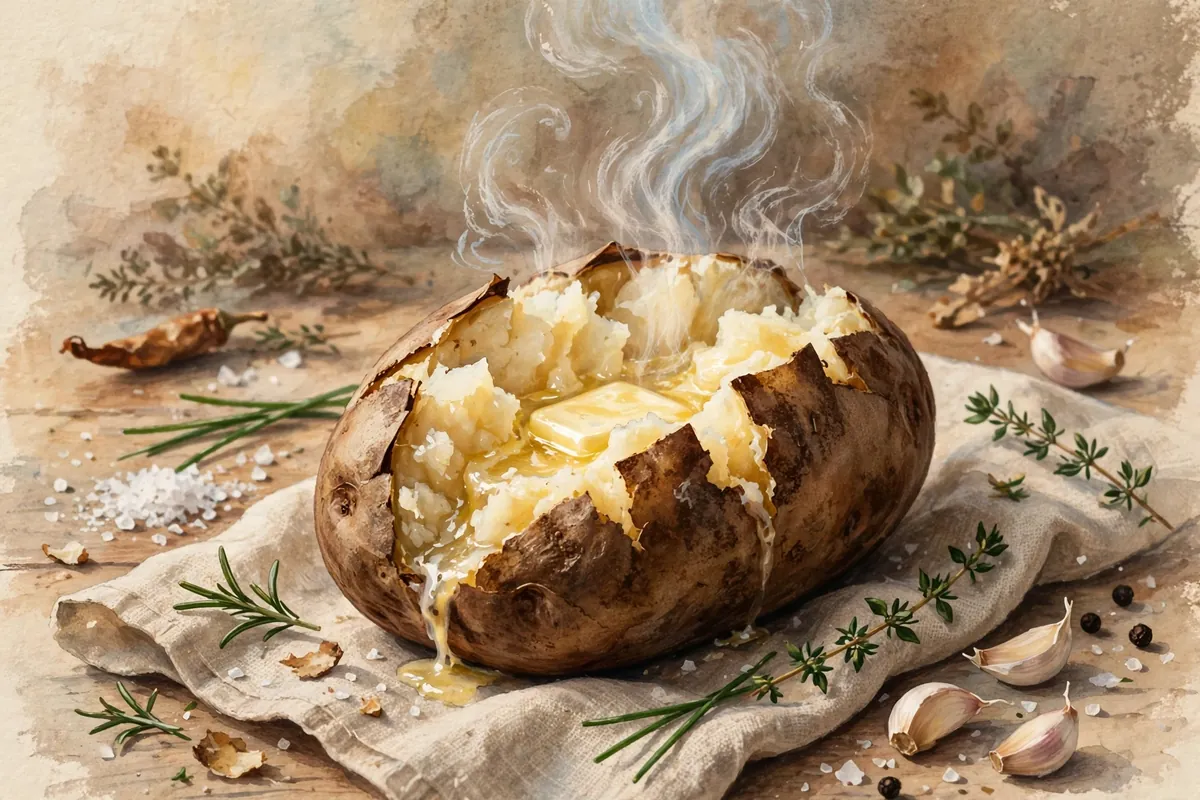
Your steak is getting cool, the green beans are lukewarm, and the dinner rolls went cold ten minutes ago. But slice into that baked potato and a puff of steam rises right out of it. Why does a potato hold onto its heat so stubbornly?
Here's the short answer: two simple bits of physics do most of the work. First, a potato is mostly water, and water can soak up and store an unusually large amount of heat. Second, a baked potato is a big, compact lump, so it has a lot of hot insides compared with the amount of skin that lets heat escape. Together, that means it takes a long time to cool down.
Water Is a Heat Battery
Liquid water has one of the highest specific heat capacities of any common substance. In plain terms, it takes a lot of energy to warm water up, and that energy has to go somewhere before water cools back down. Iron, for comparison, needs less than a ninth as much energy to warm by the same amount. Oddly enough, frozen water is different. Ice just below freezing needs only about half as much energy as liquid water to warm by the same amount.
A potato is packed with water, so when you bake it, you're essentially charging up a little heat battery. It also starts out very hot. A baked potato is considered fully cooked when its center reaches about 210 degrees Fahrenheit, close to the boiling point of water.
Why Size and Shape Matter
Heat leaves food through its surface. And here's where a rule called the square-cube law comes in. Galileo first described it in 1638: as an object gets bigger, its volume grows faster than its surface area.
So a big, round potato has a lot of hot interior and relatively little skin. The heat deep inside has a long way to travel before it can escape. The same principle helps explain why an elephant has a harder time cooling off than a mouse. Thin green beans and flat slices of meat, on the other hand, have lots of surface for their size, so they cool quickly.
Tips From the Potato Pros
Before baking, cooks often prick the skin. That lets steam escape and prevents a potato from bursting open, which is especially likely in a microwave. Wrapping it in aluminum foil keeps in moisture, while leaving it bare gives you a crisp skin.
That steam is also a good reason to cut into a fresh baked potato carefully. The inside can stay much hotter than the outside feels.
Some varieties, such as Russet Burbank and King Edward, are especially good for baking because of their size and texture. And the skin is worth eating. It has a distinctive taste and is rich in dietary fiber.
An Ancient Way to Cook
People have been baking potatoes for a very long time. Potatoes originated in South America and were grown for centuries in the Inca Empire, where they were baked in an underground cooking pit called a huatia. In Britain, a baked potato is often called a jacket potato.
So the next time your potato is still steaming while everything else on your plate has gone cold, you'll know why. It's a heat battery wrapped in its own jacket, and it's in no hurry to give up its warmth.