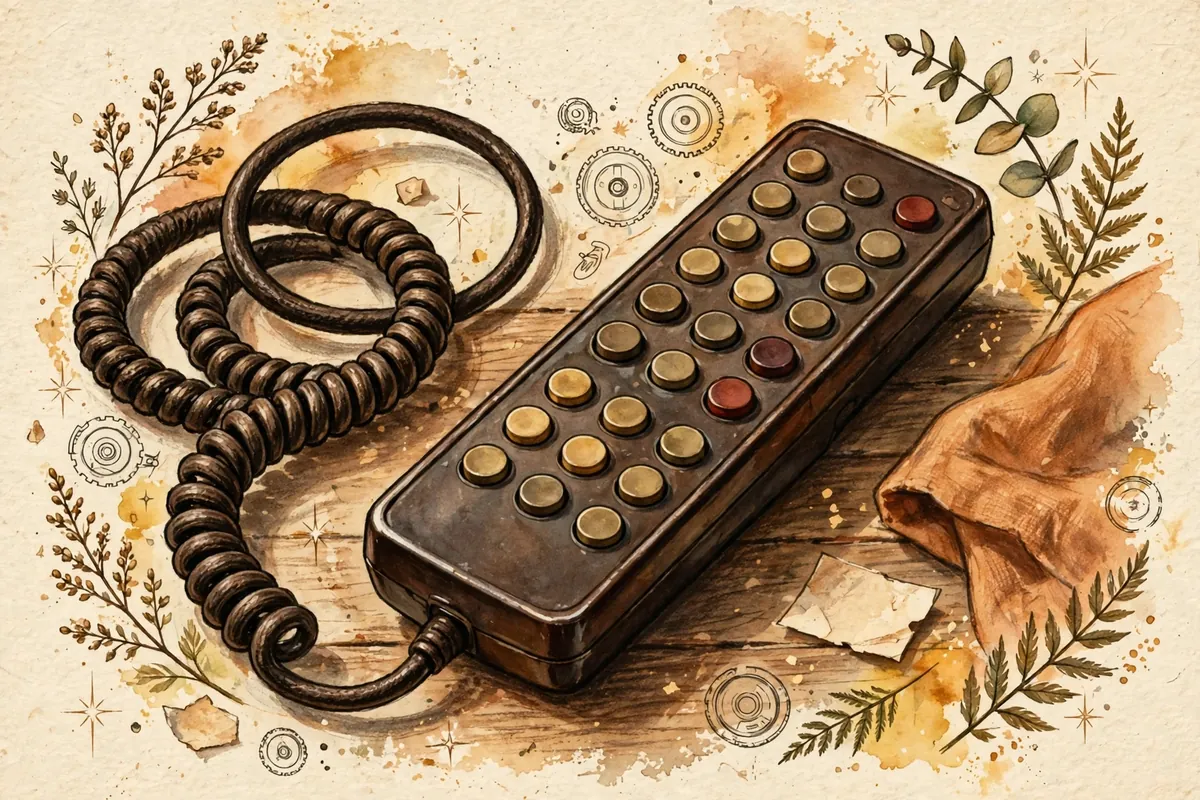
Today, most of us can't imagine watching TV without a remote. We click through channels, pause shows, and turn up the volume without moving an inch. But the earliest TV remotes looked very different, and one of the first had a name that's hard to forget: Lazy Bones.
Here's the short answer. In 1950, Zenith Radio Corporation introduced the Lazy Bones, one of the first remotes designed to control a television. It was connected to the TV by a wire. The name was a playful nod to the old expression lazybones, meaning someone who'd rather not get up, which is exactly what a remote lets you avoid.
A Boss Who Hated Commercials
The push for a remote came from the top. Eugene F. McDonald, who founded Zenith Radio in 1921, was well known for his dislike of commercials. Zenith had moved into the television business in the late 1940s, and McDonald wanted the company to make and sell a remote control.
Lazy Bones was the result. It let viewers control their set from their seat, but the cord running across the room tied the remote to the TV. Wireless remotes would come a few years later.
Remotes Before TV
Remote control itself was much older than television remotes. In the late 1800s, inventors developed wired and wireless controls for things like military torpedoes. Nikola Tesla publicly demonstrated a radio-controlled torpedo in New York in 1898, hoping to sell it to the U.S. Navy.
Radios got remotes before TVs did. By the late 1930s, several manufacturers offered remotes for higher-end radio models, mostly connected by wires. The Philco Mystery Control of 1939 was battery-powered and wireless, making it the first wireless remote for a consumer electronics device.
From Flashlight to Clicker
In 1955, Zenith engineer Eugene Polley, who had started at the company as a stock boy in 1935, created the Flash-Matic, a wireless TV remote that worked by shining a beam of light onto one of four light-sensitive cells at the corners of the screen. Aiming the pistol-shaped control at a particular cell could turn the set on or off, mute the sound, or change the channel. It had a problem, though. The cells couldn't tell the remote's light from other light, and the remote had to be aimed very precisely.
The next year, in 1956, Robert Adler developed the Zenith Space Command, named after McDonald's nickname, The Commander. Pushing a button struck a small metal bar, which gave off a high-pitched ultrasonic tone that the TV picked up. Because of the clicking sound, people called these remotes clickers. Decades later, Polley and Adler shared an Emmy award for their pioneering work on wireless TV remotes.
The Space Command cost $259.95, which made it a true luxury item at the time. Its four bars controlled channel up, channel down, sound on and off, and power.
The Remotes We Know Today
Ultrasonic remotes were used from 1956 until the late 1970s. Modern remotes usually send coded pulses of infrared light instead. Many early remotes had only a handful of functions, sometimes as few as three buttons.
So the next time you reach for the remote, think of the Lazy Bones and its long cord across the living room floor. It was a humble start for one of the most beloved gadgets in the house.