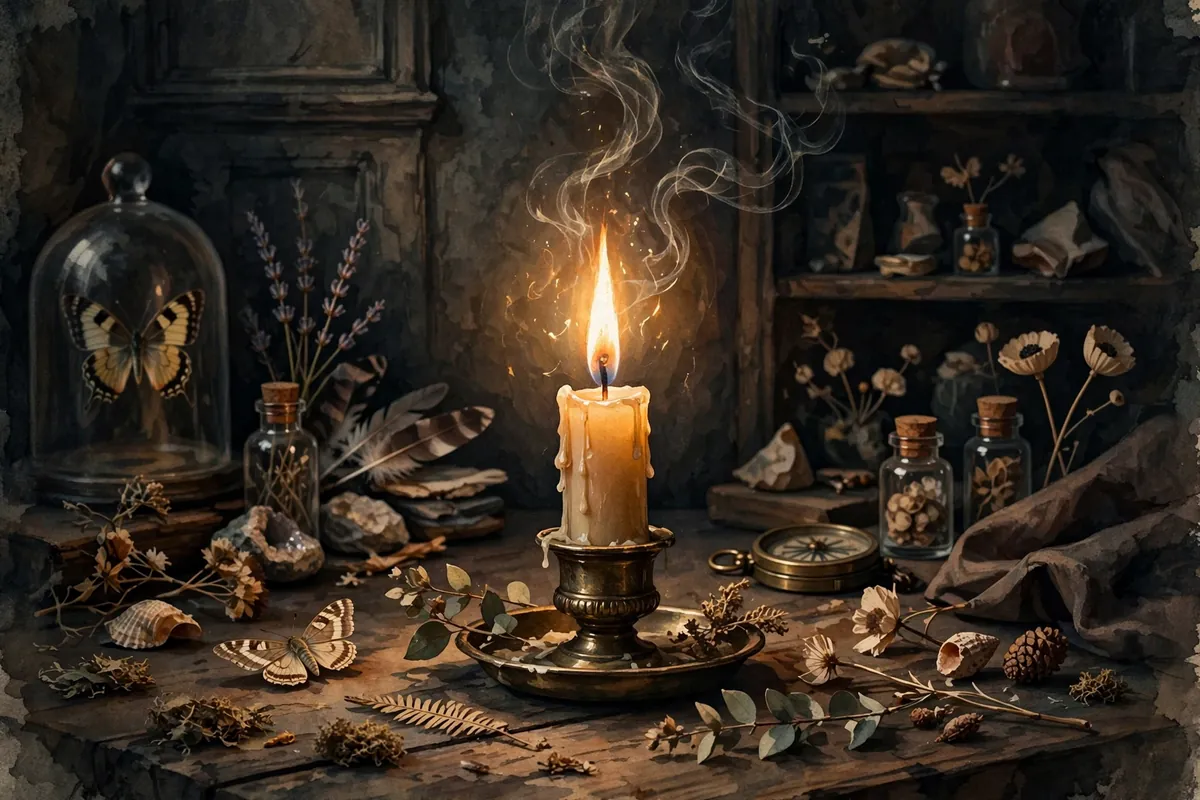
Light a candle in a dark room and watch the flame for a moment. It stretches upward in that familiar teardrop shape, flickering but always pointing toward the ceiling. Tip the candle at an angle, and the flame still points up. Why doesn't it lean along with the candle?
The short answer is that hot air rises. A flame heats the air and gases around it, and warm air is less dense than cool air, so it floats upward, much like a hot air balloon. That rising stream of hot gas carries the flame up with it, and cooler air rushes in from below to take its place. This flow, called convection, depends on gravity, which is why the flame always points away from the ground.
How a Candle Actually Burns
A candle is a clever little machine. When you light the wick, the heat melts a small amount of wax. The melted wax travels up the wick by capillary action, the same way water climbs up a paper towel. Near the flame, the wax turns into vapor, mixes with oxygen from the air, and burns.
The flame then melts more wax, which travels up the wick, keeping the whole process going on its own. As the candle burns down, the wick burns down with it. Before the 1800s, wicks had to be trimmed with scissors or "snuffers" to keep them from smoking. Modern wicks are designed to curl over as they burn, so the tip trims itself in the flame. And if a wick draws up too much wax, the extra melted wax streams down the side of the candle.
The Colors in the Flame
Look closely and you'll see different colors. The bright yellow comes from tiny particles of soot glowing in the heat. The convection current carries this soot upward, which helps give the flame its tall yellow shape.
Down at the base, there's a small, dull blue region. The hottest part of the flame is just above that blue area, where temperatures reach about 2,550 degrees Fahrenheit. That spot is very small, though, and releases little heat overall.
What Happens in Space
So what if there's no gravity to make hot air rise? In 2000, NASA experiments confirmed that gravity plays a role in how flames form. In orbit, natural convection doesn't happen, and a flame becomes spherical instead of pointed.
Space flames also tend to turn bluer and burn more efficiently. The leading explanation is that the heat is spread more evenly, so less soot forms and more of the fuel burns completely. Researchers think these findings could help improve fuel efficiency back on Earth.
A Famous Candle Lecture
Candles have fascinated scientists for a long time. In 1848, the great scientist Michael Faraday gave a series of six lectures for young people at the Royal Institution in London called The Chemical History of a Candle. He explained the different zones of the flame and showed that glowing carbon particles are what make it bright.
Faraday's Christmas lectures for young people are still given every year. It's a nice reminder that one of the simplest objects in the house can hold a whole world of science.
So the next time you light a candle for dinner, take a second to admire that upward-pointing flame. It's gravity, chemistry, and physics all working together, and, of course, never leave it burning unattended.