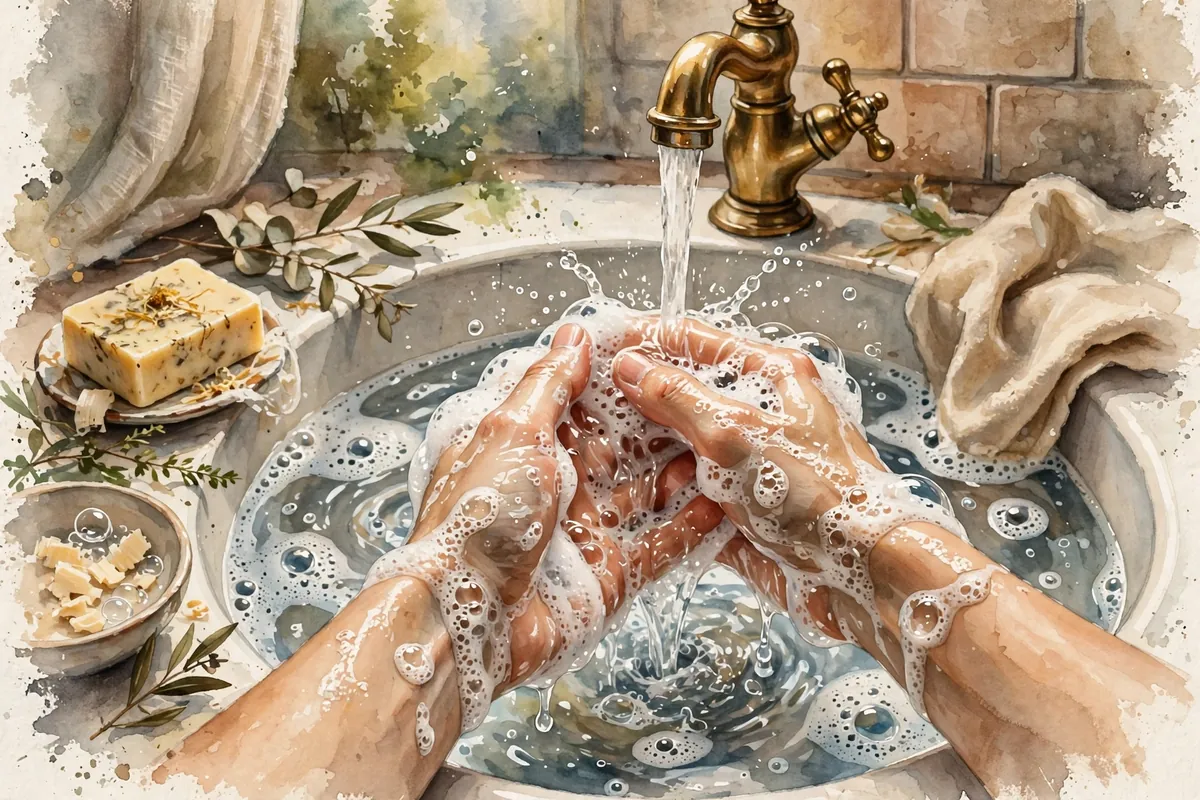
Try washing greasy hands with plain water and you'll notice the problem: the water beads up and rolls off, leaving the grime behind. Add a squirt of soap, rub for a bit, and suddenly everything rinses clean. What is soap doing that water can't?
Soap works in two ways. Its molecules have one end that's attracted to water and another that's attracted to oils and fats. They surround greasy dirt, along with the germs stuck in it, so the whole mess can be rinsed away. Soap can also kill many microorganisms outright by disrupting their outer membranes and damaging their proteins.
A Molecule With Two Personalities
Soap belongs to a group of substances called surfactants. Each molecule has a water-loving head and a fat-loving tail. On its own, oil doesn't mix with water, which is why plain rinsing struggles with grease.
When you lather up, soap molecules gather around bits of oil and dirt, forming tiny spheres called micelles. The fat-loving tails point inward, wrapping up the grease, while the water-loving heads face outward. Now the trapped grime can mix with water and wash down the drain.
That matters because the natural oils on our skin hold on to dirt and bacteria. Soap also emulsifies oils, breaking them into tiny droplets that running water can carry away.
Breaking Germs Apart
Soap does more than move germs around. Lathered with a little water, it can kill microorganisms by disorganizing the thin, fatty double layer that forms their outer membrane. It also denatures their proteins, scrambling structures they need to survive.
Lather helps, too. Rubbing your hands together with a generous amount of soap spreads it over every surface, and the soap lifts germs off the skin so the water can carry them away. A quick rinse just can't do the same job.
Scrubbing Beats Hot Water
Here's a surprise: water temperature barely matters. Water anywhere from about 39°F to 104°F removes microbes about equally well, and water that's still comfortable on your hands isn't hot enough to kill bacteria. The most important factor is proper scrubbing.
Scrubbing creates friction, which helps knock germs loose, and scrubbing longer removes more of them. The CDC says scrubbing with soap for at least 20 seconds is needed to remove most germs, whatever the water temperature. Don't forget the backs of your hands, between your fingers, and under your nails.
Antibacterial soaps have been heavily promoted, but they may not be as effective as they're marketed to be. Plain soap and running water, followed by drying your hands well, does the job. Wet hands pick up germs again more easily.
An Ancient Invention
People have been making soap for thousands of years. Evidence of soap-like materials dates to ancient Babylon around 2800 BC, and a Sumerian clay tablet from about 2500 BC records a recipe made by heating oil with wood ash. It was used to wash woolen clothing.
Doctors were slower to catch on. Hungarian physician Ignaz Semmelweis showed in the 1840s that hand-washing helped prevent disease in hospitals, but it became mandatory only long afterward. At the time, most people still believed infections were caused by foul odors called miasmas.
So the next time you wash your hands, give the soap a little credit. Those humble bubbles grab grease, break germs apart, and rinse them away in seconds. If frequent washing leaves your skin sore or cracked, talk to your doctor.