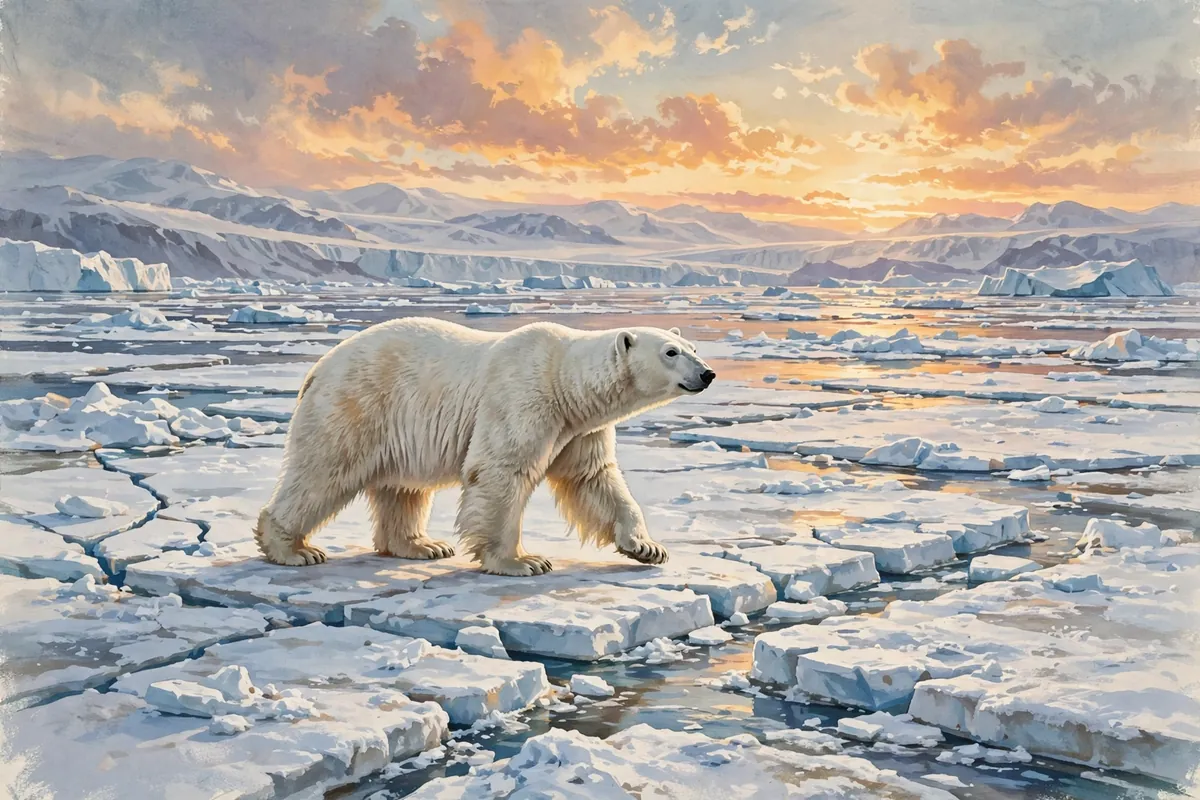
Picture a polar bear and you probably see white: a big, snowy shape against Arctic ice. It seems natural to assume the bear is pale all the way through. But part that thick fur and you'd find something unexpected underneath.
Polar bears have black skin, including the nose and lips. Dark skin absorbs heat, which is handy in one of the coldest places on Earth. And here's the twist: the fur itself has no pigment. It only looks white because of the way it scatters light.
Fur That Isn't Really White
A polar bear's coat has two layers: a dense underfur about 2 inches long and guard hairs about 6 inches long. The guard hairs are transparent and hollow. With no pigment inside, the fur looks white because light bounces back off it.
That's also why polar bears aren't always bright white. They turn yellowish as they spend more time in the sun, a tint that goes away after they molt. Some can look grayish or brownish, too.
The pale color still pays off. Against snow and ice, the coat gives the bear excellent camouflage.
A Coat Built Like a Survival Suit
Black skin is only one part of the polar bear's cold-weather gear. The hollow guard hairs help trap heat and help the bear float. The transparent hairs also scatter ultraviolet light between the underfur and the skin, which helps keep the bear warm.
Under the skin sits a layer of fat 2 to 4 inches thick that provides both warmth and stored energy. Oily secretions keep the hair from freezing, and because the hairs resist tangling when wet, a bear can simply shake itself dry after a swim.
With all that insulation, overheating can be a real problem. Polar bears handle it with finely controlled blood vessels and by taking a dip to cool off. Their core body temperature stays at about 98.4°F, very close to ours.
Babies Start Out Pink
Polar bears aren't born with black skin. Newborn cubs have woolly hair and pink skin, and they weigh only about 21 ounces. Their eyes stay closed for a month while they grow on their mother's rich, fatty milk inside a snowy den.
By the time the family leaves the den, between late February and early April, the cubs weigh about 22 to 33 pounds and can walk alongside their mother. They'll stay with her for up to two and a half years.
That Dark Nose Can Give Them Away
All that dark skin has one drawback: a black nose and dark eyes stand out against white snow. When a polar bear stalks a seal resting on the ice, it moves slowly with its head and neck lowered, possibly to make its nose and eyes less noticeable. As it gets closer, it crouches lower and then charges at high speed.
The bear's other senses help it find that seal in the first place. Its sense of smell is adapted for picking up prey over vast distances, and its eyes sit close to the top of its head, which may help it see while swimming at the surface.
So the great white bear of the North is really a black-skinned animal wrapped in clear, hollow hairs. Nature's version of a snowsuit turns out to be a lot cleverer than it looks.