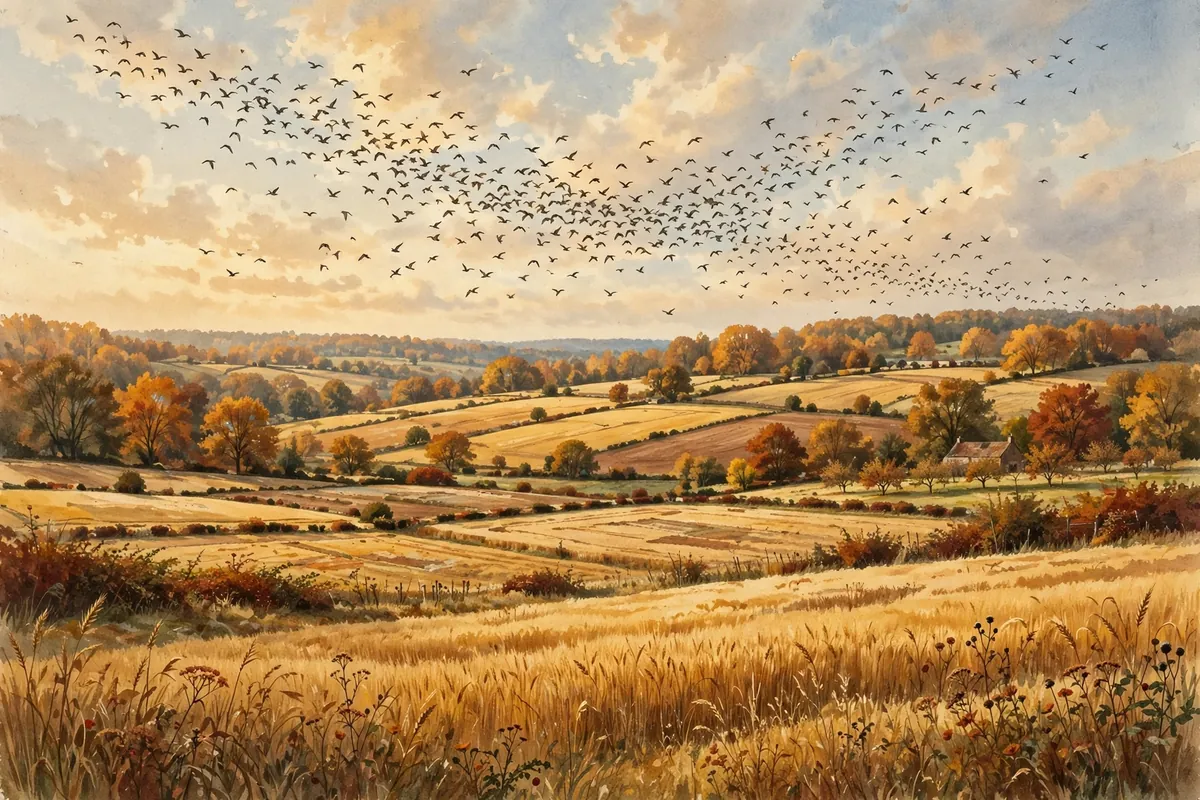
Every fall, the sky fills with V-shaped flocks heading south. Nobody hands the birds a calendar or a road map. Some of them are only a few months old and have never made the trip before. So how do they know when to leave, and which way to go?
The short answer is that the main signal is the changing length of the day. As days get shorter, hormones shift inside the bird and it starts getting restless and storing extra fat. For the trip itself, birds steer using the Sun and the stars, Earth's magnetic field, and mental maps of the landscape. Many long-distance migrants seem to be born with the urge and even the direction already built in.
The Restless Season
Before migration, many birds become unusually active. Scientists call it Zugunruhe, a German word for migratory restlessness, first described by Johann Friedrich Naumann in 1795. The birds also bulk up on fat, the fuel they'll burn on the long flight.
Here's the surprising part. Birds raised in cages, with no clues like shortening days or falling temperatures, still show this restlessness. They even tend to face the direction they would fly in the wild, and they change that direction at about the same time wild birds of their species change course. That points to an internal yearly clock that helps run the whole show.
Finding the Way
Knowing when to go is only half the job. Migrating birds use celestial cues from the Sun and stars, plus Earth's magnetic field, to keep on course. Over time, they also build mental maps of the places they pass.
Researchers study this with a clever setup called an Emlen funnel. It's a round cage with a see-through top, sometimes placed in a planetarium so scientists can control what stars the bird sees. The bird leaves marks on the walls as it hops, which reveal which direction it's trying to head.
Born Knowing, or Taught by Elders?
It depends on the bird. In long-lived, social species like white storks, flocks are often led by the oldest members, and young storks learn the route on their first journey. In shorter-lived birds that migrate alone, such as the yellow-billed cuckoo, first-year birds follow a route that is written into their genes.
Why go to all this trouble? Food seems to be the main reason. The long days of a northern summer give parents extra hours to feed their chicks. As days shorten in autumn, birds head back to warmer places where food stays more reliable. Some hummingbirds even skip migrating if people keep feeding them through the winter.
When People Thought Birds Hibernated
For centuries, people weren't sure where the birds went. The ancient Greek thinker Aristotle noted that cranes traveled long distances, but he also suggested that swallows and some other birds hibernated. That idea hung on for an astonishingly long time. As late as 1878, one naturalist counted 182 papers about swallows supposedly hibernating.
One of the best early clues came in 1822, when a white stork turned up in Germany with an arrow made of central African wood stuck in its body. The bird proved it had been to Africa and back. Germans called it a Pfeilstorch, or arrow stork.
So the next time a flock passes overhead on a crisp fall day, remember what's going on up there. Those birds are following an ancient schedule, reading the sky, and feeling their way along an invisible magnetic map, all on a few ounces of stored fat.