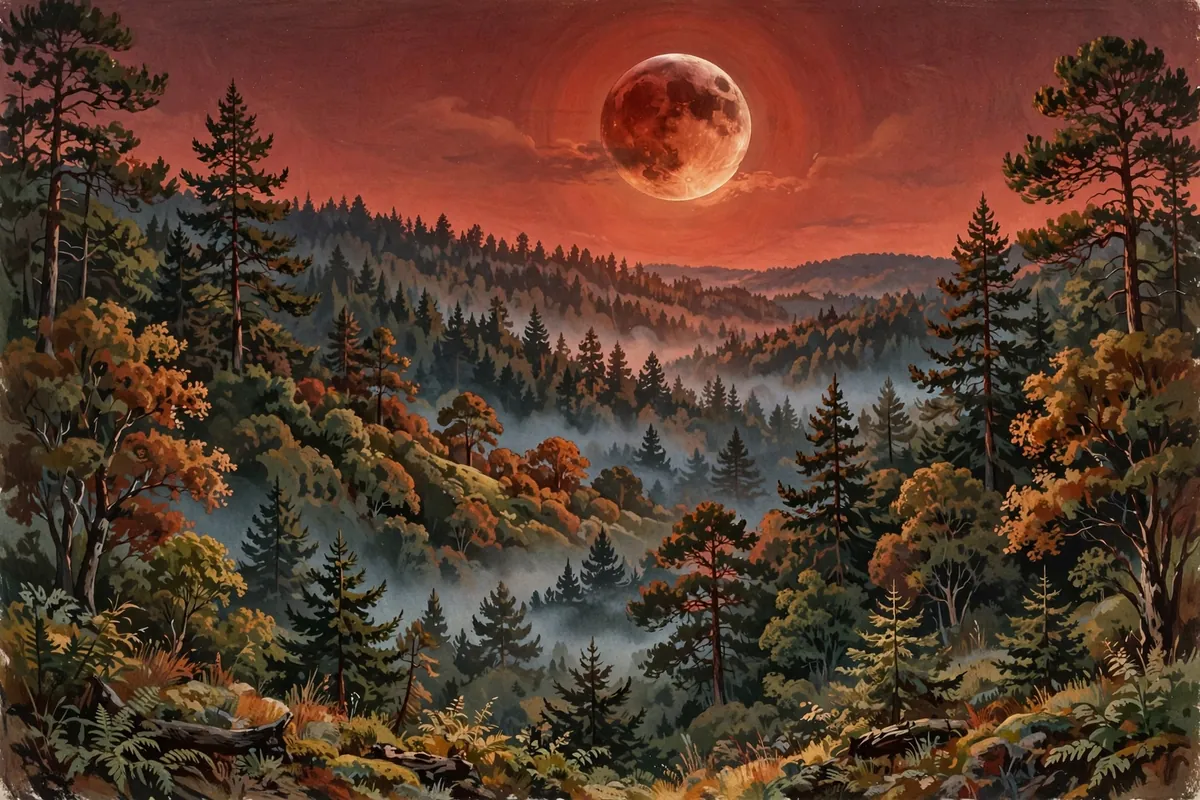
Every so often, the full Moon does something eerie. Over the course of an hour or so, a shadow creeps across its face, and then, instead of vanishing, it turns a deep, rusty red. No wonder people once saw it as an omen. Today we call it a blood moon.
A blood moon is a total lunar eclipse. It happens when Earth passes directly between the Sun and the Moon, so the Moon moves into Earth's shadow. The Moon doesn't go fully dark, because Earth's atmosphere bends some sunlight into that shadow. Along the way, the air filters out most of the blue light and lets the red through, so the Moon glows red.
Lit by Earth's Sunsets
Here's the lovely part. The light that reaches the Moon during an eclipse has passed through a long, thick slice of Earth's atmosphere. Air molecules and small particles scatter the shorter wavelengths, like blue and violet, out of the beam. The longer red wavelengths make it through.
It's the very same effect that turns our sunrises and sunsets red. In fact, if you were standing on the Moon during the eclipse, you'd see the Sun hidden behind a dark Earth ringed in red, the glow of every sunrise and sunset on our planet at that moment. A camera on the Surveyor 3 lander captured that red ring back in 1967.
If Earth had no atmosphere at all, the Moon would go completely dark during a total eclipse.
No Two Blood Moons Look Alike
The exact shade changes from one eclipse to the next. It depends on how much dust and cloud is in Earth's atmosphere. A dustier atmosphere tends to filter out even more of the other colors, leaving a deeper red. A big volcanic eruption shortly before an eclipse can make a noticeable difference.
Astronomers even rate how dark an eclipse looks using the Danjon scale, created by French astronomer André Danjon. Some blood moons are a bright copper-orange, while others are a deep, dim red that's hard to spot.
Why It Doesn't Happen Every Month
Lunar eclipses only happen during a full Moon, when the Moon is on the opposite side of Earth from the Sun. But we don't get one every month, because the Moon's path is tilted slightly compared with Earth's. Most months, the Moon slips just above or below Earth's shadow.
Eclipses happen only during eclipse seasons, when everything lines up. This century will have 228 lunar eclipses, an average of a little over two per year, though not all of them are total.
The good news is that lunar eclipses are easy to enjoy. Unlike solar eclipses, they can be seen from anywhere on the night side of Earth, they often last an hour or longer, and they're perfectly safe to watch without any eye protection. Totality alone can last close to 107 minutes.
Ancient Fears, Modern Wonder
Before science explained it, a red Moon could be frightening. The Inca believed a jaguar was eating the Moon, and people would shout and shake spears to drive it away. Ancient Mesopotamians thought seven demons were attacking the Moon and their king, so they sometimes set up a stand-in king to take the blame. In China, one story blamed a mythical three-legged toad.
Now we know the truth is gentler and just as magical. The next time a blood moon rises, step outside and take a look. That red glow is sunlight, filtered through the air we all breathe, painting the Moon with Earth's own sunsets.