If you had to sum up life on Earth for someone who had never heard of us, what would you choose? What song? What picture? What would you say? In the 1970s, a small team was handed that exact job, along with a tight deadline and a tiny budget.
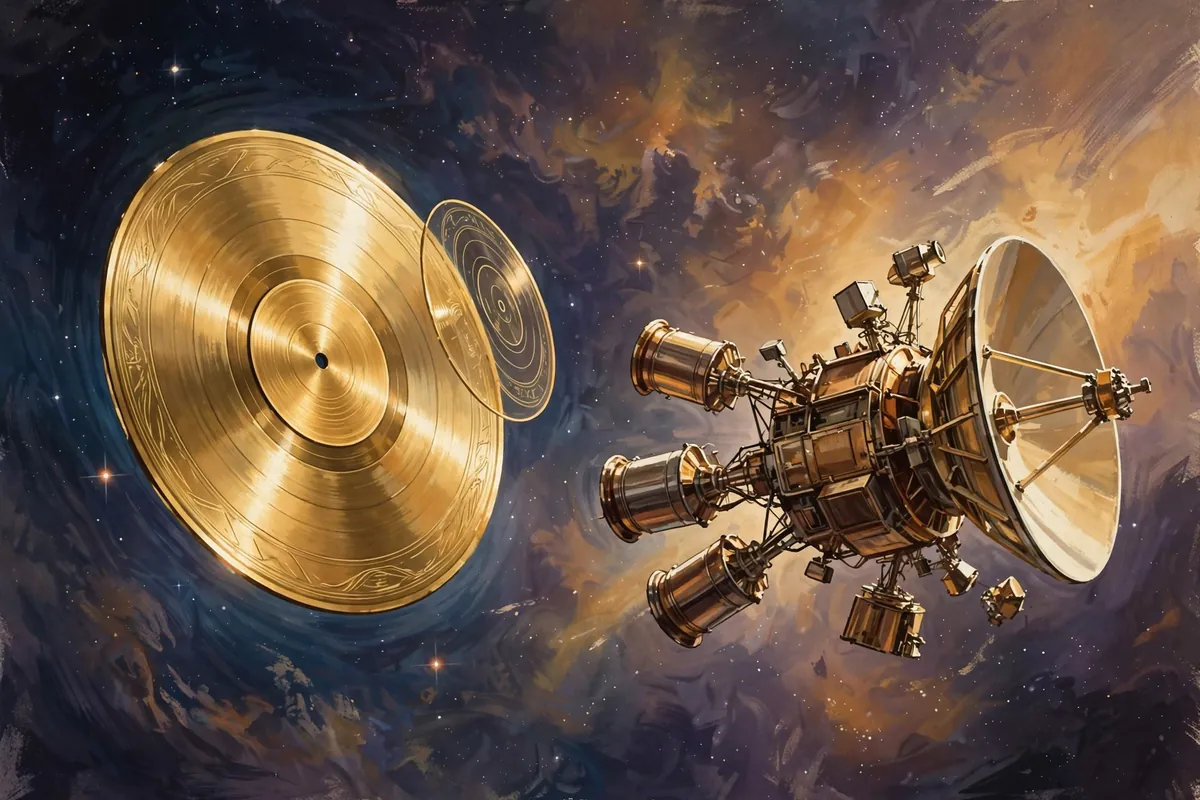
Here's the short answer: the Voyager Golden Records are two identical phonograph records, one aboard each Voyager spacecraft launched by NASA in 1977. They hold sounds, music, greetings, and images chosen to show the variety of life and culture on Earth. They're meant for any intelligent beings who might someday find them, a kind of time capsule tossed into the cosmic ocean.
A Big Job on a Small Budget
The idea came from John Casani, the Voyager project manager. He handed the task to astronomer Carl Sagan, with a budget of $1,500 for six weeks of work. Sagan and his colleagues ended up chipping in some of their own money too.
Why a record? Sagan and his colleagues realized a metal phonograph record would last far longer in space than magnetic tape. Each one is a 12-inch copper disk plated with nickel and then gold. Selecting everything that went on it took almost a year.
What's on the Record
There are 116 images, showing everything from the planets and DNA to food, architecture, and people going about their daily lives. There are natural sounds, too: surf, wind, thunder, birdsong, and whale songs. Human sounds include footsteps and laughter, and the laughter is Sagan's own.
Spoken greetings come in 55 ancient and modern languages. One is from Sagan's six-year-old son, Nick. The record also carries a printed message from President Jimmy Carter.
The music spans the globe and the centuries. Bach, Mozart, Beethoven, and Stravinsky are there, along with Louis Armstrong, Blind Willie Johnson, and Chuck Berry. Including Berry's "Johnny B. Goode" caused a stir. One team member grumbled that rock music was "adolescent." Sagan replied, "There are a lot of adolescents on the planet."
A Love Story in the Grooves
One of the most touching items is an hour-long recording of the brainwaves of Ann Druyan, the record's creative director, squeezed into about a minute of audio. While it was recorded, she thought about many things, including Earth's history, the problems civilizations face, and what it feels like to fall in love.
Instructions for Aliens
Of course, whoever finds the record will need to know how to play it. The aluminum cover shows a drawing of the record with its stylus in the right starting spot. Numbers written in binary explain how fast it should spin, using a unit of time based on the hydrogen atom, something any scientific civilization should recognize.
The cover also holds an ultra-pure sample of uranium-238. Because it decays at a known rate, a civilization that finds the record could use it to work out how long ago the record was made.
Still Traveling Today
Both Voyager spacecraft have now reached interstellar space, and Voyager 1 is the farthest human-made object from Earth. In about 40,000 years, it will pass within 1.6 light-years of a star called Gliese 445.
Sagan admitted the record would only be found and played if advanced, space-faring civilizations exist out there. But he believed launching this bottle into the cosmic ocean said something very hopeful about life on our planet. Every time you hear "Johnny B. Goode," you can smile knowing it's on its way to the stars.