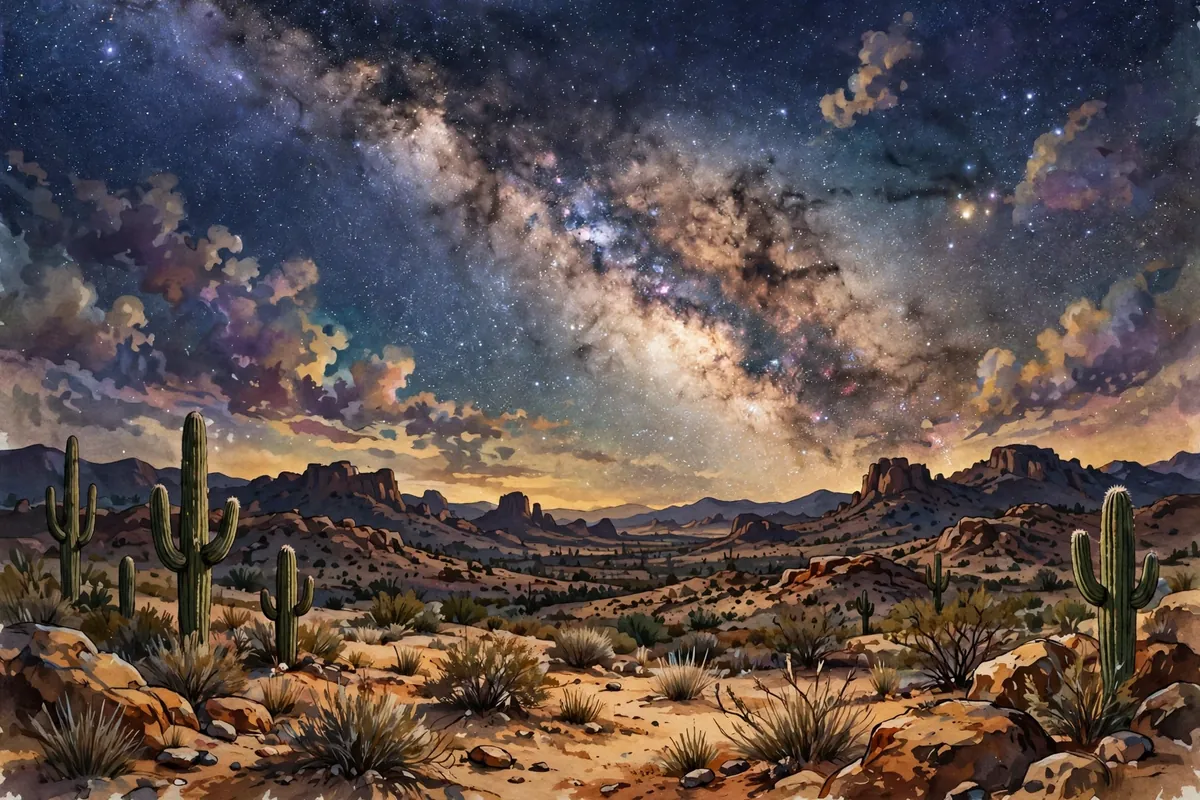
Get far enough from city lights on a moonless night and you'll see it: a soft, glowing band arching across the whole sky. It doesn't look like ordinary stars. It looks more like someone spilled a glass of milk across the darkness, which is exactly how it got its name.
The short answer: that milky glow is made of stars, an enormous number of them. They're so far away that your eyes can't pick them out one by one, so their light blends into a hazy band. What you're seeing is the disk of our own galaxy, viewed from inside it.
A Name That Started With Milk
The name Milky Way comes from the band's dim, milky appearance. It's a translation of the Latin via lactea, which in turn comes from Greek. In fact, our word galaxy comes from the Greek galaxias, meaning milky.
The Greeks even had a myth to explain it. In one version, Zeus placed his infant son Heracles at the breast of the sleeping goddess Hera so the baby would drink her divine milk and become immortal. When Hera woke and pushed the baby away, some of her milk spilled across the heavens. That spilled milk, the story goes, became the Milky Way.
Galileo Takes a Closer Look
For thousands of years, nobody could tell what the glowing band really was. That changed in 1610, when Galileo Galilei pointed his telescope at it. He discovered that the cloudy glow was actually made of a vast number of faint stars.
In 1755, the philosopher Immanuel Kant suggested that the Milky Way might be a huge, rotating collection of stars held together by gravity. Seen from inside its flat disk, it would appear as a band across the sky. He turned out to be right.
Why It's a Band, Not a Blob
Our galaxy is shaped like a flattened disk with spiral arms, and our solar system sits inside that disk, about 27,000 light-years from the center. When you look along the disk, your line of sight passes through countless distant stars, and they pile up into that glowing stripe.
Look away from the disk, and there are far fewer stars in the way. That's why the Milky Way looks like a river crossing the sky rather than a glow spread evenly everywhere. Every star you can see with the naked eye is part of our galaxy, but only that crowded band gets called the Milky Way.
The dark patches inside the band have a story too. Areas such as the Great Rift and the Coalsack are places where interstellar dust blocks light from the stars behind it. Some peoples of the Southern Hemisphere, including the Inca and Aboriginal Australians, saw shapes in these dark clouds and treated them as constellations.
Bigger Than Anyone Imagined
The Milky Way is estimated to hold 100 to 400 billion stars and stretches roughly 87,000 light-years across. At its center sits a supermassive black hole called Sagittarius A*. And until the early 1920s, most astronomers thought our galaxy contained every star in the universe. Then observations by Edwin Hubble in 1923 showed it was just one of many galaxies.
How to See It Yourself
The Milky Way is faint, so light pollution and moonlight can wipe it out. More than one-third of the world's population can't see it from home because of artificial light. Your best bet is a rural spot on a night when the Moon is below the horizon.
Give your eyes some time to adjust, look up, and enjoy the view. That spilled milk is really the glow of billions of distant suns, and you're seeing your home galaxy from the inside.