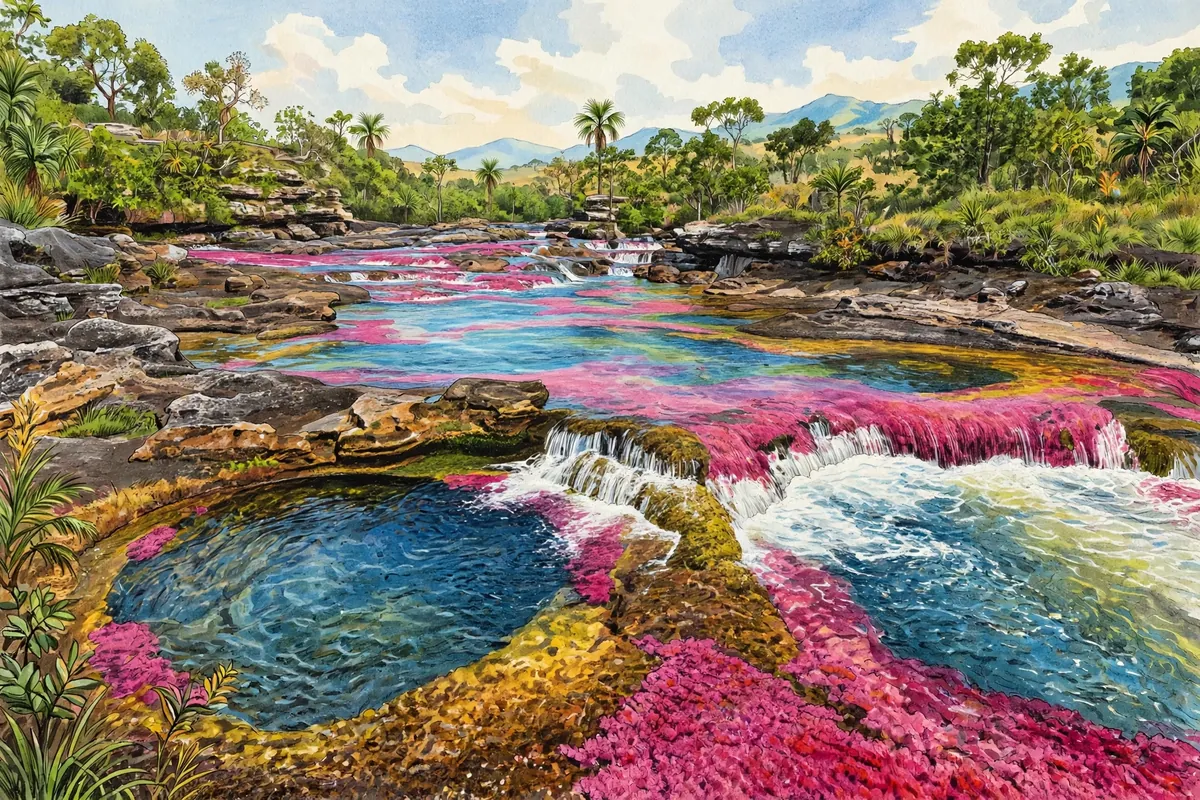
Most rivers are some shade of blue, green, or muddy brown. But tucked away in an isolated mountain range in Colombia is a river that looks almost unreal. For a few months each year, its bed bursts into bright red and pink, with patches of yellow, green, blue, and black mixed in.
The river is called Caño Cristales, Spanish for "Crystal Channel." People also call it the "River of Five Colors" or the "Liquid Rainbow." The star of the show is the red, and it's caused by a water plant called Rhyncholacis clavigera that grows on the riverbed. It's found in Caño Cristales and only a few other rivers in the region.
A Plant That Changes Color
This little plant, often known by its old name Macarenia clavigera, starts out green when it's young. Then it turns yellowish, and finally it becomes various shades of red. It clings tightly to rocks in the parts of the river where the current runs fastest.
It belongs to a family called riverweeds, plants built for life in rapids and waterfalls. Their roots are specially shaped to grip rock. When the water drops in the dry season, riverweeds can live in the open air, and that's when they flower. Many riverweeds live in just one river or even a single waterfall, which makes them vulnerable when their habitat changes.
When to See the Rainbow
The colors don't last all year. The best display comes after the rainy period, roughly from late June or July through November. That's when the red-pink color of the riverbed is at its most striking.
It helps that the water is remarkably clear. Caño Cristales carries very few nutrients and small particles, so you can see straight down to the colors on the bottom. The river itself is fast-flowing, with lots of rapids and waterfalls.
Ancient Rocks and Stone Kettles
The river runs over quartzite rock that formed about 1.2 billion years ago, part of an ancient formation called the Guiana Shield. Along the riverbed are small round pits called giant's kettles.
They form in a clever way. When a hard pebble falls into a little hollow, the current spins it around and around. The pebble grinds away at the walls, slowly making the pit bigger and rounder over time.
A Hidden Treasure
Caño Cristales flows through the Serranía de la Macarena, a mountain range about 75 miles long. It's protected as a national park, and it sits where three great natural regions meet: the Andes, the vast grasslands called the Llanos, and the Amazon rainforest. That meeting point gives the area a huge variety of life, from jaguars and anteaters to hundreds of kinds of birds.
The river was found in 1969 by a group of cattle farmers. For years it was little known to the outside world, but it has since become a tourist destination, with more than 16,000 visitors in 2016. You may have heard it has no fish, but that's not true. It's home to several kinds of fish, plus freshwater turtles and other water creatures.
So yes, the river of five colors is real, and it's even more special than it looks in photos. Its rainbow depends on one fragile little plant, a crystal-clear current, and just the right season. It's a reminder that some of the world's most beautiful sights are also its most delicate.