Most of us think of a hundred years as a very long life. Yet high in the mountains of California, there's a pine tree that, by most estimates, was already growing before the Great Pyramid of Giza was built. How does any living thing last that long?
Here's the short answer: the oldest trees survive by living slowly and wasting very little. The record-holding bristlecone pines grow in cold, dry, nutrient-poor places where even decay happens slowly. Very old trees can let most of their living tissue die back and carry on with just a narrow lifeline. Other ancient trees take a different route entirely: they clone themselves, sprouting new trunks from the same roots for thousands of years.
Meet Methuselah
The oldest known single tree is a Great Basin bristlecone pine called Methuselah, in the White Mountains of eastern California. It grows at around 9,500 to 9,800 feet above sea level and is about 4,858 years old. Its name comes from the biblical figure said to have lived 969 years.
Researchers Edmund Schulman and Tom Harlan sampled it in 1957 and estimated that it sprouted around 2833 BC. Not everyone agrees on the exact figure. Another tree-ring expert couldn't reproduce that estimate because a core sample is missing, and put its age closer to 4,669 years. For years, the U.S. Forest Service kept the tree's location secret to protect it.
The Bristlecone's Secrets
Bristlecones look like survivors, gnarled and stunted with twisted branches. Their old age is linked to harsh weather and a lack of nutrients, which slow down decay. Their wood is so durable that dead trees as old as 7,000 years can still stand beside living ones.
As a bristlecone ages, much of the living layer under its bark can die. In very old trees, often just a narrow strip of living tissue connects the roots to a handful of live branches. They're thrifty with their needles, too. Some stay green for 45 years, among the longest of any plant.
Trees That Clone Themselves
Some of the oldest trees on Earth cheat time by starting over. Old Tjikko, a Norway spruce in Sweden, is about 9,568 years old as a plant, but its current trunk is only a few centuries old. When a branch touches the ground, it can sprout roots, and when a trunk dies, the living root system can send up a new one.
In Utah, a quaking aspen named Pando takes this to another level. It has an estimated 47,000 stems that look like separate trees, but they're all genetically identical parts of one organism joined by a single root system spread over 106 acres. A 2024 estimate puts it at 9,000 to 16,000 years old. It has survived fires that would have leveled it many times, then regrown.
What About Ancient Olive Trees?
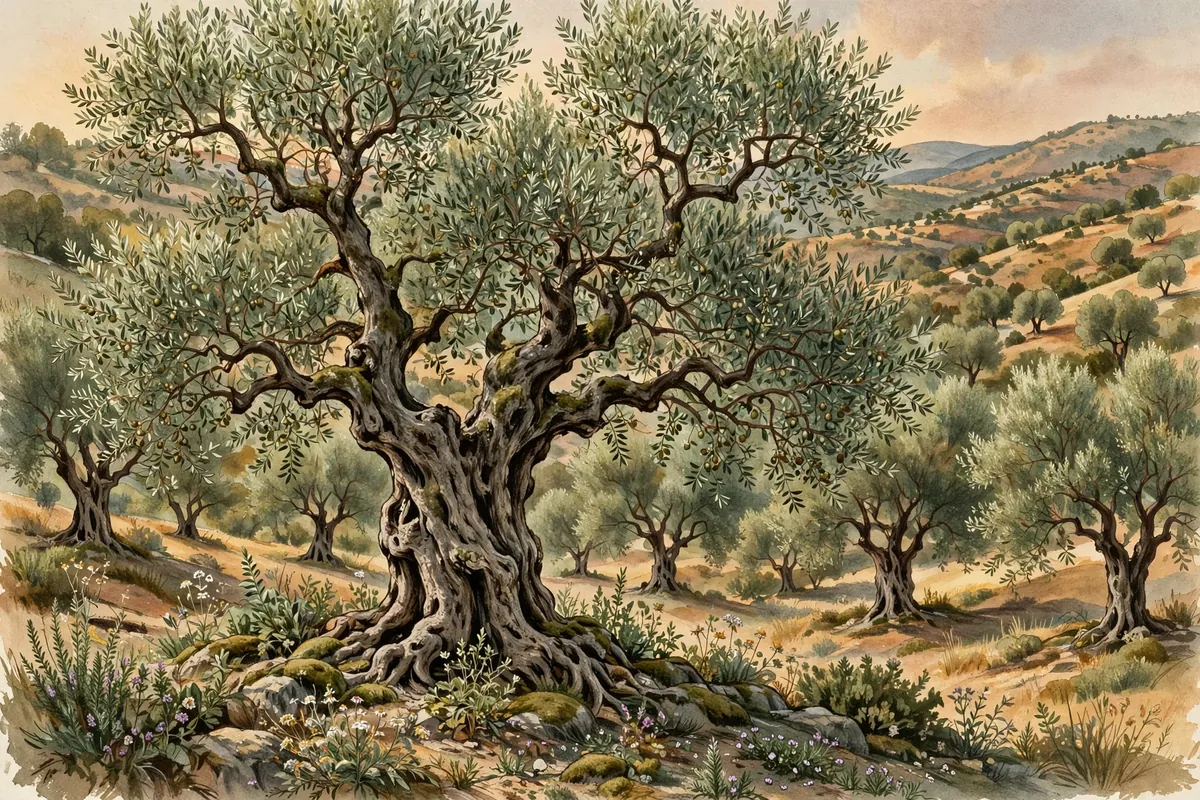
Olive trees have been admired for their toughness since ancient times, and some are said to be thousands of years old. One in Portugal has a claimed age of 3,350 years. But olives are hard to date. They can have missing tree rings, hollow trunks, and several stems. Studies combining tree rings and radiocarbon dating suggest maximum ages of 300 to 500 years, with some reaching up to 700.
They're remarkably resilient, though. When extreme cold kills the parts above ground, the rootstock can survive and send up new shoots that grow into new trees.
So the secret to a long life, at least for a tree, isn't growing big and fast. It's patience, toughness, and a willingness to start over. Not bad advice for the rest of us, either.