Stars are unimaginably far away. Even the closest ones would take thousands of years to reach with today's spacecraft, and we certainly can't scoop up a sample. Yet astronomers confidently say the Sun is mostly hydrogen and helium. How could anyone possibly know that?
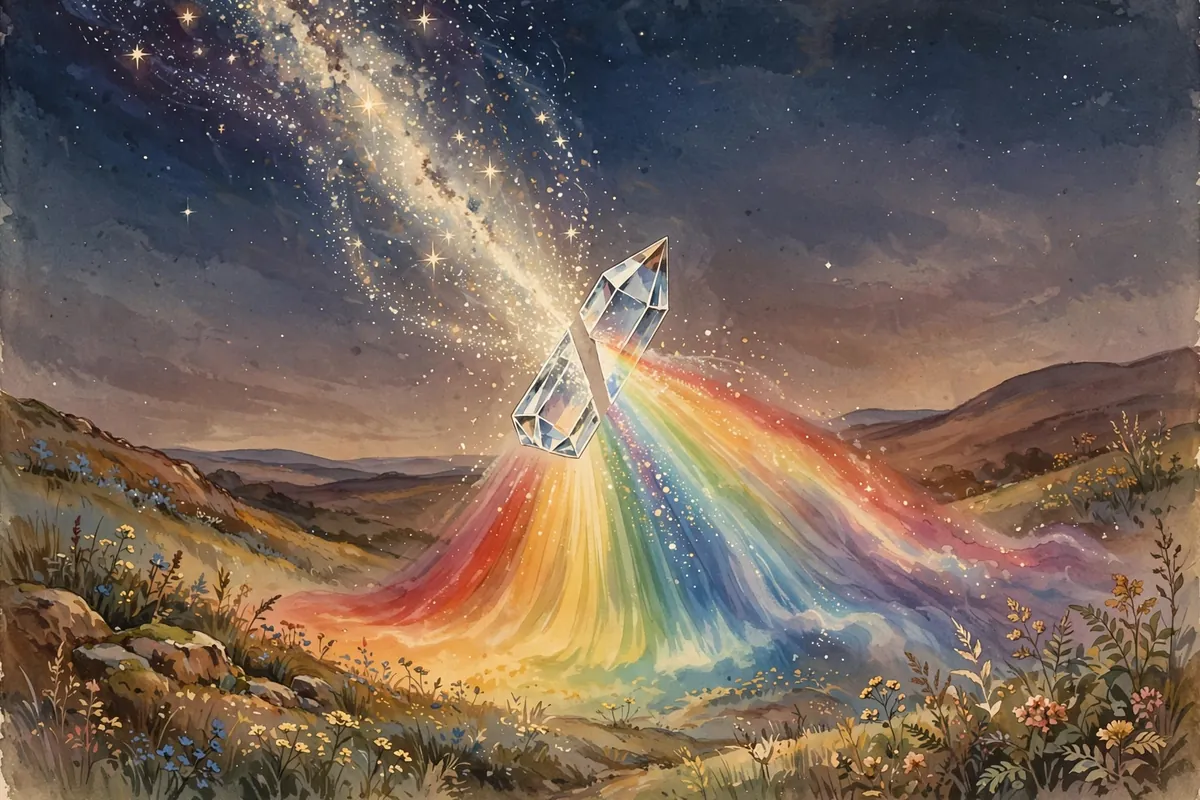
The answer is in the light. When starlight is spread out into a rainbow, called a spectrum, it's crossed by thin dark lines. Each chemical element absorbs light at its own particular colors, leaving a pattern like a fingerprint or a barcode. By matching those patterns to elements tested in labs on Earth, scientists can tell what a star contains.
A Prediction That Aged Badly
In the 1800s, the French philosopher Auguste Comte wrote that people would never learn the chemical makeup of the stars. It seemed like a safe bet. How do you study something you can never touch?
It turned out to be one of science's more famous wrong predictions. Within about thirty years, scientists were already starting to work out what stars were made of, using a technique called spectroscopy.
Mysterious Dark Lines
The story starts with Isaac Newton, who used a prism to split white light into a spectrum of colors. In the early 1800s, a German glassmaker named Joseph von Fraunhofer built extremely pure prisms. Looking at sunlight through them, he spotted 574 dark lines cutting through the rainbow. He also studied the light of the Moon, planets, and stars such as Betelgeuse.
Nobody knew what the lines meant until the 1850s. That's when Gustav Kirchhoff and Robert Bunsen, the chemist whose name lives on in the Bunsen burner, figured it out. They noticed that heated chemical elements give off light at specific colors, and that many of those colors matched the Sun's dark lines exactly. Their conclusion: the lines were caused by elements in the Sun's atmosphere absorbing light.
An Element Found in the Sun First
The method soon delivered a stunning surprise. During a solar eclipse in 1868, astronomers spotted a bright yellow line in the Sun's light that didn't match any known element. English astronomer Norman Lockyer concluded it came from something unknown on Earth.
He named it helium, after the Greek word for the Sun, helios. It wasn't found on Earth until 1895. Helium is the gas in party balloons, and it was discovered in the Sun before anyone found it here.
The Thesis That Changed Astronomy
Even then, scientists assumed stars were made of roughly the same stuff as Earth. In 1925, a young astronomer named Cecilia Payne, working at the Harvard College Observatory, showed otherwise. In her doctoral thesis, she concluded that stars are made mostly of hydrogen and helium.
Her idea clashed with the thinking of the day, and leading astronomers pushed back. Henry Norris Russell, one of the most respected of them, urged her not to claim the Sun was mostly hydrogen. Four years later, he reached the same result by a different route. Decades on, astronomer Otto Struve called her work “the most brilliant PhD thesis ever written in astronomy.” Today, the Milky Way is estimated to be about 74 percent hydrogen and 24 percent helium, just as her work pointed to.
So the next time you see a rainbow after a storm, remember that the same kind of colorful band, studied closely, lets us read the recipe of stars across the universe.