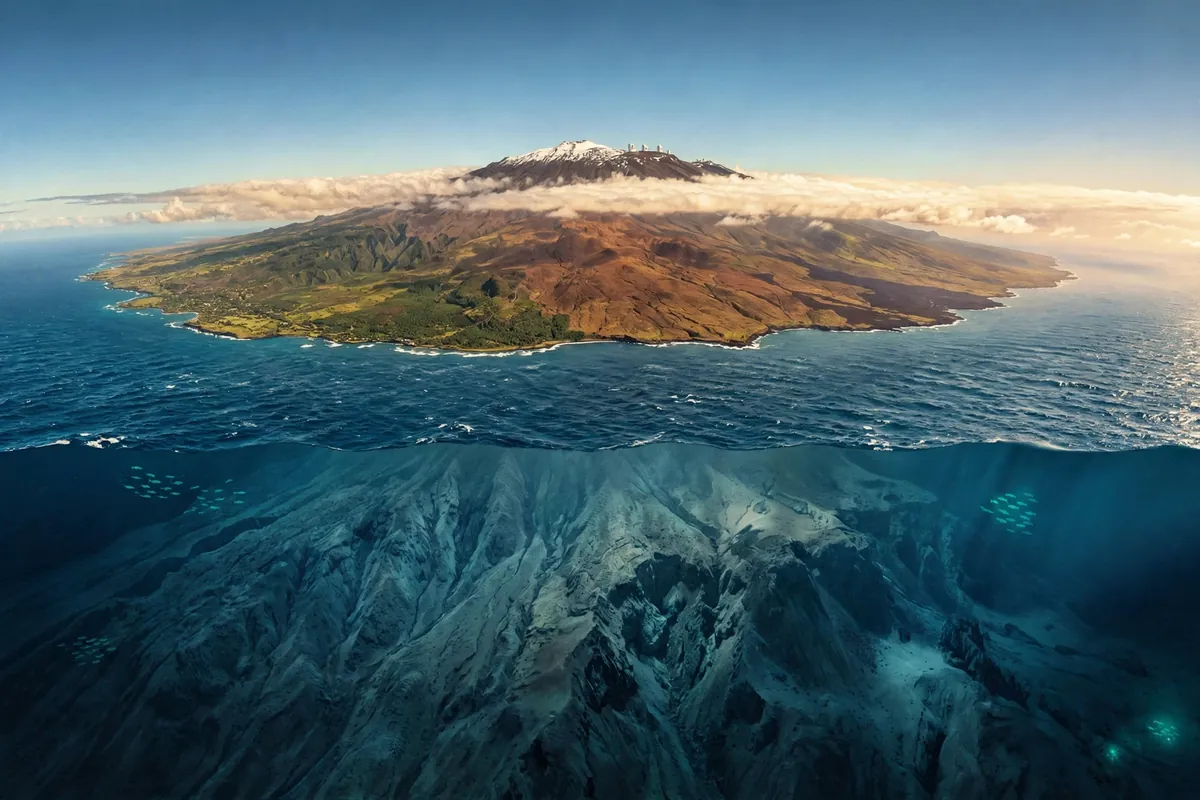
Mount Everest is the undisputed champion of height, right? At about 29,032 feet above sea level, nothing on Earth reaches higher into the sky. But there's a Hawaiian mountain with a sneaky claim to the title, and it all comes down to where you start measuring.
That mountain is Mauna Kea, on the Big Island of Hawaii. Its peak stands 13,803 feet above sea level, less than half of Everest's height. But Mauna Kea starts deep beneath the ocean. Measured from its underwater base, it rises about 30,610 feet, which is more than Everest's height above sea level. That's why some experts call it the tallest mountain in the world.
Most of the Mountain Is Hidden
When you visit Mauna Kea, you're only seeing the top portion. The Hawaiian Islands slope steeply down into the deep Pacific, so the bulk of the mountain is underwater, out of sight.
Scientists measure this with something called prominence, a way of judging how much a peak rises above the land around it. Mauna Kea's prominence from the ocean floor is rivaled only by Everest. As one description puts it, Everest would have to count whole continents as its foothills to beat Mauna Kea on this measure.
Built by a Hotspot
Mauna Kea is a volcano, one of five that make up the island of Hawaii. Like all Hawaiian volcanoes, it was created as the Pacific tectonic plate slowly moved over a hotspot, a source of heat deep in Earth's mantle.
Over about 70 million years, that same process built a chain of islands and undersea mountains stretching some 3,700 miles. Mauna Kea itself is around a million years old. Its last eruption was thousands of years ago, though scientists don't consider it finished for good.
Snow in the Tropics
Here's a surprise: this tropical mountain has seen glaciers. During past ice ages, snow stayed on the summit through the summer and built up into an ice cap. Mauna Kea is the only Hawaiian volcano with clear evidence of glaciation.
Its name reflects that frosty side. Mauna Kea is short for Mauna a Wākea and means “white mountain,” a nod to its seasonally snow-capped summit. In Hawaiian tradition, the summit was seen as a sacred place, home to Poliʻahu, the deity of snow.
Ancient Hawaiians living on its slopes relied on its forests for food and quarried its dense volcanic rock to make tools. After Europeans arrived in the late 1700s, settlers brought cattle, sheep, and game animals, and many of them went wild and damaged the mountain's natural balance.
A Window on the Stars
With its high altitude, dry air, and steady airflow, Mauna Kea's summit is one of the best places in the world for astronomy. Since an access road was built in 1964, thirteen telescopes funded by eleven countries have gone up there. Building on a landscape that many Native Hawaiians consider sacred remains a topic of debate.
There's even a third contender in the “highest mountain” debate. Ecuador's Chimborazo is far shorter than Everest, but because Earth bulges at the equator, its summit is widely reported to be the farthest point on the surface from the planet's center.
So who's really the tallest? Everest wins from sea level, Mauna Kea wins from its base, and Chimborazo wins from Earth's center. It's a nice reminder that the answer often depends on how you ask the question.