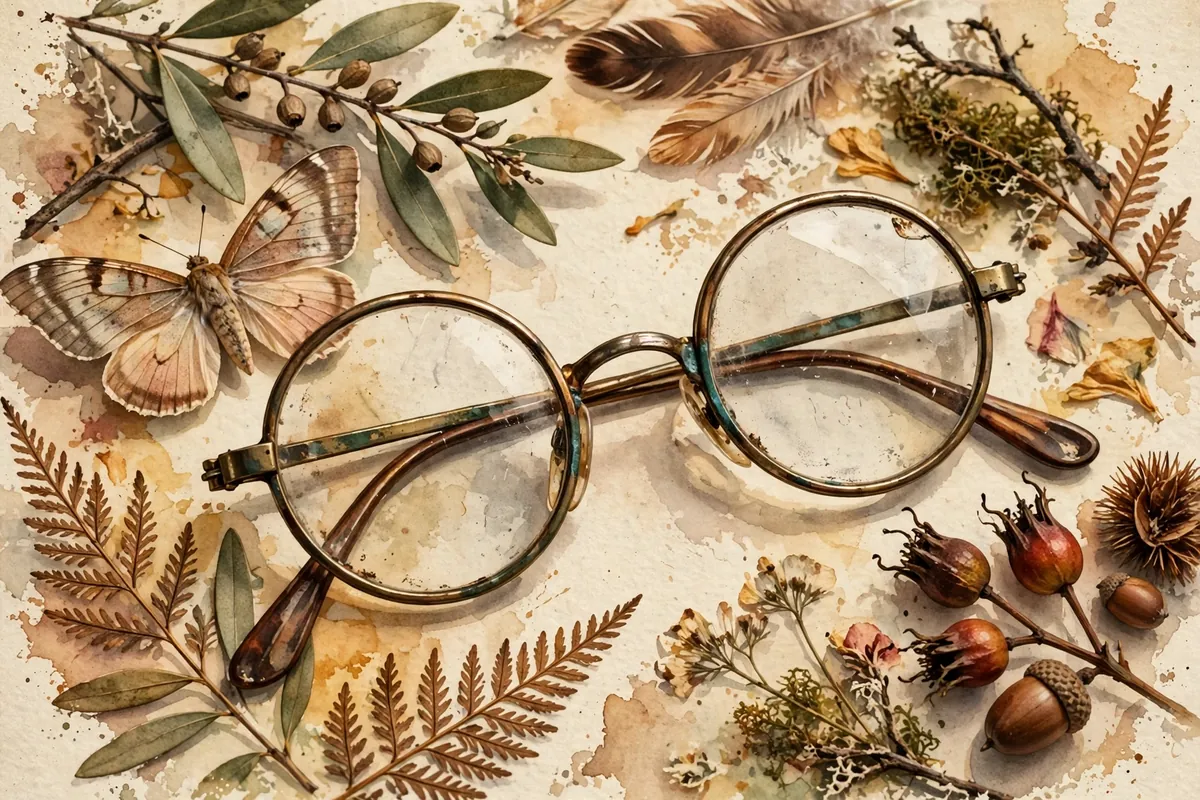
For millions of us, reading glasses are as everyday as a coffee cup. We leave them on our heads, lose them in the couch, and buy spares at the drugstore. But for most of human history, people whose eyes blurred with age simply had to live with it.
Eyeglasses were invented in central Italy, most likely in Pisa or Florence, around 1290. Nobody knows exactly who made the first pair. What we do know comes from a friar who said he met the inventor, and another friar who copied the idea and shared it freely.
The Sermon That Dated an Invention
On February 23, 1306, a Dominican friar named Giordano da Pisa gave a sermon. He said it was not yet 20 years since the art of making glasses for good vision had been discovered, and that he had seen and spoken with the man who first made them.
The inventor apparently kept the secret to himself. A chronicle from a Dominican monastery in Pisa says that Friar Alessandro della Spina made eyeglasses after someone else had made them first but refused to share. Spina, it says, made them and shared them with everyone with a cheerful and willing heart.
You may read elsewhere that a Florentine named Salvino degli Armati invented glasses. That claim, made in the 1600s, has been shown to be wrong.
Before Glasses: Reading Stones
The ancestors of eyeglasses were reading stones, used in Italy in the 1200s. These were magnifying lenses that readers held right over the page. Because they had no frames or arms at all, you had to hold one in your hand the whole time you read.
The science behind them was older still. The idea of using a curved lens to magnify was likely described by the ancient scholar Ptolemy and improved on by Arab scientists, especially Alhazen, around 1021. There are even scattered hints from Roman times: Pliny the Elder mentioned Emperor Nero using an emerald as a visual aid.
Glasses Catch On
Venice quickly became a center of eyeglass making, thanks to the fine glass made on the island of Murano. By 1301, Venice had rules governing the sale of glasses, and in 1320 a separate guild of spectacle makers was formed.
The oldest known picture of someone wearing glasses is a 1352 painting by Tommaso da Modena, showing a cardinal reading. Those early glasses had convex lenses, which help with farsightedness and the blurry close-up vision that often comes with age. Lenses for nearsightedness appeared in the mid-1400s.
The poet Petrarch wrote that he didn't need glasses until he was 60, a sign of how common they had become by the 1300s.
Arms, Bifocals, and Beyond
Here's a detail that surprises most people. The arms that hook over your ears weren't invented until the 1700s. For centuries, people had to perch their glasses on their noses or hold them in place.
Benjamin Franklin, who was both nearsighted and farsighted, invented bifocals. In 1825, British astronomer George Airy designed the first lenses to correct astigmatism. Meanwhile, Johannes Kepler had explained in 1604 exactly why convex and concave lenses work.
So the next time you push your reading glasses up your nose, tip your hat to an unknown Italian craftsman and a generous friar. Thanks to them, the fine print has been a lot easier for about 700 years.