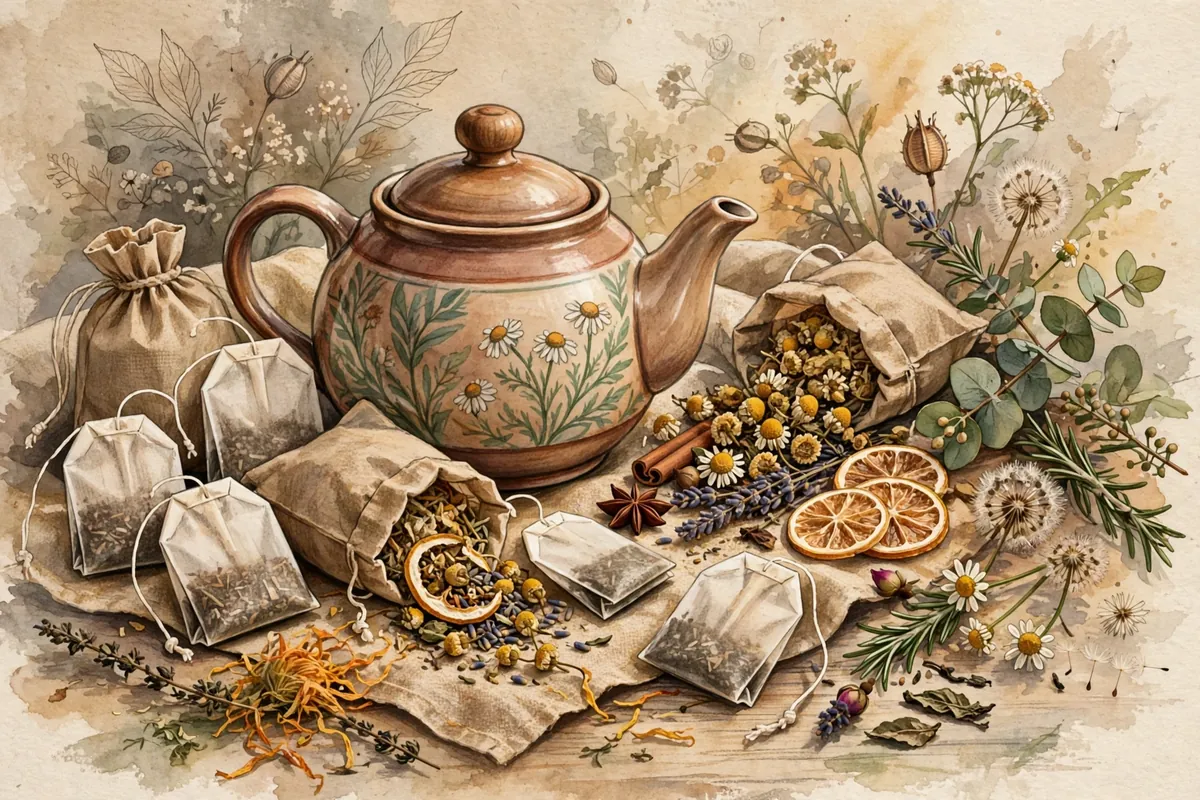
It's one of the most charming stories in kitchen history. Around 1908, a New York tea merchant named Thomas Sullivan sent samples of tea in small silk bags. His customers, the story goes, didn't realize they were supposed to empty the bags, so they dropped them right into hot water. And just like that, the tea bag was born. But is it true?
Not quite. The accidental-invention story is best described as a popular legend. Two women from Milwaukee, Wisconsin, Roberta Lawson and Mary McLaren, filed a patent for a "Tea Leaf Holder" in 1901, years before Sullivan's bags. They received U.S. patent 723287 in 1903. Sullivan does deserve credit for something important, though: he was among the first to market tea bags successfully.
The Real Early Tea Bags
The first modern tea bags were hand-sewn fabric pouches. They appeared commercially around 1904. Around 1908, Sullivan, a tea and coffee importer, began shipping his silk tea bags around the world.
That's where the legend comes in. Supposedly, his customers were meant to remove the loose tea from the bags, but they found it easier to brew the tea with the leaves still inside. Whether that actually happened is uncertain, but the idea of a ready-to-steep pouch had clearly already occurred to others.
It helps to remember what a tea bag really is. It does the same job as a tea infuser, the little strainer people had long used to hold loose leaves in the pot. A bag simply makes that strainer small, cheap, and disposable, which is why the idea occurred to more than one inventor.
From Silk Sacks to Paper Rectangles
Early tea bags looked like tiny sacks. In 1929, Adolf Rambold invented the first automatic tea bag packing machine, called the Pompadour, for the German company Teekanne. It could produce 35 gauze tea bags a minute.
In 1930, William Hermanson patented the heat-sealed paper fiber tea bag. Surprisingly, the familiar rectangular tea bag didn't arrive until 1944. In 1949, Rambold came up with another machine that made double-chamber tea bags, designed to let water flow through better. Its successor, introduced in 1990, could turn out up to 400 bags a minute.
Today, most tea bags are made of filter paper, a blend of wood and plant fibers. Part of that comes from abaca, a banana plant grown for its fiber, mostly in the Philippines and Colombia.
The British Took Their Time
You might expect Britain, famous for its love of tea, to have embraced the tea bag first. In fact, it came late. Tetley was the first company to sell tea in tea bags in the United Kingdom, in 1953. Decades later, in 1989, Tetley launched round tea bags after extensive testing of British preferences.
By 1990, Tetley was producing 20 billion tea bags a year, second in the world only to Lipton.
A Modern Twist
Even humble tea bags have been in the news recently. Many contain a little plastic to help seal them shut. In 2017, a gardener in Wrexham, in Wales, noticed that tea bags left plastic residue after composting and started a petition. Soon several brands announced plans to remove plastic from their bags, with one switching to a corn starch adhesive.
So the tea bag wasn't quite a happy accident, but it was a clever idea that several people chased at once. The next time you dunk one into your mug, give a quiet nod to two inventors from Milwaukee who saw it coming.