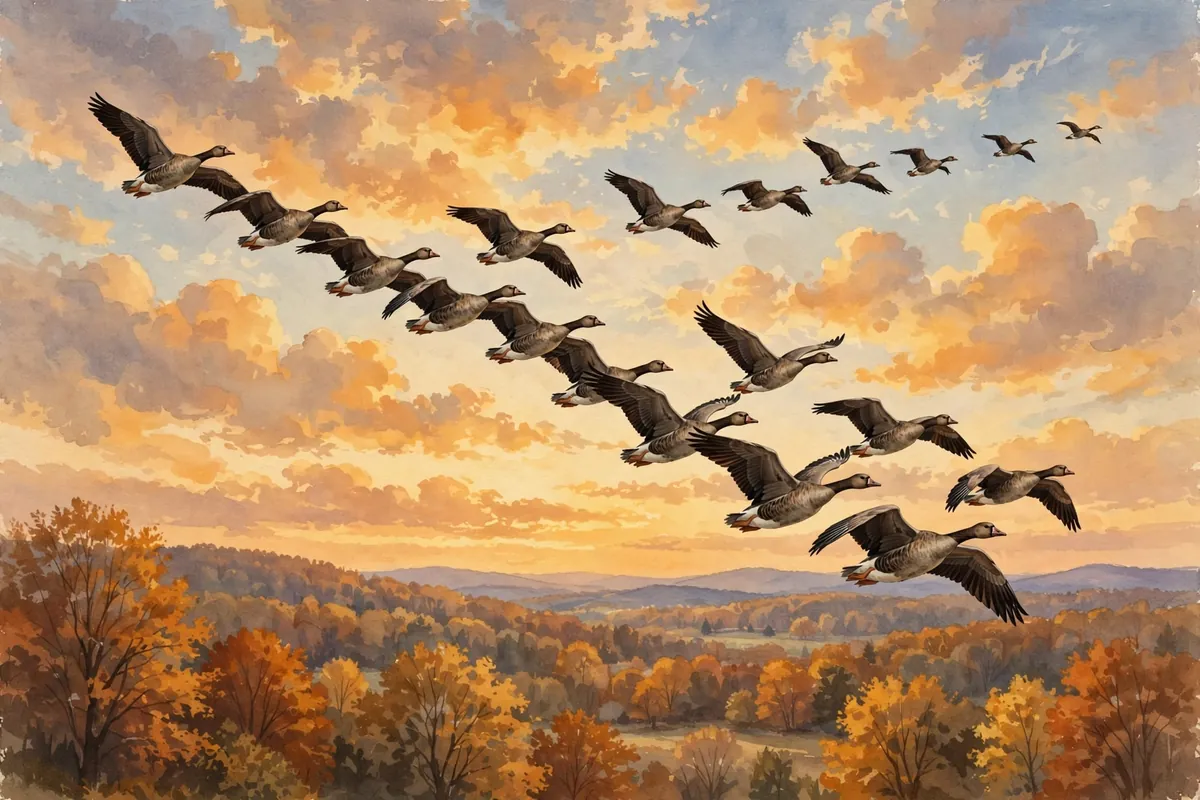
Look up on a crisp fall day and you might hear them before you see them: a noisy line of geese stretched across the sky in a neat V. It's one of the classic signs that the seasons are changing. But why that shape, and not a clump or a straight line?
The leading idea is that the V helps birds save energy. As a bird flaps, air swirls off the tips of its wings and creates a little rising current just behind and to the side. A goose tucked into that spot gets a free bit of lift, a bit like a glider riding warm, rising air. Scientists are still debating the details, but the energy-saving theory is the best known.
Riding the Air of the Bird in Front
That rising air is called upwash. It helps each bird hold up its own weight, so it doesn't have to work quite as hard. Scientists suspect the birds find the sweet spot either by sight or by feeling the airflow with their feathers.
The math behind it is striking. A 1970 paper calculated that in a V of 25 birds, each one could cut the drag it has to fight and increase its range by 71 percent. That's a big deal for birds that travel long distances between their summer and winter homes.
How Scientists Tested It
Real birds are harder to study than equations, so researchers got creative. In a study published in the journal Nature in 2001, scientists trained pelicans to fly behind a motorboat and fitted them with trackers.
The results backed up the theory. Pelicans flying alone had higher heart rates and flapped their wings more often than pelicans flying at the same speed in a V formation. Flying together was simply easier.
There's also a second idea. Some researchers think the V is the shape that best lets a large flock fly close together without anyone getting bumped around by the swirling air of the bird ahead, while still giving each bird a clear view of its neighbors. The two ideas may well work together.
It's All in the Timing
Position isn't the only trick. Studies of ibises flying in formation found that the birds behind match the timing of their wingbeats to the bird in front, so they keep riding its trail of rising air.
When a bird ends up directly behind another, where the air is pushed downward instead, it flips its flapping pattern to avoid that downwash. The V also isn't rigid. In the ibis study, some birds preferred the left side, some the right, and some the middle, and the shape kept shifting.
Taking Turns at the Front
Somebody has to fly at the point of the V, and that spot gets no free ride. For Canada geese, the front position is rotated, since flying in front uses the most energy. It's teamwork in the most literal sense.
Canada geese usually migrate at an altitude of about 3,000 feet. Their maximum ceiling isn't known, but they have been reported as high as 29,000 feet.
Pilots Took Notes
Humans have borrowed the idea. The V, or “Vic,” is a basic formation for military aircraft and a favorite at air shows. NASA has studied automatic formation flying to save fuel, aiming for a 10 percent savings, and its test data suggested savings as high as 15 percent were possible.
So the next time a honking V passes overhead, give those geese a little credit. They're sharing the work, timing every flap, and taking turns at the hardest job, all without a single word of instruction. Not bad for a bird that also likes to chase people across the park.