When you ask your phone for directions or watch the little blue dot follow your car, it feels like simple technology. But behind that dot is one of the strangest ideas in physics. Without it, the Global Positioning System would drift off course quickly.
Here's the short answer: GPS works by timing signals from satellites very precisely, and Einstein's theories of relativity say clocks in orbit don't tick at the same rate as clocks on the ground. Together, the effects make satellite clocks run about 38 microseconds a day fast compared with clocks on Earth. GPS is designed to correct for that difference.
GPS Is Really a Timing System
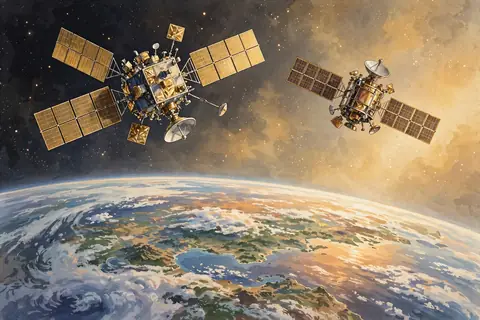
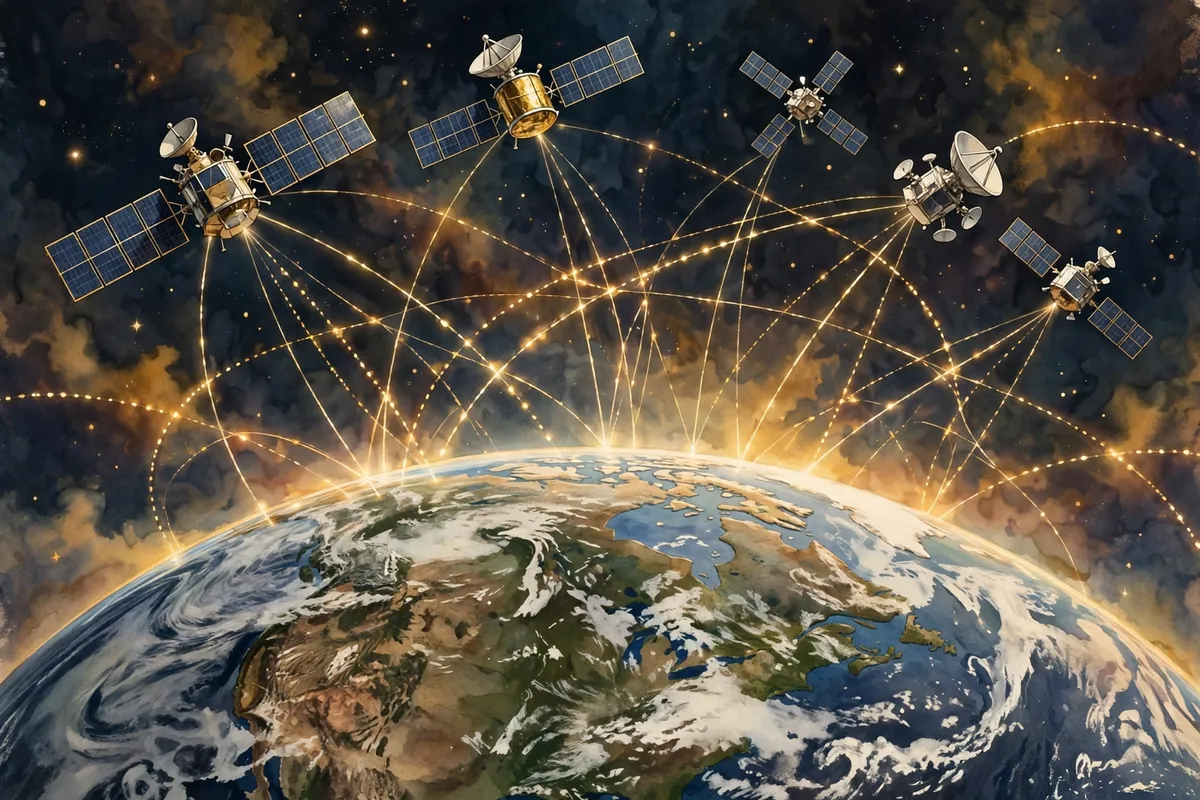
Each GPS satellite carries extremely stable atomic clocks and constantly broadcasts the time. Your receiver notes when the signals arrive from at least four satellites. Because radio signals travel at the speed of light, the delay tells the receiver how far away each satellite is, and from that it works out your position.
The catch is that light is incredibly fast, covering roughly a thousand feet in a single microsecond. So a timing error of just a few millionths of a second can throw off a position by a long way. The clocks must agree with astonishing precision.
Two Einstein Effects Pulling in Opposite Directions
The first effect comes from special relativity: the faster something moves, the slower its time runs. GPS satellites race around Earth, so their clocks lose about 7 microseconds per day compared with clocks on the ground.
The second effect comes from general relativity: clocks closer to a massive body like Earth tick more slowly. Your phone sits deep in Earth's gravity, while the satellites orbit high above. That makes the satellite clocks gain about 45 microseconds per day.
Put them together and the gravity effect wins. The satellite clocks end up running about 38 microseconds faster each day than clocks on Earth. That sounds tiny, but left uncorrected it would pile up day after day.
The Fix Happens Before Launch
Engineers solve the problem in a clever way. Before each satellite is launched, its clock is deliberately set to run slightly slow. Instead of the standard 10.23 megahertz, it's tuned to 10.22999999543 megahertz. Once the satellite reaches orbit, relativity speeds it up to exactly the right rate as seen from the ground.
Interestingly, during GPS's early development, some people believed relativity wouldn't matter. A 1971 test changed minds. Physicist Joseph Hafele and astronomer Richard Keating carried four atomic clocks around the world on commercial airliners, and when the clocks were compared afterward, their differences matched what relativity predicted. Back in 1955, physicist Friedwardt Winterberg had even proposed putting atomic clocks on satellites to test Einstein's theory.
From Military Tool to Your Dashboard
The U.S. Department of Defense started the GPS project in 1973, and a full set of 24 satellites became operational in 1993. After a Korean Air Lines passenger jet was shot down in 1983 when it strayed into Soviet airspace, President Ronald Reagan directed that GPS be made freely available for civilian use.
Today, GPS counts as a real-world, everyday application of Einstein's theory of relativity. So the next time your phone tells you to turn left in 500 feet, you can thank a physicist who never saw a satellite, and the engineers who took his ideas seriously.