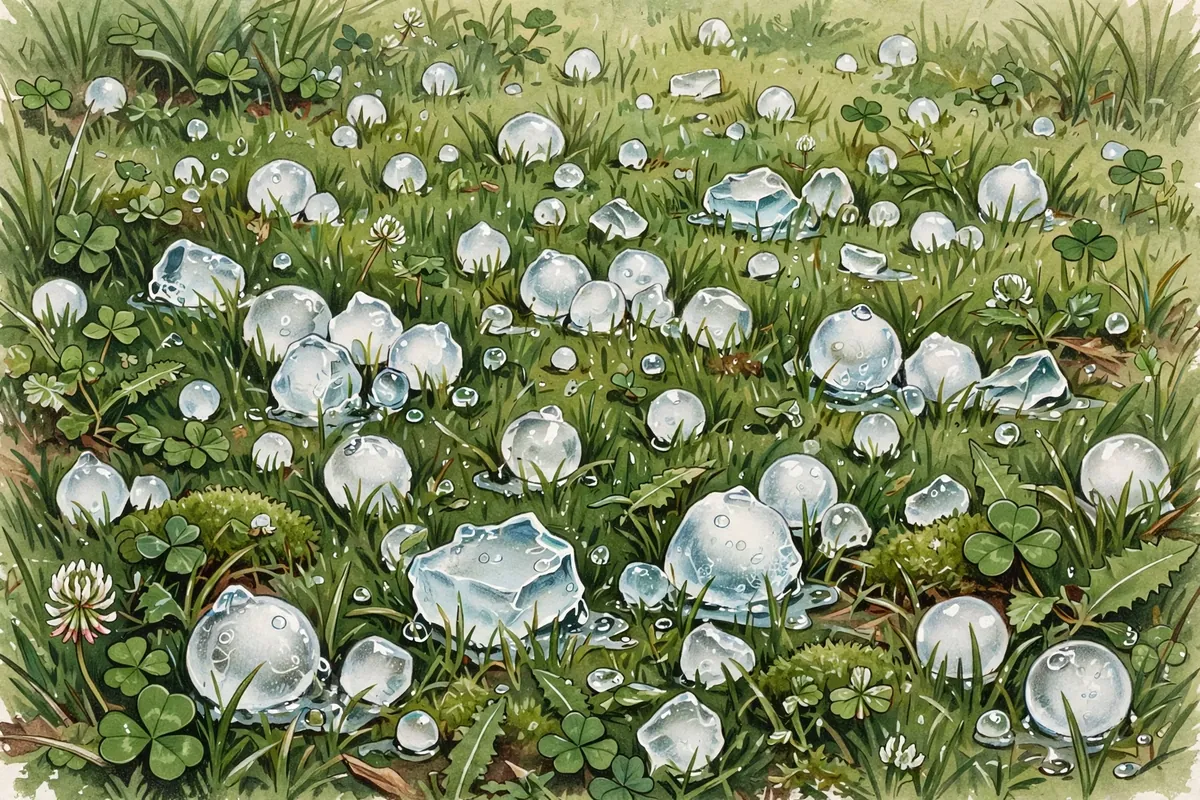
It's a warm summer afternoon, and suddenly chunks of ice are bouncing off the driveway and denting the car. How can a thunderstorm drop ice when it's 80 degrees outside? The answer lies miles overhead, inside the storm itself.
Hail forms inside strong thunderstorms with powerful updrafts, where much of the cloud is below freezing. A tiny frozen droplet gets swept upward and collects layers of ice as it meets supercooled water, which is water that stays liquid below freezing. It keeps growing until it's too heavy for the updraft to hold, and then it falls.
A Ride on a Powerful Updraft
Hail starts like other precipitation, as droplets of water. As the droplets rise into air below freezing, they become supercooled and freeze when they touch tiny particles in the cloud. That gives the hailstone its start.
The storm's updraft is what makes hail possible. Rising winds inside the cloud can reach as high as 110 miles per hour, blowing the young hailstones upward. The stronger the updraft, the larger the hailstones it can keep aloft. That's why powerful storms like supercells produce the biggest hail.
Layers Like an Onion
If you cut a large hailstone in half, you'll see an onion-like pattern. Thick, clear layers alternate with thin, white, cloudy ones. Each layer records the conditions the hailstone passed through.
When a hailstone moves through part of the cloud packed with supercooled water droplets, it collects them and grows a clear layer. When it passes through an area with mostly water vapor, it gains a layer of white, opaque ice. Big hailstones can also stick to smaller ones and grow into lumpy, irregular shapes.
The Up-and-Down Myth
For a long time, the popular explanation was that hailstones bounced up and down inside the cloud many times, falling, gathering moisture, and getting lifted and refrozen again, with each trip adding a layer. It's a tidy picture, but research has shown it isn't necessarily true.
A single trip upward through a storm is enough to explain the layers, because the hailstone passes through zones with different amounts of moisture along the way. Multiple trips do happen in some cases, but scientists consider them exceptional.
The hailstone keeps rising until the updraft can no longer support its weight, which can take at least 30 minutes. Then it falls, still growing until it leaves the cloud, before it begins to melt in warmer air below.
Record-Breaking Hail
Most damaging hail in the United States measures between about 1 inch and the size of a golf ball. But some storms produce monsters. The largest hailstone ever officially measured fell in Vivian, South Dakota, on July 23, 2010. It was 7.9 inches across. The heaviest on record weighed about 2.2 pounds and fell in Bangladesh in 1986. That's roughly the weight of a quart of milk, falling from the sky.
In North America, hail is most common where Colorado, Nebraska, and Wyoming meet, an area nicknamed "Hail Alley." Starting in spring 2025, about 100 scientists began the largest field study ever devoted to hail there and along the Front Range.
So the next time hail rattles your roof, picture its journey: a tiny droplet riding a powerful wind miles high, collecting icy layers like rings on a tree, before finally making its noisy arrival in your backyard.