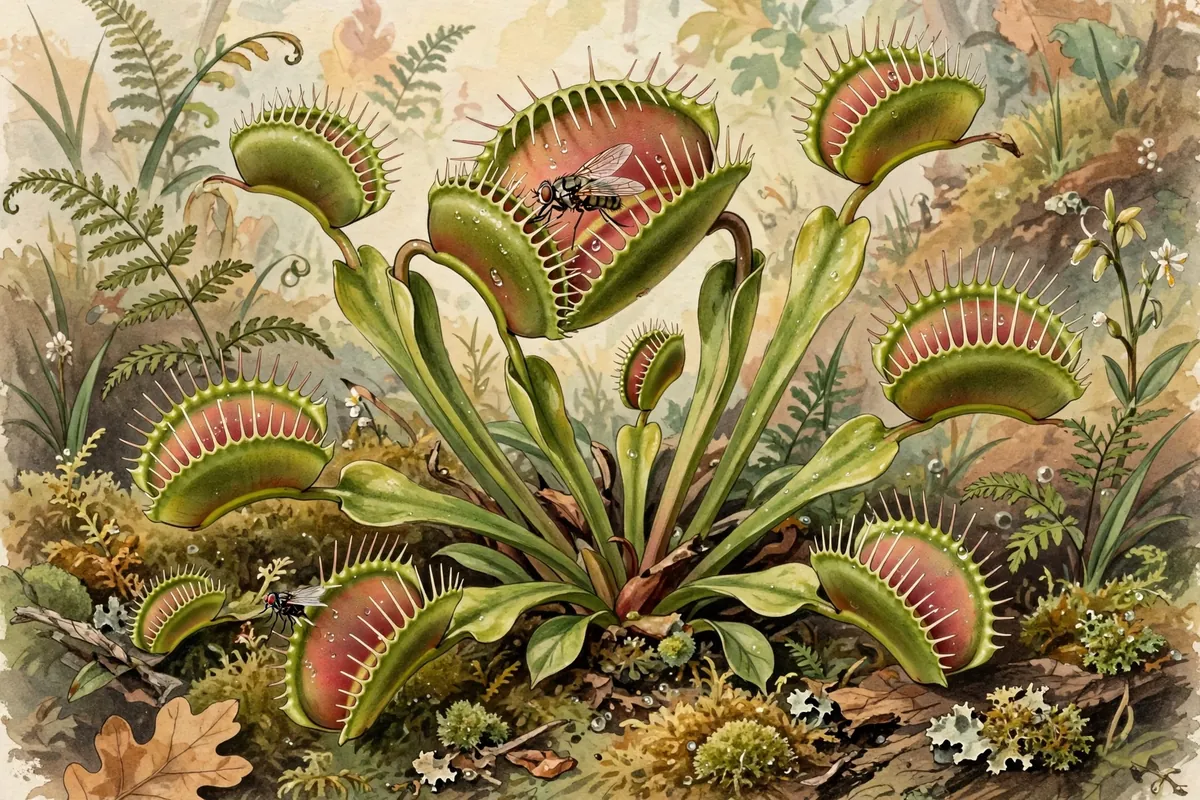
It looks like something out of science fiction. A small plant with leaves shaped like open jaws, lined with spiky teeth and blushing red inside. A fly lands, wanders a step or two, and suddenly the jaws slam shut. The plant has just caught dinner.
The Venus flytrap is a real carnivorous plant, and it eats mostly insects and spiders. It grows in boggy soil that's very poor in nitrogen, a nutrient plants need to build protein. Its leaves still make energy from sunlight like any other plant. But the bugs it catches supply the nitrogen that the soil can't.
A Trap That Counts to Two
Each trap has three tiny trigger hairs on the inside of each lobe. If something brushes one hair, the trap gets ready but doesn't close. Only if a second hair is touched within about 20 seconds, or the same hair is touched twice quickly, does it snap shut, usually in about a tenth of a second.
This double-check is smart. It helps the plant tell the difference between a living insect and something useless, like a falling raindrop. Closing a trap costs energy, so the plant doesn't want to waste it.
When a hair is triggered, it sends an electrical impulse across the trap. The lobes are held under tension by stiff cells, and the signal makes those cells suddenly soften. The strain releases and the trap closes. Stiff bristles along the edges mesh together like the bars of a cage, keeping larger prey from escaping.
Dinner Takes About Ten Days
Catching the bug is just the start. The plant only begins digesting after the trapped prey keeps moving and triggers the hairs five more times. That's its final proof that it has caught something alive and worth eating.
Digestion takes about ten days. When it's done, all that's left of the insect is an empty husk. The trap then reopens, ready for its next visitor.
The trigger hairs can also sense heat. A wildfire, for example, can make the traps snap shut. That's useful, because the Venus flytrap actually depends on regular fires to clear away taller plants that would otherwise crowd it out.
Found in Just One Small Corner of the World
Venus flytraps are sold in garden stores everywhere, but in the wild they grow only in the coastal bogs of North and South Carolina, within about 62 miles of Wilmington, North Carolina.
The first written description came in 1759 from Arthur Dobbs, the colonial governor of North Carolina. He wrote to an English botanist about a plant that "closes upon anything that touches it." In 1760 he called it "the great wonder of the vegetable kingdom." The English botanist John Ellis gave it its scientific name in 1768 and proposed the English name Venus's flytrap, after the Roman goddess of love and beauty.
A Plant in Trouble
Wild flytrap populations have been declining fast. Threats include farming, road building, draining wetlands, stopping natural fires, and poaching. North Carolina made poaching wild Venus flytraps a felony in 2014, and one man got 17 months in prison for taking 970 plants.
Luckily, you don't need a wild one to enjoy it. Greenhouses grow flytraps by the tens of thousands. Just resist the urge to poke the traps for fun, since every snap uses up a bit of the plant's precious energy.