Imagine reaching into a dark crack in a rock and knowing what's inside just by touching it. Not only whether it's smooth or rough, but whether it tastes like dinner. For an octopus, that's an ordinary day on the reef.
Here's the short answer. An octopus's suction cups are equipped with chemical sensors, called chemoreceptors, so the animal can taste whatever it touches. And because about two-thirds of its nerve cells sit in its arms rather than its brain, each arm can handle a surprising amount of decision-making on its own.
Suckers That Grab and Taste
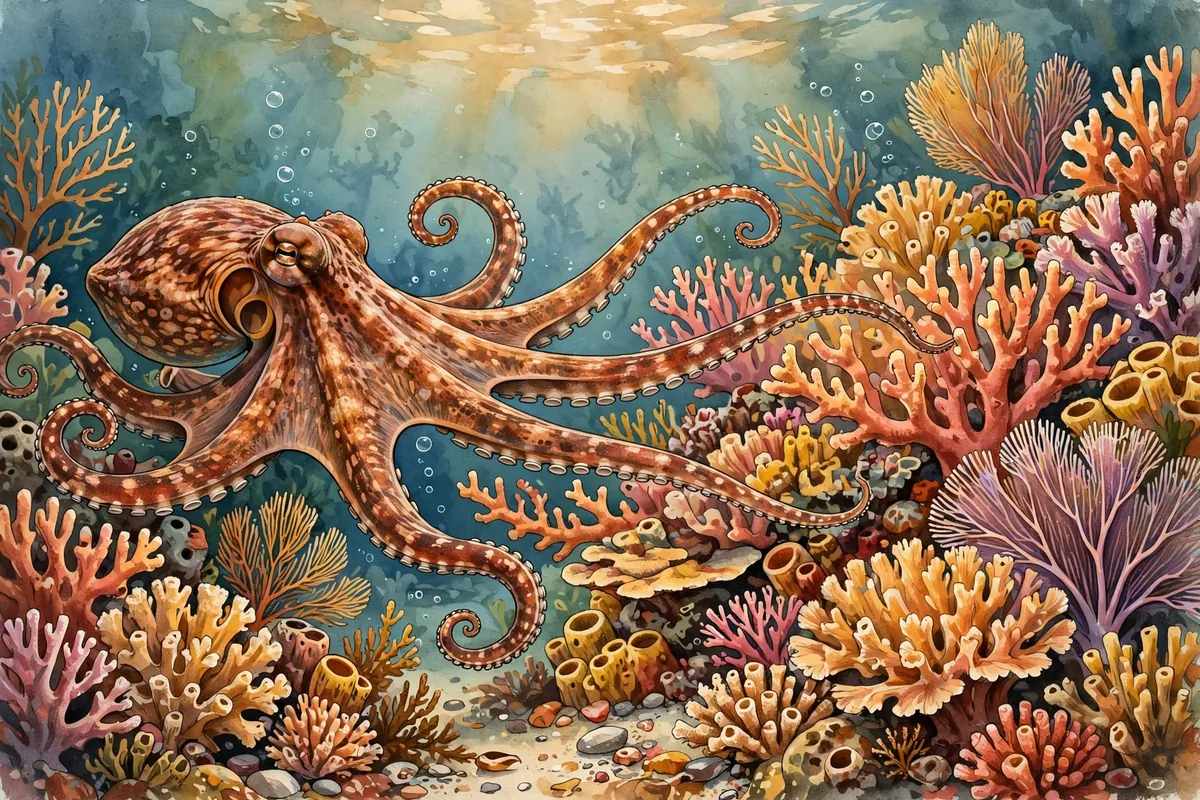
The underside of each arm is lined with round, sticky suckers. Each one is shaped a bit like a small bowl, with an outer disc and an inner cup, both made of thick muscle. When a sucker presses against a surface, it seals tight, and muscle contractions let the octopus grip and let go.
Those same suckers carry the chemoreceptors. So when an octopus pokes an arm into a gap between rocks, it isn't just feeling around. It's sampling whatever it brushes against, which helps it hunt the crabs, clams, snails, and fish it likes to eat.
There's a clever bonus, too. The sensors recognize octopus skin and keep the suckers from latching onto the animal's own body. That's one reason eight sticky arms can move easily without gluing themselves together.
Arms With a Mind of Their Own
Octopuses have a remarkably large nervous system for an invertebrate, with more than 500 million neurons. That's around the same number as a dog. But only part of it sits in the brain, which is tucked inside a protective capsule of cartilage.
About two-thirds of the neurons run through nerve cords in the arms. Learning mainly happens in the brain, but the arms can make decisions independently when they're given information. A severed octopus arm can even keep moving and responding to touch for a while.
That independence is so impressive that robot builders study it. Octopus arms can move and sense largely without help from the central nervous system, and engineers have borrowed the idea for soft-bodied robots and for flexible grippers fitted with rows of suckers.
A Strange Way to Keep Track of Eight Arms
Here's a twist. Octopuses appear to have a poor sense of where their arms are at any given moment, the body awareness scientists call proprioception. To keep track of them, they generally need to look.
Their bodies make up for it in other ways. Each of the eight arms can sense and respond to light, which lets an octopus control its limbs even when its head is hidden. Light-sensing proteins in the skin may also help the animal choose colors that blend into its surroundings.
More Reasons Octopuses Seem Out of This World
An octopus has three hearts. One main heart pumps blood around the body, and two smaller ones push it through the gills. Its blood carries oxygen with a copper-rich protein instead of the iron-based hemoglobin we use, and that gives it a bluish color.
Octopuses can also change their body shape dramatically and squeeze through remarkably small gaps. Some species have even been seen walking on just two arms while disguising themselves as bits of drifting plant.
So the next time you see an octopus curl an arm around a rock, picture what it's experiencing. It's gripping, feeling, and tasting all at once, with an arm that's partly thinking for itself. Not bad for a soft-bodied creature that most of us only know from the aquarium glass.