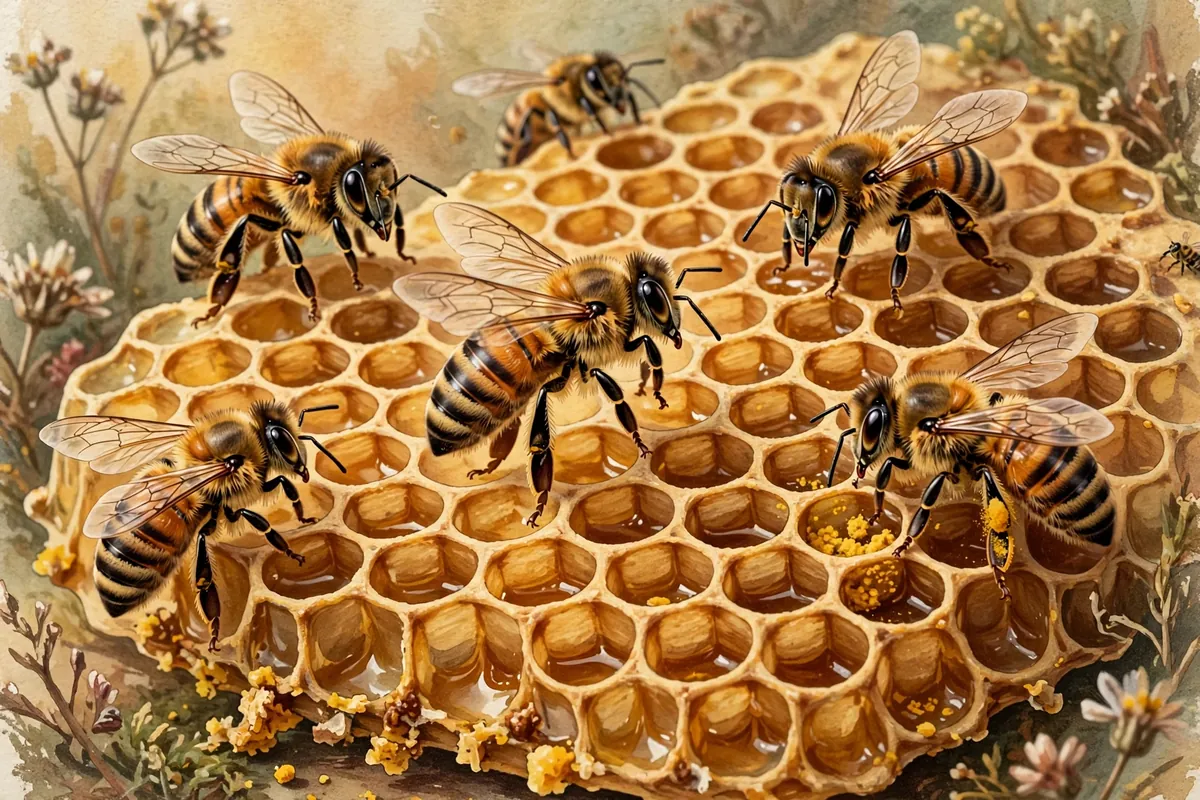
A honeybee finds a field of blooming flowers well away from the hive. She flies home, but she can't speak and she can't point. Somehow, a few minutes later, other bees from her colony are heading straight for the same flowers. How did they know where to go?
The answer is a dance. Successful foragers perform what scientists call the waggle dance, a little figure-eight routine on the honeycomb. The angle of the dance tells other bees which direction to fly, and the length of the wiggle tells them how far to go. It works like a map drawn with the body.
The Steps of the Dance
The dance has two parts. First comes the waggle run, where the bee walks forward in a straight line while shaking her body from side to side. Then she loops back to the starting point, does another waggle run, and loops back the other way. Right, then left, then right again, tracing a figure eight over and over.
A single performance can be just one loop or more than 100. Other bees crowd close to follow along, picking up the message as she goes.
How the Sun Becomes a Compass
Here's the clever part. Inside a dark hive, the combs hang vertically, so the dancer uses gravity as her reference. Straight up on the comb stands for the direction of the sun. If the flowers lie directly toward the sun, she waggles straight up. If they lie at an angle to the left or right of the sun, she tilts her waggle run by that same angle.
Distance is coded in time. The farther away the flowers, the longer the waggle run lasts. And the more excited the bee is about her find, the faster she waggles, which grabs the attention of the bees watching her.
The sun moves across the sky during the day, of course. Bees that stay in the hive for a while adjust the angle of their dance to keep up, so the bees following them still get pointed the right way.
Short Trips Get a Simpler Dance
Not every message needs the full routine. When food is very close to the hive, bees perform a simpler round dance. As the distance grows, it shifts into in-between versions and then into the full waggle dance. In one well-studied type of honeybee, the switch to the waggle dance happens once food is more than about 130 feet away.
The dance isn't only about flowers, either. Bees use it to point out water sources and even promising spots for a new nest. When several bees are dancing about different places, it becomes a contest to win over the crowd. Rival dancers may even interrupt each other.
The Scientist Who Cracked the Code
People noticed bees dancing long before anyone understood it. The ancient Greek thinker Aristotle suspected that foraging bees somehow communicated inside the nest. Later observers saw the dancing but couldn't explain it. One writer simply decided the bees were enjoying themselves.
The Austrian scientist Karl von Frisch was one of the first to translate what the dance meant. He also showed that bees can find their bearings using the sun, the pattern of polarized light in a blue sky, and even Earth's magnetic field. In 1973, he shared the Nobel Prize in Physiology or Medicine, partly for his pioneering work on how insects communicate.
Scientists are still debating how much bees rely on the dance. In one experiment, most bees that carefully followed a waggle dance ignored the directions and went back to foraging areas they already knew. So the dance may work alongside memory and smell rather than replacing them.
Next time you see a bee buzzing from flower to flower in your garden, there's a decent chance she got there thanks to a sister's little dance back home. Not bad for an insect small enough to land on a clover blossom.