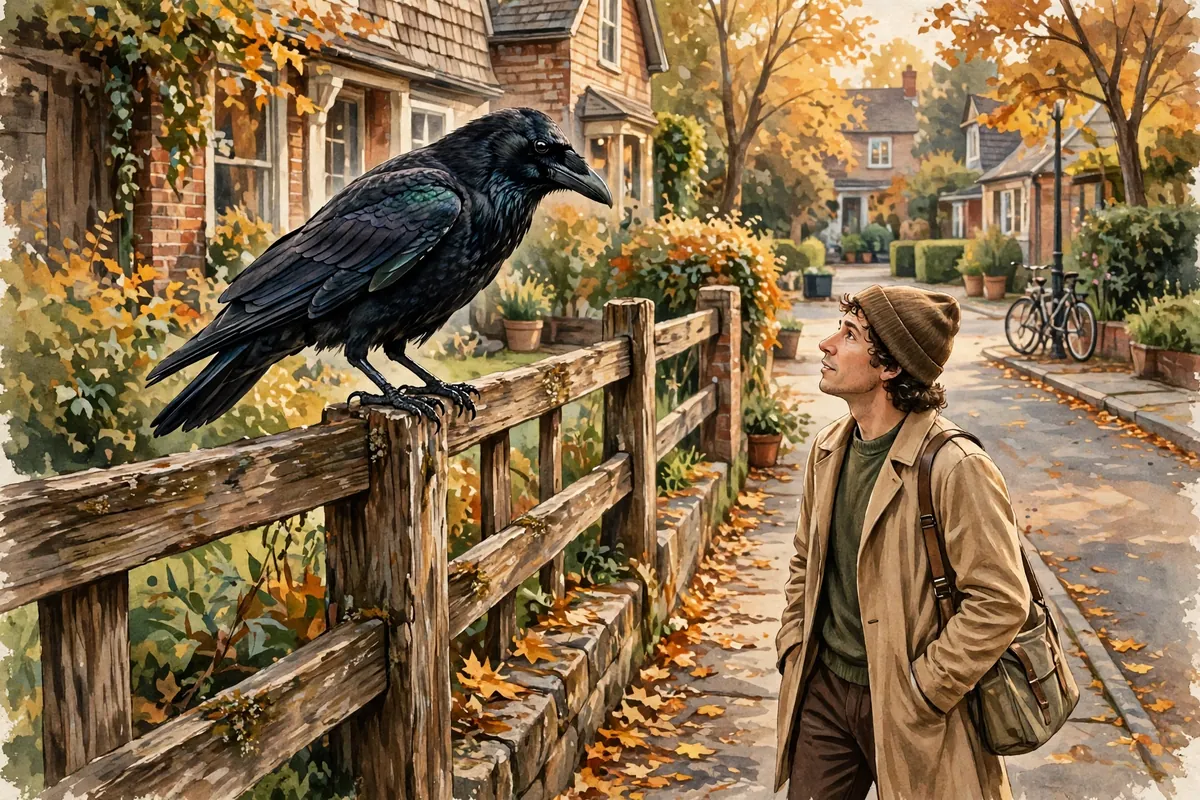
Plenty of people swear that a neighborhood crow has it in for them. It squawks when they step outside, follows them down the block, and seems to ignore everyone else. It sounds like a tall tale, but scientists have actually tested whether crows can single out one human from a crowd.
The short answer: yes, they can. Studies have shown that crows recognize and remember individual human faces, and they share information about dangerous people with other crows. A crow that has a bad experience with you may not just hold a grudge. It may tell its friends and family.
The Famous Mask Experiment
The best-known evidence comes from researchers at the University of Washington, led by Professor John Marzluff. They wanted to know whether crows learn about danger on their own or pick it up from each other. So they designed a clever test around a single scary face.
The team wore a distinctive "dangerous" mask while they trapped, banded, and released small groups of wild crows, about 7 to 15 birds at a time, at five sites around Seattle. Being caught is a frightening experience for a crow. Afterward, the researchers walked around wearing the same mask, and also a neutral mask, to see how the birds reacted.
The crows that had been caught began scolding the dangerous mask right away. They squawked loudly and mobbed the person wearing it. The neutral mask didn't get the same treatment, which showed the birds were reacting to that particular face, not just to people in general.
Crows Pass the Word
Here's where it gets really interesting. Crows that had never been trapped also started scolding the dangerous mask. Some were unbanded birds that had simply watched the commotion during a capture. Others were young crows whose parents had been caught. They learned the face was bad news without ever being handled themselves.
Scientists call this social learning. Learning from peers is called horizontal learning, and learning from parents is called vertical learning. The crows did both. The birds that had been caught directly were the most precise at telling the dangerous mask from the neutral one, but the warning still spread widely.
Over time, the scolding grew instead of fading. At one site, it doubled in frequency and spread at least 1.2 kilometers, about three-quarters of a mile, from where the experiment started, over a five-year period. In other words, crows that weren't even born when the trapping happened learned to dislike that face.
Why Would a Bird Need This Skill?
Crows are famously smart. They solve problems, make and use tools, and live in social groups where they communicate with a variety of calls. One leading idea, called the social complexity hypothesis, suggests that living in groups pushes animals to get smarter. To thrive in a crowd, a crow must recognize individuals and keep track of who is who.
Recognizing people is a natural extension of that. Crows live right alongside humans in cities and towns. Knowing which person tosses out food scraps and which one might cause trouble is a handy survival skill. Researchers studying American crows have found that the birds are more wary of disturbances in urban areas, and they change their behavior when a person looks straight at them.
What Crows Don't Seem to Notice
Crows aren't mind readers, though. In one 2013 study, American crows reacted when a person stared directly at them, but they did not respond differently to human facial expressions. A smile or a frown didn't seem to matter much. Who you are, and where you're looking, appear to count more than your mood.
So the next time a crow eyes you from a fence post, it may really be sizing you up. The good news is that the same memory works in both directions. Treat your local crows kindly, keep your distance from their nests, and you may find yourself on the right side of the neighborhood's smartest gossip network.