If you went to school before 2006, you probably learned a handy rhyme to remember nine planets, with tiny Pluto bringing up the rear. Then one summer, the news broke that Pluto was out. Many people took it personally. So what actually happened to the little world at the edge of the solar system?
In 2006, the International Astronomical Union, the group that names things in space, wrote its first formal definition of a planet. A planet must orbit the Sun, be big enough for its own gravity to pull it into a round shape, and have cleared the neighborhood around its orbit. Pluto passes the first two tests but fails the third, so it was reclassified as a dwarf planet.
The Test Pluto Couldn't Pass
"Clearing the neighborhood" means a planet dominates its orbit, sweeping up or flinging away most other objects nearby. Earth does this easily. Its mass is about 1.7 million times the mass of everything else in its orbit, not counting the Moon.
Pluto is a different story. It lives in the Kuiper belt, a vast ring of icy bodies beyond Neptune, and it shares that space with lots of other objects. Pluto's mass is only about 0.07 times the combined mass of the other objects in its orbit. It's one member of a crowd, not the boss of its block.
Doubts Started Early
Pluto was discovered in 1930 by Clyde Tombaugh, a 23-year-old working at Lowell Observatory in Arizona. It was hailed right away as the ninth planet. But astronomers soon found it was much smaller than expected. Today we know it has only about one-sixth the mass of our Moon.
Starting in the 1990s, astronomers found more and more objects in the Kuiper belt. Then in 2005 came Eris, a far-off world more massive than Pluto. If Pluto was a planet, Eris had a good claim too, and many more might follow. Astronomers had to decide what the word "planet" really meant.
Not Everyone Agreed
The decision was controversial and still is. Many planetary scientists continue to call Pluto a planet. Alan Stern, who led NASA's New Horizons mission to Pluto, criticized the ruling and pointed out that fewer than 5 percent of astronomers voted on it. Others, including Mike Brown, the astronomer who discovered Eris, supported the change.
Officially, Pluto is now listed in the catalog of minor planets as number 134340. Had it been added when it was discovered in 1930, it likely would have been number 1164.
Still a Remarkable World
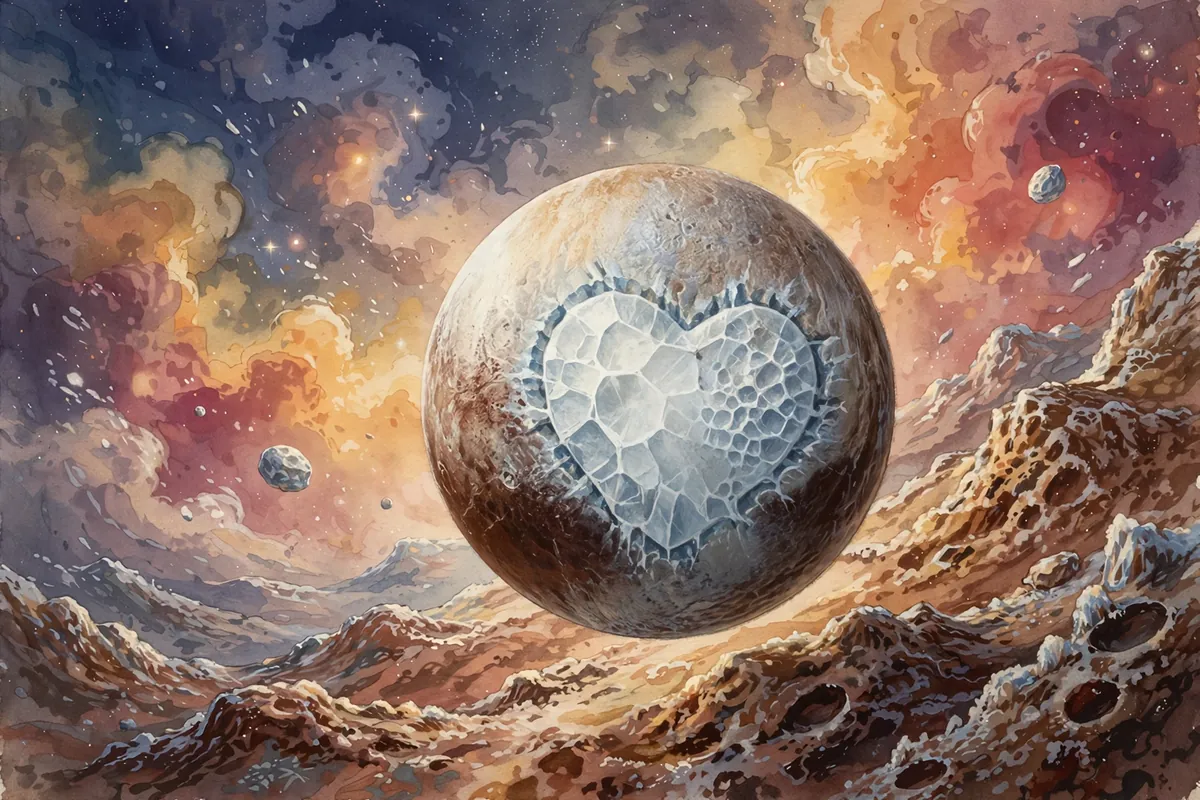
Demoted or not, Pluto turned out to be anything but boring. When NASA's New Horizons spacecraft flew past on July 14, 2015, it revealed a giant heart-shaped region. Its western half, called Sputnik Planitia, is a basin about 620 miles wide filled with frozen nitrogen and other ices.
Pluto has five known moons. The largest, Charon, is just over half Pluto's width, so big that the two are sometimes called a double system. And one trip around the Sun takes Pluto about 248 years, which means it hasn't completed a single orbit since it was discovered.
The name itself has a sweet origin. It was suggested by Venetia Burney, an 11-year-old schoolgirl in Oxford, England, who loved classical mythology. So whether you call it a planet or a dwarf planet, Pluto still holds a special place in a lot of hearts, including the one on its own surface.