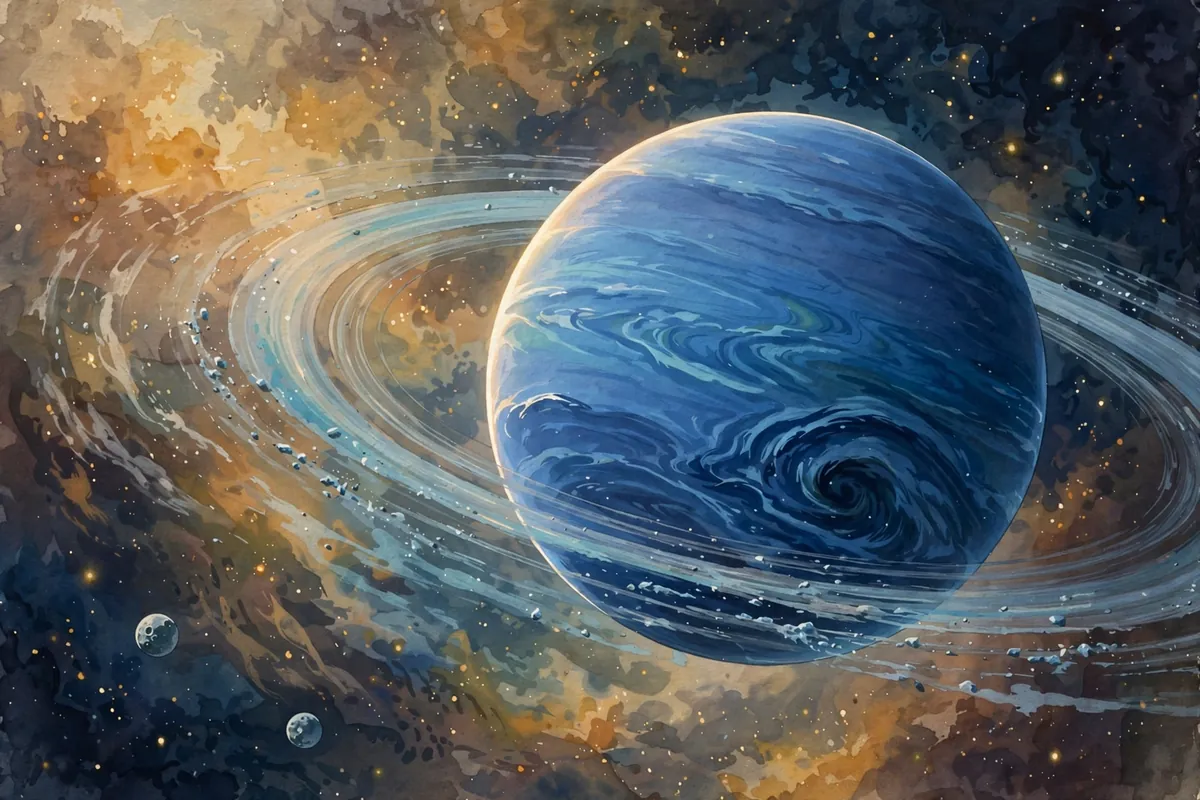
Neptune is the most distant planet from the Sun, a deep blue world wrapped in clouds and lashed by howling winds. Only one spacecraft has ever visited it. Yet scientists believe that far beneath its clouds, something remarkable may be happening: a steady fall of diamonds.
Here's the short answer. Scientists think it's likely, though nobody has seen it directly. Neptune's interior is rich in methane, a compound of carbon and hydrogen. About 7,000 kilometers, or roughly 4,300 miles, down, the heat and pressure may be extreme enough to split the carbon from the hydrogen and squeeze it into diamond crystals. Being heavy, those diamonds would sink deeper like hailstones. Lab experiments strongly support the idea, but some uncertainties remain.
An Idea From 1981
The idea goes back to a 1981 paper by scientist Martin Ross, with the memorable title 'The ice layer in Uranus and Neptune: diamonds in the sky?' Working at Lawrence Livermore National Laboratory, he studied what happens when methane is crushed by powerful shock waves. The extreme pressure separated the carbon atoms from the hydrogen, freeing the carbon to form diamond.
Later experiments added more clues. Researchers at the University of California, Berkeley, squeezed methane in a device called a diamond anvil cell and found diamond-like structures forming at pressures and temperatures similar to those about 7,000 kilometers below Neptune's cloud tops.
What It's Like Down There
Neptune and its neighbor Uranus are called ice giants. That doesn't mean they're full of ordinary ice. Neptune's mantle is a hot, dense fluid rich in water, ammonia, and methane. Planetary scientists call it 'icy' by custom, though it's nothing like a frozen pond.
It's a place of extremes. The cloud tops are among the coldest spots in the solar system, at about minus 361 degrees Fahrenheit. The center of the planet, by contrast, is thought to reach about 9,300 degrees Fahrenheit. Somewhere in between, conditions may be just right for diamonds.
Experiments at Lawrence Livermore even suggest the top of the mantle might hold an ocean of liquid carbon with solid diamonds floating in it, a picture that sounds more like science fiction than science.
Why Falling Diamonds Matter
This isn't just a pretty idea. As heavy diamonds sink, they would release energy as heat. That heat may help stir the planet's interior, which in turn could help power Neptune's unusual magnetic field.
Recent experiments have made the case stronger. In one, scientists used lasers to recreate conditions like those about 10,000 kilometers below the surface of Uranus. When they did this to a type of plastic called polystyrene, nearly every carbon atom turned into diamond crystals within a billionth of a second.
The Fine Print
Scientists are careful here. The water and hydrogen mixed in with Neptune's methane may change the chemistry. One physicist argued that the carbon inside these planets isn't concentrated enough to form diamonds from scratch. Newer studies suggest the diamonds may form faster and on smaller scales than once imagined, perhaps as tiny nanodiamonds rather than giant gems.
There's also the matter of proof. Voyager 2, which flew past on August 25, 1989, remains the only spacecraft ever to visit Neptune, and no probe could survive a trip that deep.
So the diamond rain remains one of the solar system's most dazzling maybes. Somewhere out there, in the cold and dark, a faraway blue planet may be quietly showering its depths with treasure that no one will ever collect.